

Author: Deniz Kirkali
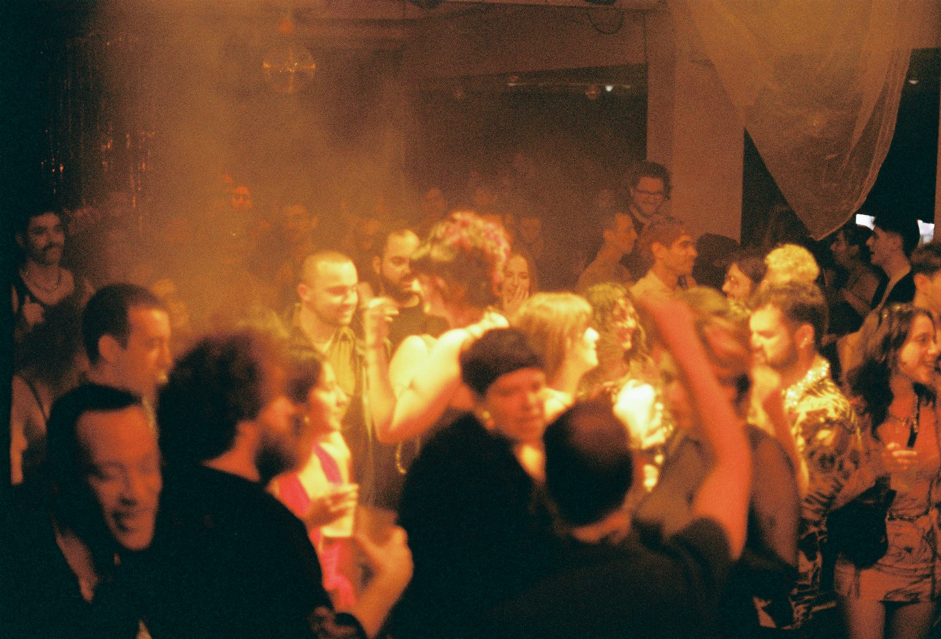
In a cultural landscape marked by scarcity, precarity, and constraint, Sessions emerges as an important queer space in Cyprus—at the intersection of gathering, experiment, and infrastructural proposition. Conceived by Dimitris Chimonas and Lex Gregoriou, the project cultivates a living, collective ecology where performance, politics, and everyday life blur. Through its evolving formats—from underground happenings to the temporary occupation of a state gallery—Sessions reimagines what queer space can do: not merely host visibility, but sustain community, friction, and the ongoing practice of becoming otherwise.
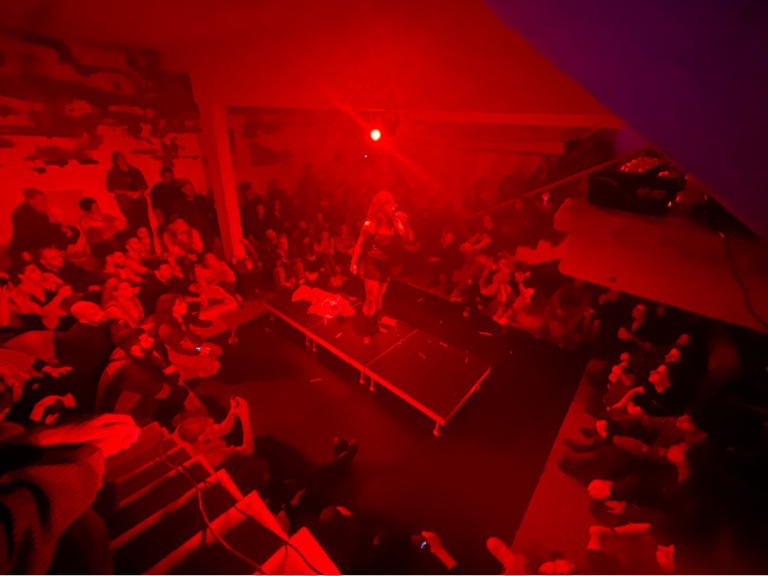
Krista Papista Concert — © Courtesy of Sessions
Sessions, a series of queer happenings in Cyprus, has been conceived as an independent and porous platform for performance and experimentation and eventually taking over institutional spaces. Dimitris Chimonas and Lex Gregoriou, co-founders of the project, talk more about what it entails to sustain the Cypriot queer space.
Deniz Kirkali: Can you tell me how Sessions has started? What gaps in the Cypriot art and cultural ecosystem did it respond to or attempt to fill?
Dimitris Chimonas and Lex Gregoriou: Sessions began with a very concrete need: queer people and allied subcultures in Cyprus lacking spaces to gather, experiment, and sustain community without having to “behave” according to institutional expectations. In the post-pandemic period, and in response to socio-political developments in Cyprus and beyond, there was an urgent need for spaces of gathering, exchange, and collective creation. Everyday life increasingly pushed us toward both literal and metaphorical forms of exhaustion. We sensed growing confusion and anxiety around personal and collective identity, belonging, and a widespread withdrawal from inspiration for living and creating. Through Sessions, we sought to create a space to experiment with ways of emerging from this condition, and to reimagine our relationship to life and to what surrounds us.
The first edition of Sessions happenings (Oct–Dec 2022), which we initially imagined as a one-off, transformed a former artist-run space into a queer hangout with a purpose-built stage, a lounge, and a bar that helped support the project financially. In collaboration with local artists and collectives, we designed an intensive programme spanning over two months of cross-pollinating happenings: performances, workshops, parties, and screenings. From there, the second cycle (June–Dec 2023) scaled this impulse into a more radical proposition: a six-month “takeover” of the entire State Gallery of Contemporary Art – SPEL. The programme unfolded fluidly, experimenting with what it means to activate a state institution as a public, porous, and collectively shaped space.
The “gap” Sessions addresses is both infrastructural and cultural. There is a lack of continuous, self-defined queer cultural infrastructure, alongside a shortage of platforms where marginal practices are not merely showcased, but allowed to experiment with the terms of spectatorship, participation, and authorship.
DK: How did the local queer community shape the programme rather than simply participate in it?
DC and LG: The local queer community shaped Sessions through the project’s very structure. It was never framed as an institution inviting queer artists in, but as a living ecology built together with local artists, activist groups, and organised subcultures acting as co-hosts. Already in the first edition, the project operated through dense networks of collaboration; by the second cycle, the state gallery was open all day and night, which meant people didn’t just attend events or the programme wasn’t just happening on stage. It was how people cooked, rehearsed, argued, flirted, collapsed on couches, improvised, and claimed corners of the space as their own. In this way, community members were not audiences, but active agents continuously shaping it.
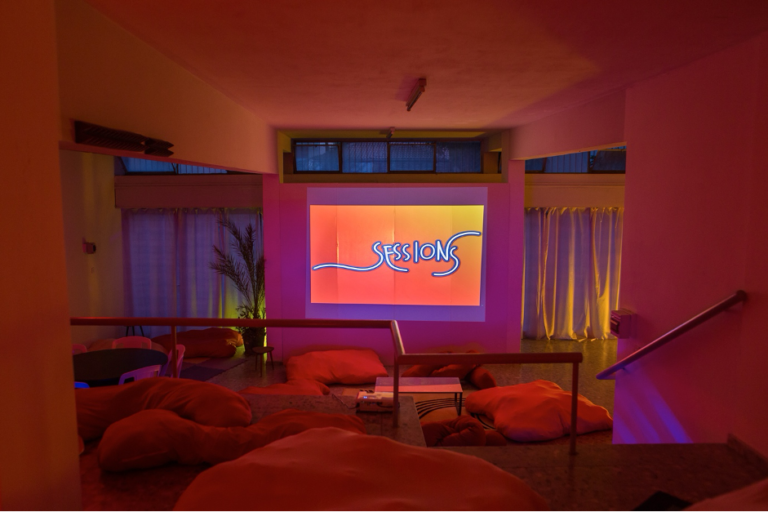
© Panagiotis Mina
DK: What, if any, frictions or negotiations arose between institutional frameworks and the queer reclaiming of the space?
DC and LG: Sessions began quite literally underground, in a hidden basement in the centre of the city, with an explicitly anti-dependence stance toward institutions and with the desire to gather queer people together. Suddenly, we found ourselves holding the keys to a state building, invited to “occupy” it for six months with public funding. We were immediately caught in a paradox: whether to treat this as an achievement or as a form of co-option.
Inside SPEL, we approached institutional negotiation by rearranging its signals of power rather than attempting to erase them. This included an intentionally unstaffed reception desk; wall texts replaced by a handwritten, constantly edited programme, full of mistakes, corrections, and scribbles; guards and staff invited to inhabit the space; artists presenting unfinished or unpolished work; and audiences encouraged to use their bodies in unruly ways, whether on the dancefloor or within improvised sitting arrangements. These gestures may appear small, but they directly challenge how gallery spaces produce authority, control, and an aesthetics of order.
Friction, then, was not only conflict but an ongoing choreography: how to use the heart of the establishment as a warm, porous, pedagogical, and social space, without slipping back into the gallery’s expected hierarchies of order, expertise, and passive spectatorship. This inevitably created further tensions with defenders of more traditional art practices, who expect such spaces to function as uncontested authorities of knowledge and aesthetic value. From our perspective, these very structures are what reproduce violent inequities, precisely what art must continually unsettle, challenge, and reimagine.
DK: What risks are involved in working independently in Cyprus today?
DC and LG: Sessions operates in Nicosia, a city where public gathering points for radical subcultures and queer communities are almost non-existent, or at best under constant pressure from enclosure and surveillance. At the same time, rising rents and living costs turn space and time into privileges. In this context, independent work is risky because it is both materially precarious and politically legible.
Socially, working independently as a queer initiative in a small, conservative society amplifies exposure: who is visible, identifiable, and targetable. Politically, Sessions positions itself as acting in practice rather than only symbolically, using its platform to respond to urgent social and political issues as they emerged, most notably when the genocide in Palestine intensified while we were inhabiting a building run by a state complicit in it. This approach may increase relevance and impact, but it also increases vulnerability.
Artistically, the risk lies in committing to rehearsal, failure, and disorder as values, especially in public or institution-adjacent contexts where cultural labour is often expected to appear polished, legible, and continuously successful. Sessions deliberately inverted these norms, insisting instead on process, improvisation, messiness, and collective experimentation as necessary conditions for artistic and social life.
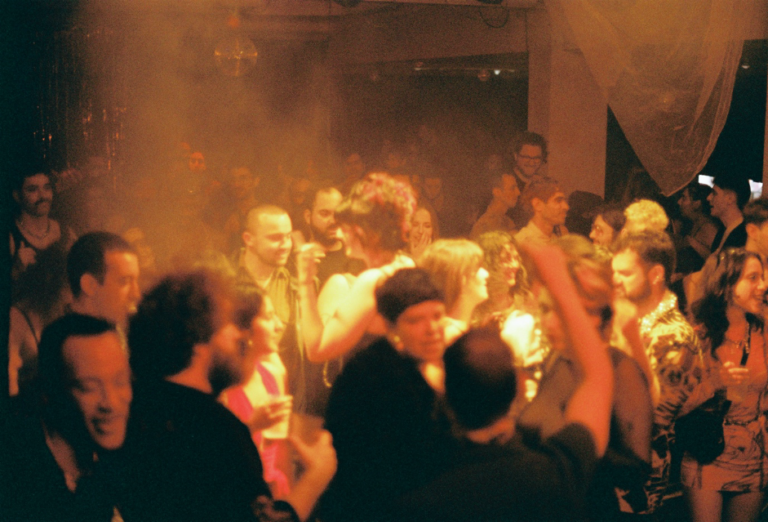
Sessions x SPEL Dancefloor NYE — © Demetris Shammas
DK: In what ways did the project help make visible practices, bodies, and narratives that were previously marginalised?
DC and LG: Sessions, through its episodic and durational nature, made visibility durable. It did so first by queering spaces that were not intended for queer presence, and then by relocating queer cultural life into sustained public visibility over the course of months, rather than through isolated events.
It also made bodies visible by redesigning participation itself. The collapse of formal, conceptual, and architectural separations between performer and audience is part of the project’s methodology. Bodies are not arranged to be looked at from a distance, but to coexist, move, rest, dance, and act together in a shared space.
Finally, Sessions made marginal narratives legible through explicit political programming. Activist groups are not invited as symbolic add-ons, but as central agents, with events framed as clear political statements.
DK: What does sustainability mean for a queer cultural initiative in Cyprus?
DC and LG: Sustainability, as we understand it, isn’t only about money. It’s about the continuity of space, time, and the conditions that allow communities to exist: safety, accessibility, and the ability to keep convening networks without burning out. The creation of a safe(r) and brave(r) space is an urgent first step toward sustainability, because it always begins with care. At the same time, care comes at a cost—financially, in terms of labour, and in terms of exposure—and these costs are not always easy to carry.
Sustainability also means resisting the forces that repeatedly cause radical spaces to disappear: rising rents, the enclosure of public space, and the exhaustion produced by operating in a constant state of crisis. Sessions responds to this by building a recurring ecology rather than a one-off event, where participants support and benefit from one another across time.
This approach does not pretend to offer a permanent solution. For this reason, each iteration of Sessions is designed with a pre-determined end. Ending, in this sense, is not a failure, but a way to protect the project from depletion and to allow it to re-emerge out of need and desire.
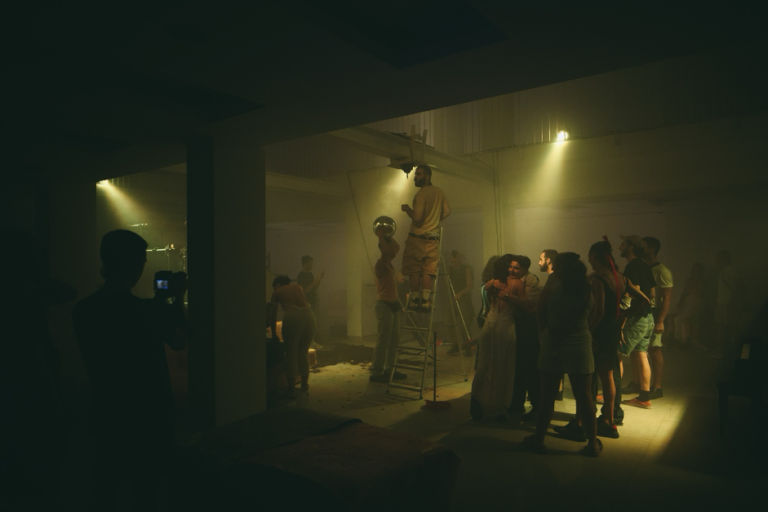
Sessions x SPEL Party Install — © Pavlos Vrionides
DK: If Sessions was to continue regularly, what forms do you think it could take?
DC and LG: Probably smaller, weirder, and less institutionally legible again. The state gallery moment was powerful, but intimacy and autonomy matter more than scale. Sessions was never meant to stabilise into a single scale or format.
The project will always operate as a kind of glitch within any context it enters. Otherwise, it would stop queering as a verb, which is our primary interest. For us, queering is not an identity marker but a method: a way of disrupting norms, expectations, and hierarchies wherever the project is called to operate.
Sessions understands itself as a world-making project made of non-centralised practices, capable of responding to specific conditions rather than reproducing itself. Continuation, if it happens, would not mean repetition, but mutation.
DK: Do you feel Sessions has inspired independent queer initiatives in Cyprus? What kind of an inspiration can it be for future projects in similar contexts?
DC and LG: The strongest inspiration Sessions offers is methodological. It demonstrates that queer culture can be organised as an infrastructure: as a mode of meeting, a rehearsal condition, and a hosting environment, not only as representation or visibility. In that sense, it proposes queerness as something that can be built, maintained, and shared.
It can also serve as an example of how to hold tension. Sessions maintain a critical stance toward the establishment while strategically using institutional openings to redistribute resources, space, and visibility back into communities and informal networks. This kind of double positioning, inside and against, can be useful for future projects operating in similarly constrained contexts.
Finally, the project is committed to creating space for bravery: for failure, whimsy, theatricality, and the play of identity and performance without any pressure to resolve or explain itself. If Sessions has inspired anything, it is perhaps the permission to take such risks seriously and to understand them as necessary rather than indulgent.
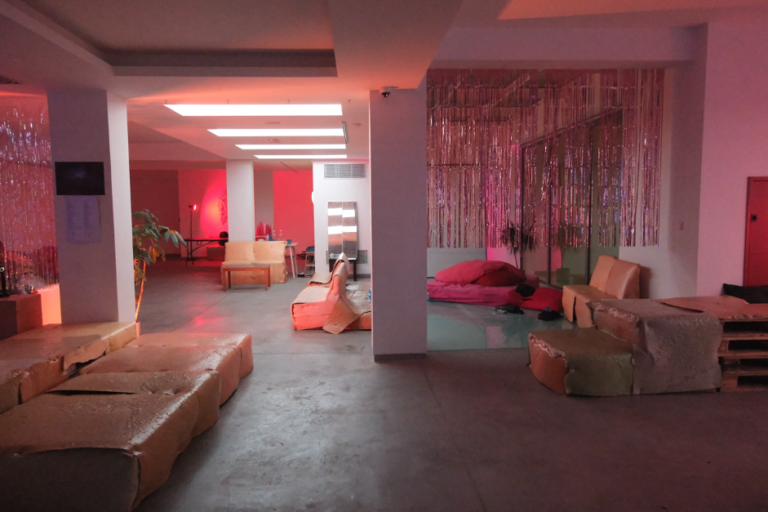
Sessions x SPEL — © Courtesy of Sessions
DK: How can such initiatives avoid becoming isolated moments and contribute to long-term cultural change?
DC and LG: Sessions has first and foremost built a collective memory. On one level, this consists of the shared experiences a large and diverse community lived through together, across many different modes of gathering and making. On another, the archiving of these experiences through our zine, book, and films transformed what could have remained fleeting moments into references that others can return to and build upon–an archived past that we did not have access to.
By rewriting spatial cues, Sessions proposes new habits of being together. It tests how “publicness” can function as a space for becoming, learning, and hospitality, allowing political positions to appear embodied rather than abstract. The project consistently frames itself as political in practice, responding to urgent issues as they emerge, rather than only producing symbolic gestures. This is where cultural work begins to leak into civic life.
Perhaps the project’s strongest contribution, and the reason it resonated so widely, was its collaborative praxis. Sessions demonstrated that we can do far more together than alone. The project became possible through pre-existing networks and collectives that lacked a common ground on which to meet and operate together. Sustaining long-term change means continuing to convene and replenish these networks, while honouring the people who have been sustaining underground cultural production and queer activism on the island for years before us, and hopefully for many more to come.
Published on April 14th, 2026
About the author:
Deniz Kirkali is an independent curator and writer based in London. She has co-founded topsoil, a transnational curatorial and research collective, and Garp Sessions, a summer residency programme in Babakale, Turkey. She holds a PhD from Goldsmiths University.
