Author: Heloísa Traiano
Across Europe—from the cooperative newsrooms of Germany to donor-funded initiatives in Bulgaria, Italy, France, Portugal, and Netherlands—independent journalists are reimagining how to survive in contexts of shrinking revenues, digital disruption, and eroding trust. As traditional business models falter, a new wave of media organisations is experimenting with cooperatives, foundations, community donations, and hybrid funding schemes to preserve editorial autonomy and democratic accountability. Their struggle raises an important question: can alternative economic models truly sustain our informative watchdogs, or will financial fragility continue to threaten the very journalism democracy depends on?
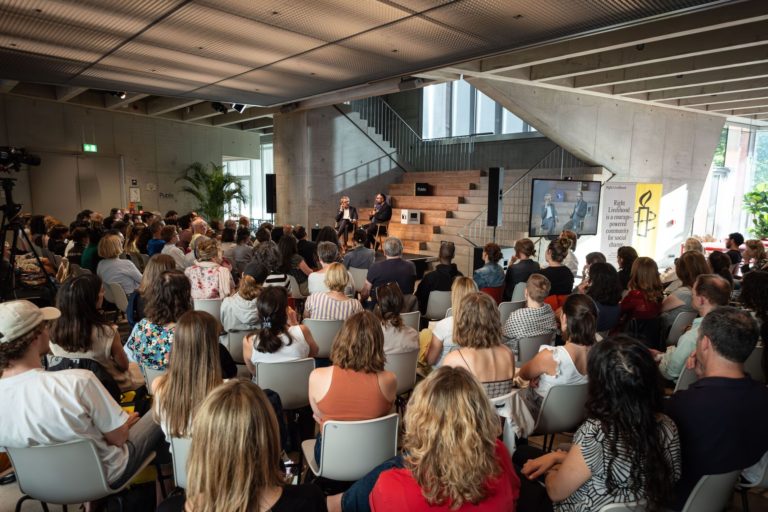
Publix, Berlin — © Paul Alexander Probst
From East to West, reporters and editors across Europe strive to carve out a future beyond mainstream media at a time of economic obstacles, digital shifts, and distrust of public information. Amid shortcomings and ambitions, independent journalism is looking for innovative ways to ensure financial sustainability and thrive anew as a watchdog of democracy.
Over the past decade a growing number of initiatives have experimented with alternative economic models to craft or support journalism that aims to be diverse, critical, and editorially autonomous. These efforts sometimes fail, as small organisations or projects succumb to financial pressure. Yet new initiatives then repeatedly emerge to try again in countries as wide-ranging as Germany, Bulgaria, Italy, France, Portugal, and The Netherlands.
For those that survive, the current debate is shaped by a set of existential questions: what does the future hold in an increasingly competitive funding environment? How can independent journalism move beyond its dependence on external financing and build community-supported models? And, ultimately, should the sector be expected to sustain itself at all?
Various Strategies from Germany
In Germany, where cities like Berlin are a melting pot of cultural, media, and political actors, the independent media landscape has long embraced various strategies. They range from strategically campaigning for donations and operating under a cooperative model to diversifying funding sources and working closer together.
As distinct as they may be, across many of these efforts runs a common thread: mobilising citizens who fear for the resilience of democratic values in the country and beyond. The taz Panter Foundation, affiliated with the independent left-leaning daily newspaper taz, stands out as one of the field’s pioneers. Founded in 2008, it supports journalists holding power to account in Germany and worldwide by promoting training and support programmes, enabling international exchange, and offering a platform for reporters to publish their work.
The foundation relies primarily on small, one-off donations from individuals and companies, which it regards as a sustainable model at present. The annual budget did not reach six figures until 2015, but it has grown steadily thereafter, peaking at over €930,000 in 2023. Contributions by 7,800 donors have ranged from as little as €15 to a maximum of €20,000, adding up to €7 million by 2024. Another €2,2 million have been secured over 17 years through grants provided by private foundations and the German state.
Donations from individuals and companies are also the most important source of revenue for Correctiv, a newsroom primarily dedicated to investigative journalism. These are complemented by institutional funding for project implementation and the organisation’s own income, which comes from side activities such as book sales.In January 2024, a groundbreaking report by Correctiv revealed that Alternative for Germany (AfD) and far-right networks had discussed plans to expel millions of people with a migration background from Germany. The report sparked mass pro-democracy demonstrations, and donations rose to over €6 million in 2024, up from nearly €1.9 million in 2023.
“Put Your Money Where Your Mouth Is”
According to Gemma Terés Arilla, head of taz Panter, the foundation’s fundraising strategy has to a significant extent relied on mobilising its community of supporters during moments of heightened urgency. When novel political events are widely perceived as threats to democracy, citizens come to see support for independent, value-driven journalism as a tangible way to contribute to the public good.
“It works once donors understand that their money has a very direct, personal impact. Our readers are very well informed and concerned about the news situation worldwide,” she said. “People donate because they still believe a better world is possible. It sounds idealistic, but that is how the idea of taz as a newspaper started.”
The taz itself has operated as a cooperative since 1992, shortly after German reunification and 14 years after its inauguration as a newspaper in West Berlin. Today, more than 25,000 readers co-own shares that confer no interest or financial returns, and the cooperative grows by around 1,000 members and around 1 million euros in capital every year.
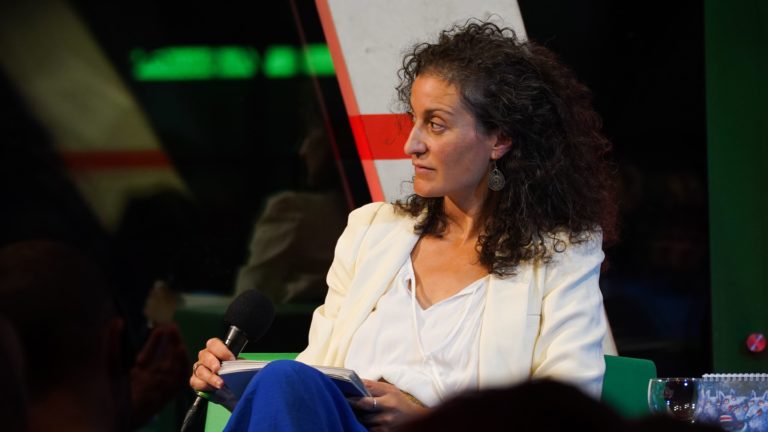
Gemma Terés Arilla, head of taz Panter — © Kyaw Soe
For media and journalism expert Nadia Zaboura, financial support for such emerging models serves as a proxy for civic engagement in societies impacted by sharp fractures.
“The laid-back mentality of letting yourself be served and clicking away when you no longer like media content is not really a basic democratic skill,” she said at an event held by Publix, a Berlin-based hub that houses investigative newsrooms, freelance journalists, and media organisations. “Instead, people who ‘put their money where their mouth is’ are already being proactive, democratic, supportive, and socially engaged at that very moment.”
Publix’s offices and coworking spaces currently serve around 450 users. It also hosts debates, encourages collaboration, and runs its own scholarship and education programmes.
“Our community is setting strong new impulses and is actively working to build networks at the European level with actors engaged in the field of public interest information,” says director Maria Exner. As a model project, Publix has been testing a mix of external funding and self-financing since its inauguration in September 2024.
The Risks of External Dependency
In Bulgaria, the news site Den, which produces news and debate podcasts as well as long-form and multimedia reporting, was built exclusively on European and international project funding, with an initial budget of around €20,000.
“Grants made it possible to structure the initial project, produce the first investigations, and form a core team. Later, new grants allowed us to relaunch the news podcast, create new audio formats, and publish several in-depth investigations,” said Alexander Nikolov, one of Den’s founders.
Yet the reliance on external funding remains a structural weakness for sustainable independent journalism around Europe.
Multiple European newsrooms report feeling locked into recurring fundraising cycles. Aware of their fragilities, they sometimes fear even for their short-term future, forcing journalists to take on additional work alongside their reporting.
Diversifying the base of supporting foundations has been a key strategy for Hostwriter, a Germany-based network connecting nearly 8,000 journalists with publishers across 166 countries. It also runs the feminist-oriented newsroom Unbias the News!, that provides space for journalists facing structural barriers in the field.
In 2024, Hostwriter received nearly €405,000 in financial support from seven foundations, compared with approximately €1,200 in donations. Charitable activities, including journalism training programmes, and side strategies generated an additional €36,000.
But actors in the sector perceive competition for funding to be intensifying, and social media as a more challenging channel for attracting and retaining audiences.
“Times are too dark to rely only on non-profit. There’s less money around than there was in 2015, and many have tried the non-profit route to find support,” said Lorenzo Bagnoli, director of IRPI Media in Italy, an independent online publication founded in 2020 by a group of freelancers. “We don’t yet know exactly in which direction to change, but we’re working on it.”
A Profitability Dilemma
Much of independent journalism in Europe has also been seeking to attract regular subscribers or donors in an effort to ensure greater financial predictability.
This has been the case, for instance, in France, where observers point to a rise in efforts to build communities around emerging, value-driven outlets. At the same time, the independent media ecosystem has been investing more time and energy in co-developing projects and jointly responding to calls for funding.
Ensuring broad-based support or a stable readership, however, remains a significantly greater challenge for smaller players still working to grow their audiences. The obstacles are even more pronounced in societies where financial support for media is not deeply embedded in the local culture.
“Newspapers do not generate wealth. In a country like ours, information is not considered a good to pay for,” says Bagnoli. He also sees a crisis in the relationship between readers and the media. Italy scores one of the lowest levels of trust in news media in Europe, according to Reuters Institute’s Digital News Report.
Elsewhere in Europe, open access has been a deliberate feature of the identity of several independent outlets, which promote inclusiveness as a way to counter digital echo chambers. Parts of the sector argue that the introduction of restrictive paywalls risks pushing segments of society even further away from democratic debate.
“This is a conversation about how to make new models profitable. We have to change positions, and a lot of people feel wary,” says Christina Lee, editor-in-chief of Unbias the News! in Germany. “But I personally believe we need to recognise that journalism is necessary for democracy, and it ought to be funded in that way.”
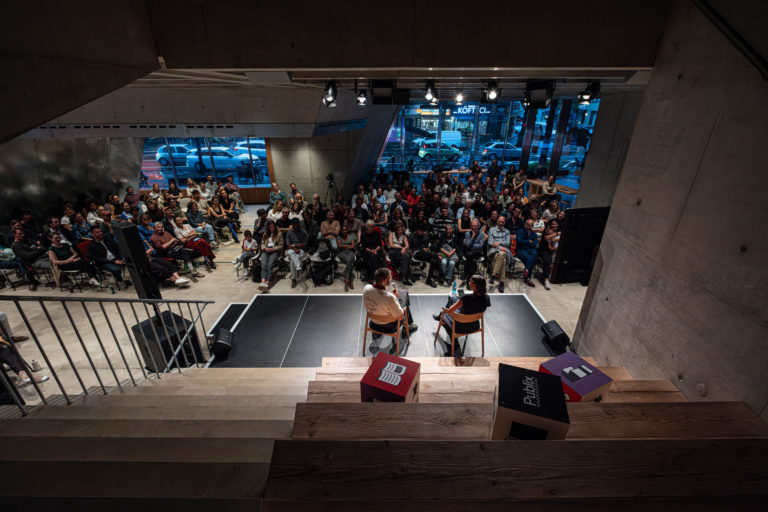
Publix, Berlin — © Paul Alexander Probst
Solutions Top-down and Bottom-up
Similarly, many in the field point to the need for increased public resources to support journalism.
“The European Union is increasingly convinced that it needs to invest in the media if it wants to strengthen fragile democracies,” according to Ides Debruyne, managing director at Journalism Fund, a Brussels-based non-profit fostering independent media. “A democracy can fail, and it is fragile. We have to fight for it every day.”
Many have sought to take the mission into their own hands—like the co-founders and employees of the independent French newspaper Mediapart. In 2019, they created the Press Freedom Fund (FPL), the country’s first press fund dedicated to independent journalism. It has been officially recognised as serving the public interest and operates autonomously from Mediapart.
By legal design, the FPL can rely only on private donations, which are then redistributed to the projects it supports. Around 80% of its funding derives from individual donors, complemented since 2025 by foundations, mainly French and European. Mediapart is required to make an annual financial contribution to the FPL, proportional to its results.
In six years, the fund has assembled a community of more than 10,000 donors, supporting organisations with diverse editorial lines but shared core values, including independence, journalistic integrity, and fair working conditions.
In a similar spirit, the Fund for Investigative Journalism (SPJP) from the Netherlands directly finances journalists’ working time—especially freelancers—as part of an explicit commitment to democracy.
On its turn, the Portuguese Fumaça has followed a different, bottom-up path as an independent outlet. Its slow, non-project-based approach has led to the organic emergence of the “Fumaça community,” made up of over 1,800 listeners and readers who chose to provide financial support. At present, roughly 40% of its budget comes from individual supporters, and the remaining 60% from foundations.
It’s All About Culture
One key ingredient in Fumaça’s success may be its ability to foster reader engagement by maintaining close connections to social realities beyond traditional journalism circles.
For media expert Zaboura, the articulation of a more diverse range of perspectives is one of independent journalism’s central roles in Europe. Ultimately, however, its future may depend on the emergence of a more supportive culture for outlets serving as vehicles for democracy.
“When many people give a little, a lot can be achieved. The idea that we are part of a collective needs to be much more clearly ingrained in minds and hearts,” she argued.
Even for well-established initiatives like the taz Panter Foundation in Germany, the constant renewal of calls for support for democracy remains necessary. Much of its donor base was established in a different era and has remained faithful over decades. However, many from this generation are now reaching retirement and gradually losing some of their financial capacity.
Maintaining steady cash flow from an engaged community will be a central challenge for the foundation’s fundraising team in the years ahead, after a rather successful decade. Just like for others in the field, it will be all about making a new media culture rise.
This content was produced in the framework of PULSE, a European initiative supporting cross-border journalistic collaborations lead by OBCT, together with n-ost, and Voxeurop. Marta Abbà, Hugo dos Santos, and Francesca Barca contributed to it.
Published on February 17th, 2026
About the author:
Heloísa Traiano is a journalist based in Berlin. Her coverage of societal, political, and ecological themes has been featured in multiple news outlets in Brazil, the United States, and Germany. One of her interests is how information and disinformation shape democracy.