This article is part of Reset! Yearly Focus 2026: Digital Independence
Author: Jamie Noone
As the internet becomes increasingly consolidated under a handful of powerful platforms, the spaces available for experimentation, artistic expression, and digital autonomy are steadily shrinking. Yet some artists and curators have responded not by abandoning these platforms, but by subverting them from within. The London-based project Cosmos Carl offers an example of this approach, transforming the infrastructures of big tech into tools for artistic experimentation, archival practice, and data resistance.
Cosmos Carl website logo, 2026
As a small number of technology companies continue to dominate online life and shape how people communicate, create, and consume, this series highlights grassroots initiatives and artists who propose meaningful alternatives. Many of these projects take an activist stance, working to empower users and artists, protect data and create spaces that resist extraction and surveillance.
One such project was Cosmos Carl.
What Is Cosmos Carl?
Cosmos Carl was founded in London in 2014 by curators and artists Frédérique Pisuisse and Sæmundur Þór Helgason. They wanted to combine their strengths and host exhibitions, soon realising that the best format for this was the online art space.
Observing the growth of net art, the pair noticed that much of it relied heavily on technical knowledge, particularly coding skills that many artists did not possess. Creating and hosting online exhibitions often required navigating complex infrastructures that mirrored the exclusionary nature of the platforms being critiqued.
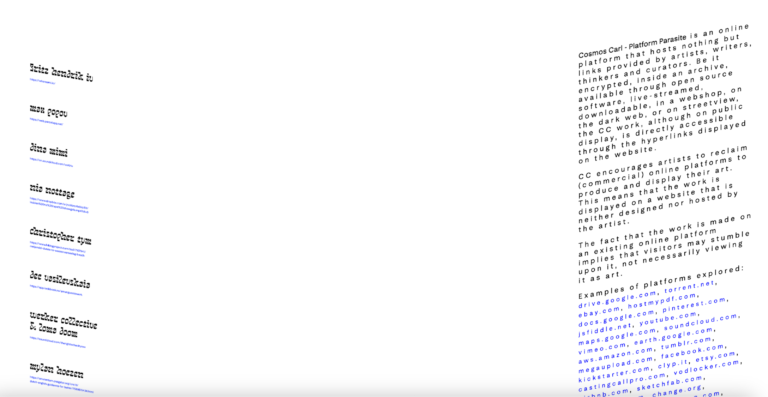
As Pisuisse and Helgason explained in a 2019 interview with Artzine, “Cosmos Carl became a way to use these existing platforms to explore the online presence of artworks and a way to critique platform-based capital by misusing them for art.” Rather than building an entirely new platform, Cosmos Carl deliberately operated within existing ones, repurposing their infrastructure in unexpected ways.
Taken from Cosmos Carl website, 2026
Platform Parasitism as Artistic Strategy
Cosmos Carl described its approach as a form of platform parasitism. While the term “parasite” often carries negative connotations, its meaning shifts in this context. The project operated alongside major platforms, including Google Drive, Meta-owned services, and LiveLeaks, redirecting users through third-party links that obscured conventional data tracking. In doing so, Cosmos Carl repurposed the power and data hunger of large-scale platforms to serve artistic and critical ends.
For users, this meant navigating a digital exhibition that functioned as a launchpad rather than a destination. Clicking through works redirected traffic in ways that rendered user data fragmented and largely unusable. The project did not seek to overthrow dominant platforms but instead to undermine them from within by muddying their data streams and exposing their underlying logics.
By acting as a “launchpad”, Cosmos Carl utilised a series of third-party redirects and short-link gateways. When a user clicked a work, the referral metadata (the “HTTP Referer” header) often pointed back to Cosmos Carl’s non-commercial domain rather than a consistent user-profile source. This stripped the target platform (like Google Drive or Etsy) of the context regarding who the user was before they arrived.
Archiving the Internet as Artistic Practice
The project’s name draws inspiration from American astronomer Carl Sagan’s Cosmos series and its expansive language of exploration. Cosmos Carl functioned as a point of departure, sending visitors outward to different corners of the internet rather than enclosing them within a single interface.
One of the project’s core ambitions was to provide artists with a space to present work online without requiring coding expertise. In this sense, Cosmos Carl demonstrated a practical attempt to reclaim digital space for art and to democratise web-based exhibition making.
The founders also adopted a distinctly archival approach. In their Artzine interview, they discussed tools that allow websites to be documented in their original form, preserving not only content but also context. They referenced Rhizome’s web archiving initiatives, which began by preserving net art from the 1990s and recording it in ways that allow works to be experienced within their original technological environments. When viewing archived works by artists such as Constant Dullaart, users encounter the pieces through browsers that replicate the visual quality, resolution, and limitations of the period in which they were created.
This approach highlights a key characteristic of online art. The platform hosting a work often shapes how it is perceived and understood. Just as the architecture of a physical gallery can influence engagement, the digital environment in which a work appears can frame its meaning.
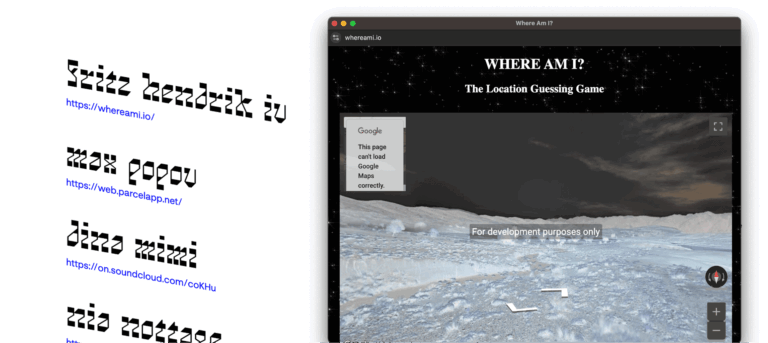
Cosmos Carl embraced this instability. In one notable instance, the founders described how a pornographic website later purchased a domain previously owned by artist Nicolas Riis. Riis had used the domain cleancare.club to host a visually refined collection of research materials and objects connected to his artistic process, which the founders described as a form of “object porn.” When the domain changed hands, Cosmos Carl temporarily presented Riis’s contribution as a porn site, unintentionally transforming the work through its new context.
Taken from Cosmos Carl website, 2026
Bulwarks Against Big Tech
As large technology companies continue to produce increasingly standardised and “frictionless” versions of the internet, projects like Cosmos Carl offer valuable lessons in the power of friction. They do not attempt to compete with major platforms on scale or efficiency, a race that grassroots initiatives are destined to lose. Instead, they propose subtle and tactical forms of resistance by redirecting traffic, confusing data collection, and presenting alternative modes of engagement that prioritise human curiosity over algorithmic predictability.
The aim of democratising the web, particularly by increasing access to online resources for artists without technical barriers, is more than a matter of convenience. It is a matter of digital sovereignty. By creating a user experience that prioritised data obfuscation over extraction, Cosmos Carl offered a potential model for a new generation of artist-activists. These practitioners are now faced with the task of fostering a more diverse and “weird” version of the internet, a tool so deeply ingrained in everyday life that its architecture increasingly shapes social reality.
This raises a critical question. If the platforms we inhabit are designed to harvest our every move, how do we exist within them without being consumed? One possible answer lies in the parasitic model. Rather than retreating into isolated digital enclaves that few people visit, this approach suggests remaining within dominant platforms and using their own infrastructures to transmit messages they were never intended to carry.
Although Cosmos Carl is no longer active, its legacy remains deeply instructive. The project demonstrates how cultural practitioners can intervene in digital infrastructures without reproducing the power structures they seek to critique. In an online environment increasingly shaped by the opaque logic of automation, totalising surveillance, and generative artificial intelligence, Cosmos Carl stands as a vital reminder. Resistance does not always need to take the form of a loud or confrontational gesture. It can be quiet, parasitic, and deeply imaginative, thriving in the gaps of the code and the shadows of the interface.
Published on March 31st, 2025
About the author:
Jamie Noone is a freelance writer from Dublin, Ireland, based in Berlin, Germany. Covering digital ethics, music, and culture across Europe and beyond.