Author: Marie-Louise Schlutius
Since 2014, Indiecon Hamburg has brought together independent magazines, publishers, artists, and zine makers from around the world. What began as an experiment by brothers Malte and Urs Spindler is now an essential platform for independent publishing. Co-founder Malte Spindler speaks more about the need for exchange, economic realities, publishing during wartime, and why some Chinese magazines have to travel inside a tote bag.
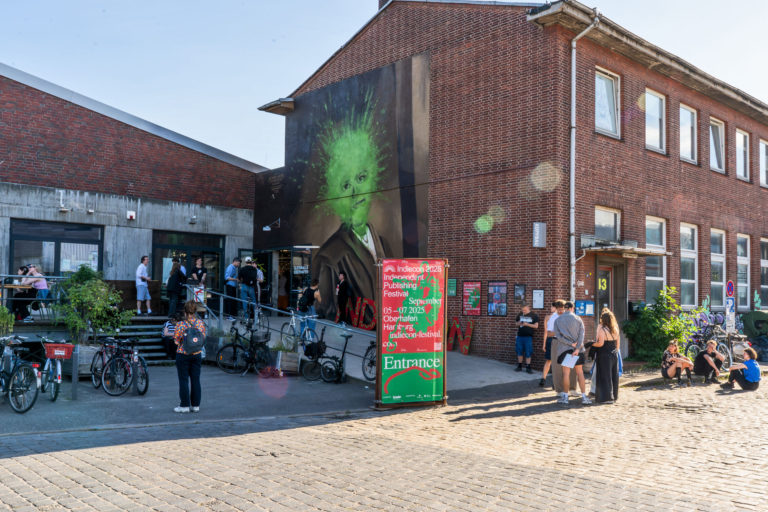
Indiecon Main Entrance at Oberhafen — © Malte Spindler, brueder coop
Marie-Louise Schlutius: Which moments at Indiecon have surprised or moved you the most?
Malte Spindler: There are many, but some stay with us. The team behind the Ukrainian magazine Solomiya, for instance. They’ve joined us throughout the war. Part of the team was able to leave Kyiv temporarily, yet they continue creating a magazine in a place where everyday life and destruction exist side by side. Their reportage and artistic work act like small windows into that reality. It touches us and many visitors deeply.
And this isn’t an isolated case. Projects from countries where publishing is restricted often require extraordinary courage. Some publications from China officially don’t exist; they can’t be sold, so they travel hidden in tote bags that are allowed to be sold. At fairs that don’t call themselves fairs, links are exchanged discreetly. You see how inventive people become when they want to tell stories.
Another example is Meantime Magazine from Singapore. They work very subtly because the limits of what can be said are narrow. In their first issue, there’s one line I’ll never forget: “Maybe the luck we are looking for is simply the courage to speak, even when the room goes quiet.” It captures the essence of what many independent publishers do—quiet on the outside, immensely brave within.
MLS: Let’s rewind a bit. How did Indiecon actually begin?
MS: Before founding Indiecon in 2014, my brother Urs and I mostly worked for clients, creating magazines, books, and communication projects. It worked well, but eventually we asked ourselves what it would be like to create something of our own, something we could shape entirely ourselves. A magazine that told stories the way we wanted them told.
That was when the real research began. We wanted to understand: who else works independently, and how do they make it happen? So we started inviting people who inspired us, from students to seasoned editors. At first it was just conversations. Then suddenly around a hundred people were standing in a villa by the Alster, and we found ourselves hosting our first self-organised conference.
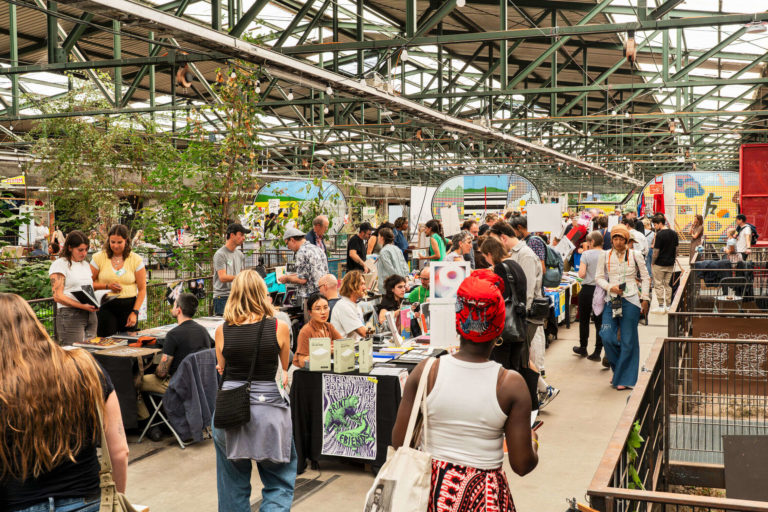
View of the fair — © Malte Spindler, brueder coop
MLS: How did you convince people to come to Hamburg back then?
MS: We simply asked them. It was surprising how open everyone was. Most of them did not know us, but the desire for exchange was huge. Thanks to city support and hotel deals, we offered a hotel room and good food, but above all curiosity and openness. That was what mattered. One of the first guests, Steven Watson from Stack Magazines in London, still comes today.
MLS: When did the idea of adding a fair emerge?
MS: Quite early. After the first conversations we realised that many people wanted to exchange ideas, but also needed a way to show and sell their work. In 2015, we organised a small fair, then still called “Free Trade Zone for Printed Goods”. At first it was an experiment, but we quickly saw that the fair and the conference belong together. Today everything takes place at the Oberhafenquartier in Hamburg.
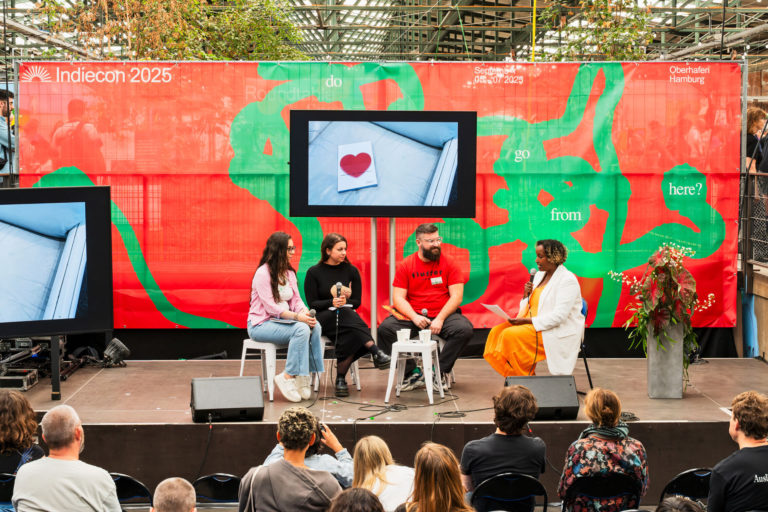
On the main stage, "The Shape of Desire: Eros, Aesthetics & Editorial Resistance," with Frisson (Francesca Ceccarelli), Chéri Magazine (Gemma Ferriero), Fluffer Everyday Magazine (Sotiris Trechas), Indiecon curator Lubi Barre — © Malte Spindler, brueder coop
MLS: Let’s talk about finances. How do you fund Indiecon?
MS: Our foundation is mostly public-funded from the City of Hamburg. Without that basic support the festival would not be possible. Everything we offer is subsidised. We also have a handful of supporters, such as paper manufacturers, printers, distributors, web hosting providers, or digital tools for publishers. Usually, Indiecon works with a small number of sponsors, some hotels and partners from the city. Hamburg is a very good place for this. The city has a lively cultural funding landscape that is open to independent initiatives. It is big enough to attract people from abroad but not as saturated as Berlin.
The funding changes every year. Currently, about half of Indiecon’s funding comes from municipal grants, while the remaining half is roughly equally split between sponsorship, event-generated income, and in-kind contributions in the form of volunteer work.
MLS: When you look at Indiecon, the diversity of exhibitors stands out. From independent magazines to publishing houses, zinesters, book artists, (riso) print studios, digital publications, and even universities. Why is that so important to you?
MS: We never wanted to show only one type of publication. Some people create magazines, others zines, others art books, or photographic projects. There are established publishers and very small initiatives. That mix is where the energy comes from. If everyone made the same thing, they would often have the same questions and fewer impulses. This way, different worlds meet and enrich each other. Out of these encounters, new magazines, companies and even families have been formed.
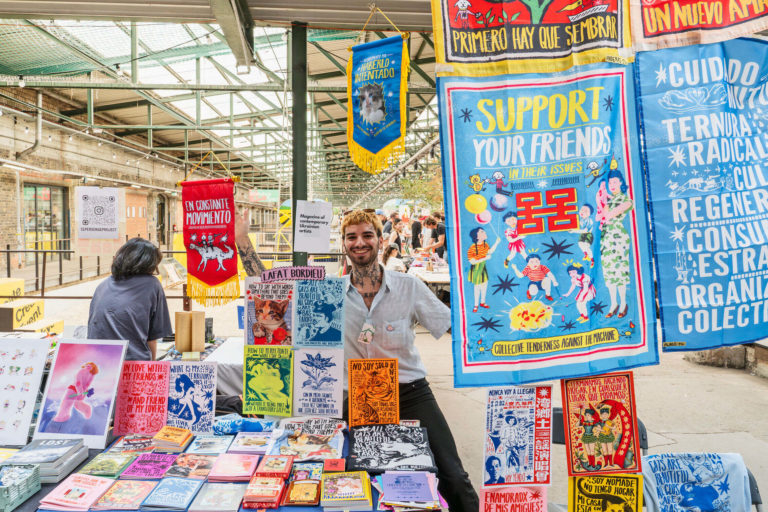
Table view (Exhibitor pictured: Lafat Bordieu) — © Malte Spindler, brueder coop
MLS: What does Indiecon look like behind the scenes?
MS: Most of the year I work on it alone. From spring onwards, more areas join in: curation, marketing, organisation. Over the year we’re about ten people, mostly freelancers, and during the festival another ten to fifteen helpers support us.
MLS: And how big is the festival today?
MS: We host around one hundred tables and an additional kiosk area with rotating exhibitors during our three-day Indiecon weekend each autumn. In total, about one hundred and fifty exhibitors from many countries[1] take part, and each year we welcome around four thousand visitors.
MLS: Beyond the fair, there’s a programme. What do you offer?
MS: We don’t curate a top-down conference. Every exhibitor can propose sessions they want to host: workshops, readings, roundtables, talks, or something more experimental. We collect all ideas at the beginning of the year and build a programme that reflects what’s happening in independent publishing right now. It’s a very collaborative structure. People actively shape the content of the festival.
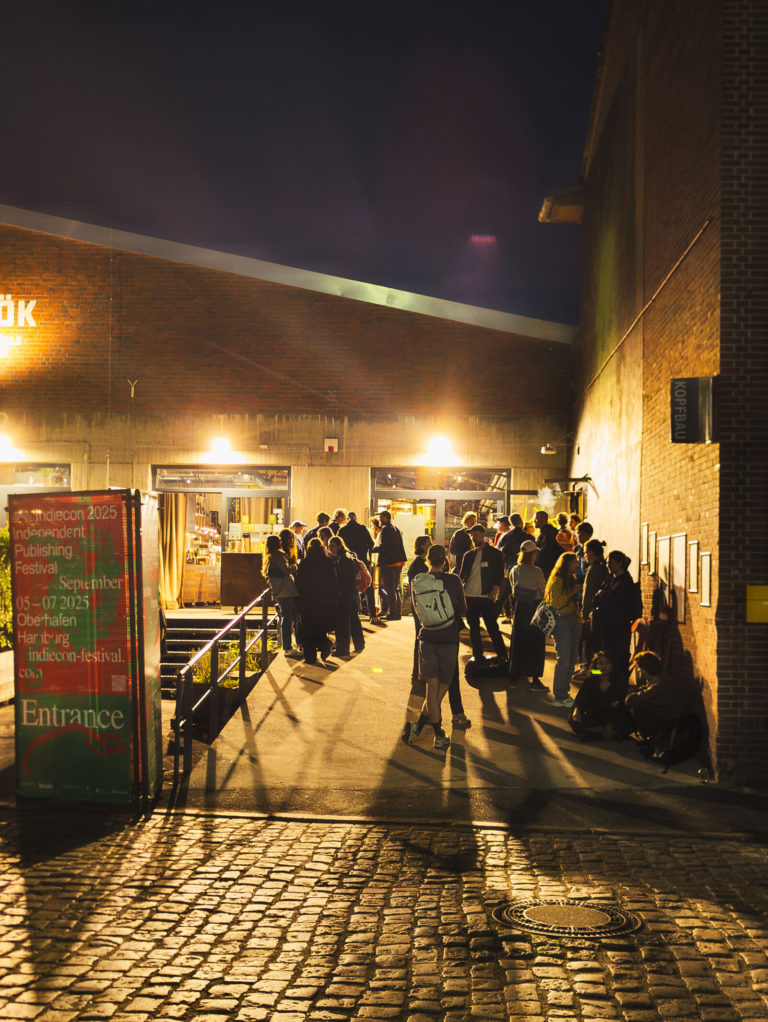
Indiecon Main Entrance at Oberhafen — © Malte Spindler, brueder coop
MLS: What trends do you observe in independent publishing today?
MS: Many projects work in hybrid ways: newsletters, podcasts, community memberships, small print runs. The printed magazine has become a kind of quality seal. It shows that someone truly cares. Some print only seven hundred copies but have built strong communities through Substack or similar platforms. Today print is often the element that holds everything together and not the one that has to finance everything.
Our table prices at Indiecon are tiered. For a standard table, fees range from €59 to €249. Publishers can also share a table.[2]
Financing is the biggest pressure point for everyone, that’s why we subsidise all tables because otherwise many couldn’t afford to exhibit. And even then, some still can’t manage the fee. When someone writes that they’re coming to Europe for the first time to exhibit at Indiecon, we make it work. Those are the people who enrich the festival.
MLS: If someone wanted to start a small publishing festival today, what would you advise?
MS: Start as small as possible. Ideally with a local community that already exists. A backyard, ten tables, a handful of curious people.
Notes
[1] Origin of Exhibitors (2025 figures): 45% Europe/international, 23% Hamburg, 32% other German cities
[2] The prices range as such: €59.00 (120 × 80 cm) – Subsidised rate for zinesters, students, single artists, or solo publishers with very low income; €99.00 (120 × 80 cm) – Reduced rate for those who are just starting out, or for magazines/collectives operating on a tight budget; €129.00 (120 × 80 cm) – Regular rate for publishing houses, corporations, or businesses that generate income from their activities; €249.00 (160 × 80 cm) – Large table, if more space is needed to present publications. Exhibitors can already apply for a table here.
Published on April 7th, 2026
About the author:
Marie-Louise Schlutius is a freelance journalist who was born in Nuremberg. She studied political science and history in Dresden and Berlin. She gained experience at the Goethe-Institut in Paris, through an internship at ZDF in New York and by working for the newspaper Die Zeit in Hamburg. Since autumn 2025, she has worked at Haus der Kunst in Munich as a digital communications manager, alongside her freelancing.