

Author: Lamija Kovačević
From the 'Foreign Agents Law' to the funding collapse, independent journalism faces an existential struggle against legislative pressure and economic instability.
In May 2024, a group of activists from citizens’ association “Restart Srpska” walked through Banja Luka, the largest city in Republika Srpska entity in Bosnia and Herzegovina, carrying a casket. This “funeral for democracy” took place in front of the Republika Srpska National Assembly as a response to plans to adopt the Law on the Special Register and Publicity of the Work of Non-Profit Organisations, colloquially known as the “foreign agents law.” The activists received minor offence notices from the police for insulting conduct at the scene.
The law was formally adopted in February 2025. Soon after, it was repealed by the decision of the Constitutional Court of Bosnia and Herzegovina. In its explanation, the Court drew a parallel with Russia’s Foreign Agents Law, which the European Court of Human Rights ruled as incompatible with the freedom of association. However, a lasting stigmatising effect remained, especially on donor-funded media and civil society organisations.
Since 2023, concerns about freedom of expression, association, media freedom, and journalist protection were noted in Bosnia and Herzegovina—reflected in the recognition of “backsliding” in freedom of expression and media freedom, and the protection of journalists in the annual European Commission progress report.
Restrictive Initiatives and Protracted Progress
The backsliding was widely recognised as driven by the re-criminalisation of defamation in Republika Srpska entity in 2023. A year later, the country dropped 17 places on the Reporters Without Borders Media Freedom Index ranking, followed by a further drop by five places in 2025, to the 86th position among 180 countries.
Defamation was previously decriminalised in the early 2000s, when civil liability for damage to reputation was introduced across the country. The decision to include defamation in criminal law was widely assessed as a disproportionate and unnecessary measure that threatens freedom of expression and contributes to a chilling effect on public debate and journalism. By the end of 2025, more than 270 reports were filed for the criminal offence, with 47 filed against the media and journalists, while there were no court-confirmed indictments against them in this period.
The law raises concerns across the whole country, as legal experts explain that even individuals outside the entity, including those in the Federation of Bosnia and Herzegovina entity or abroad, may face criminal liability for defamation. Across the country, other legislative initiatives likewise raised concerns about their effects on journalistic work, particularly with a resurgence of ad hoc solutions to regulate online speech at different levels in Federation of Bosnia and Herzegovina.
Maida Muminović, executive director of Foundation Mediacentar Sarajevo, explains that the long-standing criticism of poor implementation of existing legal solutions no longer stands, as “it has become evident that the legal and regulatory framework is outdated and needs to be aligned with the EU legal framework and standards for the protection of freedom of expression and media freedom.” She noted the delay of important legal solutions, such as the law on media ownership transparency, and the absence of an effective legal solution that would ensure the stable functioning and financial sustainability of the state-level public broadcaster.
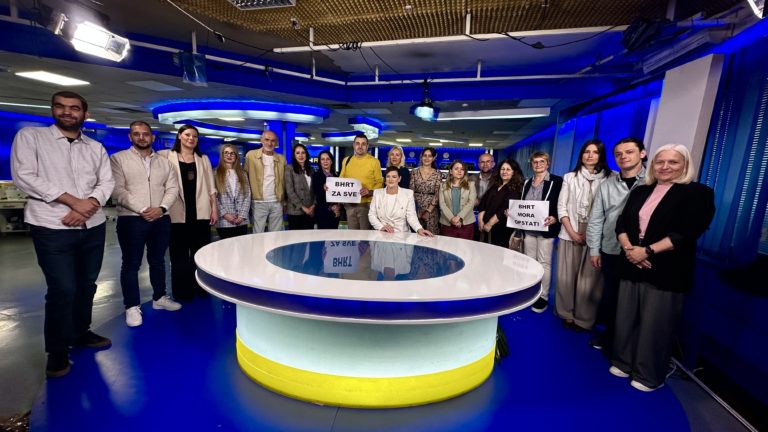
Journalists and activists visited Radio and Television of Bosnia and Herzegovina to support the public broadcaster amid a financial crisis and risk of shutdown — © Mediacentar/BHRT (E.D.)
Weak and Oversaturated Market Worsened by a Funding Collapse
Alongside the challenges emanating from the vulnerability to prosecution, journalists and newsrooms have lost a significant amount of financial support from abroad. For years, international donors have helped bridge the gap between the local market potential and the cost of independent journalism.
A 2024 Future of Media study warned about this dependence, emphasising the vulnerability of the market. Observing country trends, the author outlined the conditions of a stagnating advertising market, increasingly turning digital, while media depend on donors, or public funds that are allocated non-transparently through subsidies and grants—making media vulnerable to political influence.
The situation is particularly acute among local media, explains Berislav Jurič, the editor of Mostar’s Bljesak online media. “The lowest levels of government are particularly closed off in terms of transparency,” Jurič says. He adds that the undesirable position of local journalists has increasingly resulted in “many media in small communities being run by municipal civil servants and local radios.”
The number of media in Bosnia and Herzegovina keeps growing, tripling over the past decade according to 2024 estimates, but this does not amount to growing media pluralism due to the parallel decline of quality journalism by many accounts. This is particularly true for informative online media, as the Press and Online Media Council research finds that more than 60% operate non-transparently, missing or publishing incomplete imprint information.
The diversifying, oversaturated media environment is difficult to sustain, given the shrinking of the advertising market and financing challenges. Many media professionals from independent newsrooms affirm the negative impact this brings both to media operations and the reputation of journalism among the public.
Last year, the financial viability for many media organisations has deteriorated further with the withdrawal of USAID funds and the dismantling of the agency by March 2025. Based on the data published by foreign assistance, between 2020 and 2024, USAID disbursed over 15 million USD toward investigative journalism and media in the country, through programmes including the Media Engagement Activity, the Investigative Journalism Programme, Balkan Media Assistance Programme, and the Independent Media Empowerment Programme.
As Almedin Šišić, editor-in-chief at Valter Portal, explains, “these funds were allocated for advancing professional, independent, and frequently investigative journalism.” He adds that “European partners have taken on a lot of burden, but it is difficult and at times impossible to fill the gaps left by the USAID shutdown.” This has ultimately resulted in the shrinking or closure of some newsrooms, such as Newipe online media serving the Roma community.
Struggle to Resist Pressures
Jurič emphasises that “pressures on media were always present, and they are here to stay”, pointing out that “audience trust, truthfulness, and public interest topics” remain the main value of the media.
Milica Samardžić, executive director of Umbrella (an association which brings together 12 independent media outlets from across the country) explains that “independent media are surviving because of their high professional commitment and perseverance,” with strong emphasis on the importance of solidarity among media professionals. However, she maintains that independent media need “systemic support and stable sources of income” to survive.
Samardžić highlights that opportunities to sustain and strengthen independence exist, but that a “strategic approach is mandated” through improved cooperation, strengthening of shared resources, and diversification of revenue streams. She adds that there is a pressing need to develop “the culture of paying for media content,” and one of the opportunities she observes is direct communication with audiences.
Selma Fukelj, journalist at the specialised online outlet for journalism Media.ba, explains that protecting the freedom of expression has been a central focus of independent media, which, compared to commercially funded, “have more space and time to follow through on stories and events” and especially those that affect them directly.
A more favourable policy environment is necessary as well. From a top-down perspective, the Reform agenda adopted at the end of 2025 is a positive signal, as it contains specific measures, such as decriminalisation of defamation by the end of 2027, that would strengthen media freedoms.
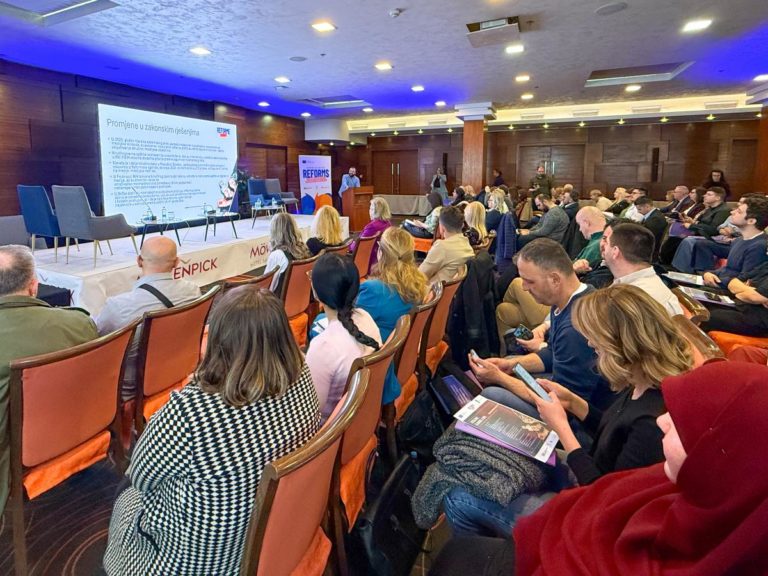
Media stakeholders attending the conference “Media Freedoms in Bosnia and Herzegovina: From Reform Priorities to a Strategic Framework for Media Development” — © Mediacentar
Media and civil society engage in bottom-up efforts through advocacy, often highlighting good practice and legal frameworks for protection of fundamental freedoms, such as the existing anti-SLAPP (Strategic Lawsuits Against Public Participation) mechanisms in the European Union, and recommended by the Council of Europe.
In 2025, civil society launched a structured initiative to introduce anti-SLAPP safeguards through changes and amendments to the Law on Protection from Defamation in the Federation of Bosnia and Herzegovina. Bringing together media professionals, legal experts, and civil society actors. Šišić explains that the initiative presents a concrete attempt to “achieve better, systemic protection for journalists against strategic lawsuits against public participation.”Bosnia and Herzegovina is not alone in facing persistent pressures on media, present in Europe and beyond, including funding withdrawal, platformisation, regulatory uncertainty, and shrinking advertising markets. However, the speed and intensity with which pressures unfold in recent years stand out.
At this moment, they are navigating a difficult market without the systemic support that could soften the landing—struggling to resist pressures, and increasingly, to redefine what resistance looks like. The top-down promises and bottom-up persistence have yet to find each other.
Published on May 12th, 2026
About the author:
Lamija Kovačević is a media researcher and research project coordinator at Mediacentar Sarajevo. Her applied research explores the intersections of media, digital life, democratic resilience, and social power in Bosnia and Herzegovina and Southeast Europe.
