This article is part of Reset! Yearly Focus 2026: Digital Independence
Author: Matilde Moro
Long before platforms and algorithms came to define how we connect, a network built from folded sheets of paper, postal routes, and shared intent was already at work. Fanzines formed an analog web that linked communities across borders, sustaining independent scenes, and alternative voices. Looking back at that pre-internet “net” allows to ask a timely question: what can today’s cultural sector learn from these grassroots infrastructures as it seeks more human, independent, and resilient ways to connect in the digital sphere?
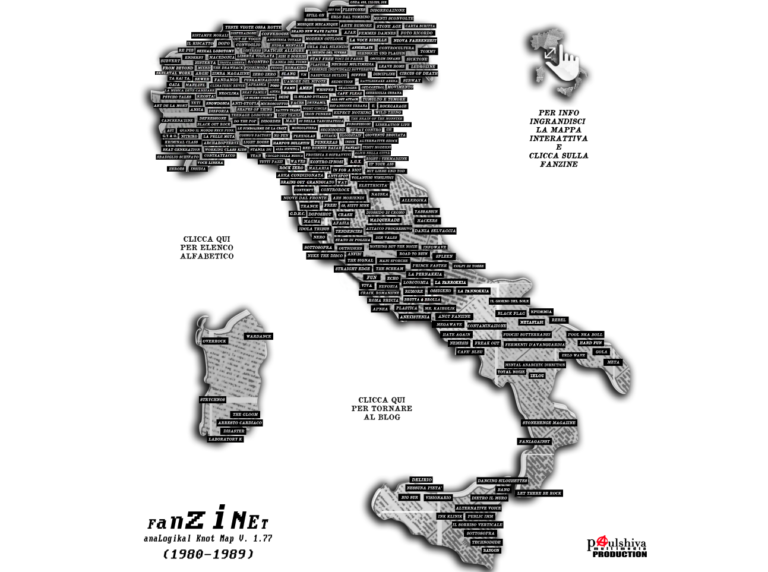
FanziNet analogical Knot Map website
Most of the time, it’s a sheet of paper folded in four or eight. The style is simple, rough, often black and white, always with a home-made touch. After all, the fanzine is the queen of editorial DIY. The first fanzines were printed as far back as the 1930s and 50s, in the United States. At the time, they were mostly about science fiction—their very name coming from sci-fi’s so-called fandom. The point, from the beginning, was sharing reviews and opinions about a segment of culture that rarely made it to mainstream channels. Fanzines then took a political turn—playing a crucial role in the political movements of the 1960s and 70s both in the US and in Europe. Printed with a simple mimeograph, they were easy to craft and cheap to distribute—a perfect combo for becoming an instrumental medium for sharing grassroots ideas. Independent, artsy, creative, and almost free to produce, they were also quite difficult to control. At the same time, they presented an incredibly effective opportunity for creating a net. Fanzines were built and lived on their own infrastructure and ended up becoming a means for connections: together with reviews, articles, collages, political call-to-actions, hundreds of phone numbers and addresses circulated on them. People got in touch, but it was more than that: from one issue to the next, from one fanzine to the other, people debated, discussed, exchanged ideas. At the end of the day, each copy linked to at least another, and the conversation kept going and going, for decades. It was, as artist Paolo Palmacci puts it, “an analogical Knot Map, a pre-internet net.”
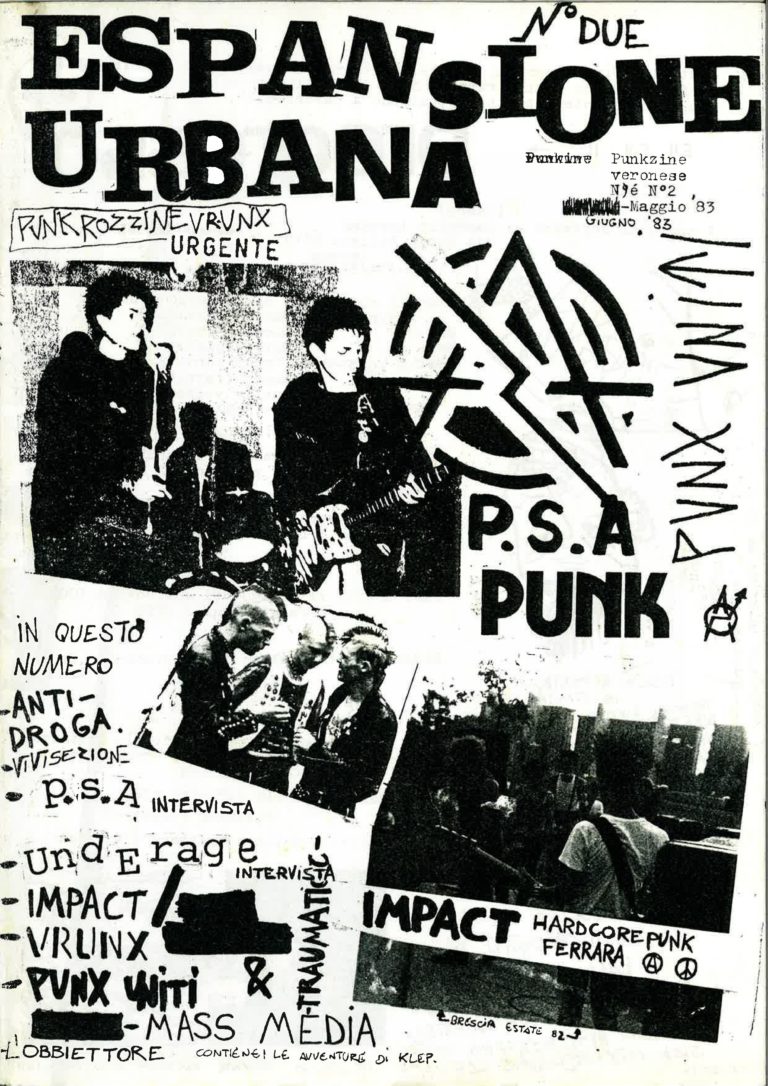
Espansione urbana fanzine cover — © FanziNet
Connecting the Dots
I meet Palmacci at a café next to the train station in Milan. He has been investigating contemporary cultural phenomena for decades through media ranging from music to blogging to digital art, and recently turned to look at fanzines. With the project FanziNet, he put together more than 675 Italian fanzines from the 1980s. 492 are already available for download on his website, Capit Mundi?. The result is a simple, straight-forward design map, showcasing both the fanzines and how they were connected: who made them, when, which are linking to which. It is, as it appears clear at a glance, the picture of a proper, complex, interconnected web. The cartography of a ramified subculture: a map of knots that existed through the whole country and beyond. It shows the pre-internet, real-life web of contents, culture, information, art that were circulating at the time. It is, in the end, a pre-digital social network.
In Italy, too, fanzines were a physical space where postal addresses, letters, cassettes, and contacts were continuously exchanged, keeping alive the many local, otherwise fragmented, micro music scenes of the time. To be precise, most of the fanzines present in Palmacci’s digital collection deal with punk subculture—a fanzine trend that was at its height in the 1980s—and how it developed during that decade in Italy. Punk culture, especially at the time, was not about the music or the style as much as it was about being outsiders, feeling like there is some sort of error in the system and actively, crazily trying to create something new.
The socio-political context in which punk fanzines were printed is not to be overlooked either. The fanzines mapped by Palmacci come right after the political phase of the 1960s and 70s, they are from the so-called “baby boom era” in Italy, coinciding with the peak of neoliberal capitalism, advertising, and consumerism. Thus, in a way, punk fanzines were also a way to escape this reality through a collective dream, made of paper.
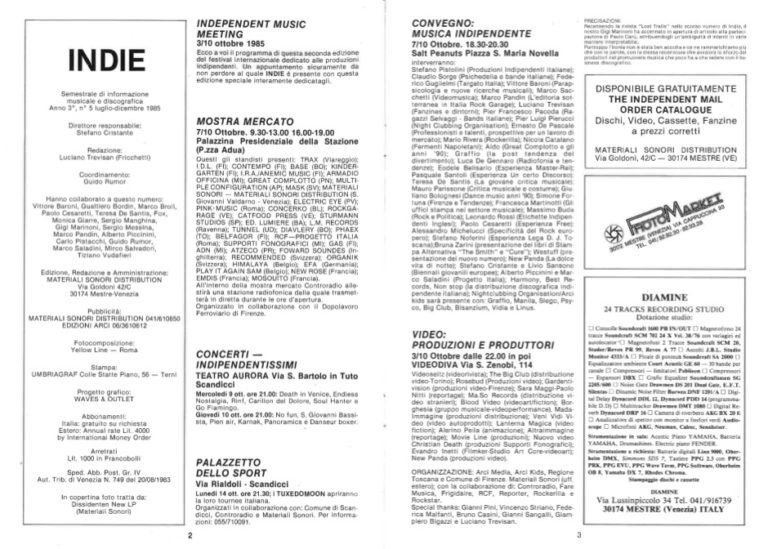
FareMusica fanzine — © FanziNet
Material and Immaterial Archives
Materiality is a crucial aspect in Palmacci’s FanziNet. They were connecting those who felt like they didn’t belong, from paper to ideas: “materiality,” reads his website, “is inescapable, unavoidable (unfortunately on the one hand, fortunately on the other) for those who are body as well as mind. Therefore, any human attempt at abstraction is necessarily based on matter. It is therefore inescapable and indispensable as a way of knowing the world: and today we are well aware of the damage that the dematerialisation of cognitive experience has caused and continues to cause. At every level.”
In order to put his digital archive together, Palmacci too had to, unexpectedly, go back to an entirely physical, almost obsolete way of doing things: “I first got interested by looking at the connections; I was looking at a press review of a punk band from Latina, and I noticed there was even a Fanzine from Peru talking about this band, so I started wondering how it worked, how this global communication net was created.” He started researching but noticed that even though there were articles and blogs about the topic, there were very few actual fanzines available. He started talking to people, trying to find copies that would help him connect the dots. Luck came in an unanticipated form: “Someone gave me an address scrabbled on the back of an envelope, it was an exchange from around 1986, a man named Luciano sending money and asking to ship fanzines in return.” The following step was both absolutely consequential and completely foolish. He went looking for the address: “I got there, and I found Luciano mowing his lawn. I said hello and showed him the piece of paper from 40 years before I carried with me—he must have thought I was coming from a different time.” At first, Luciano gave him hundreds of cassettes, which he explained was not the focus of his research. After a few days, however, he called him back and finally gave him the zines, tens and hundreds of them. “That was my starting point,” explains Palmacci.
Then came the map, a digital one. “I wanted it to be simple,” he explains “to make the knots the focus of the whole thing, to make it clear and centred.” The design reflects this. Black and white, immediate, it shows each mapped fanzine and how it is linked to others. Since he launched the website, the project went viral. People across generations got interested in a way even he was not expecting, especially given how specific the subject of the project is. Yet, something in it resonated. “As for the older generation, I get it, their interest probably comes from the fact that they were there, it was their thing, they made it and lived it, they valued it at the time and still do today,” perhaps entailing some sort of nostalgia. As for younger people, “it would be great to know that this project inspired some to get back to counterculture, to make things diy and build up independent media.” It may be more than that—it may be that FanziNet represents the vessel of something we are missing, even if we live in the illusion of having it in abundance: a proper, material, tight net. Archives have a special way of becoming not mere collections but reminders that things can be done differently—that there used to be another way and there can be a different one still.
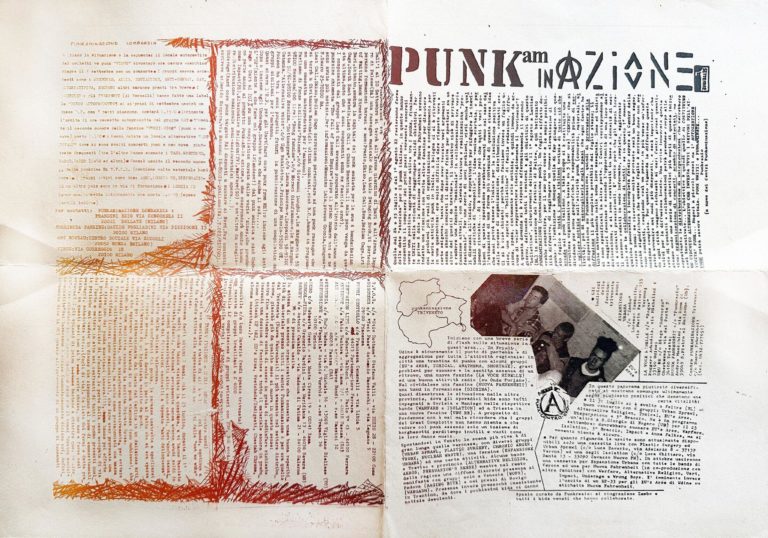
Punk Animazione fanzine — © FanziNet
In an increasingly digitalised and surveilled world, looking back at fanzine culture, mapping it, studying it, can help us go back to human, print, physical interactions. And the immense power they hold. While our world keeps going fast, fanzines go the opposite way: “the back and forth, the connection between a fanzine in Latina and one in Lima, that almost feels obvious, that we take for granted today, could take weeks at the time—and that was if everything went smoothly, if nothing went misplaced or lost.” Communicating took time and effort. Of course, today we can do things differently and as Palmacci puts it, “why struggle if you don’t have to?.” But surely, looking at fanzines and the way they were connected can serve as a reminder that the net we have is not the first nor the only one possible and that connections come in all sorts of forms—and that maybe the error in the system is still there for us to fix.
Projects like FanziNet invite us to stop and observe. Through its simple design, FanziNet is the clear demonstration that another web is possible, one that does not simply look different, but inspires different kinds of connections. Using digital tools and refusing to give in to useless nostalgia, FanziNet is first and foremost an opportunity to ask ourselves difficult questions about the web we created and the one we might actually wish to have.
Published on April 28th, 2026
About the author:
Matilde Moro is a freelance journalist currently based in Tbilisi, Georgia. She has published reportages from Ukraine, The Occupied West Bank, Albania, The Slovenian-Italian border, the Italian-French border, collaborating with Italian and international publications like Editoriale Domani, L’Espresso, and Unbias The News.