Author: Nora Balkanyi
In Hungary’s increasingly centralised cultural landscape, contemporary art has become a subtle but contested terrain. In this conversation, Budapest-based Hungarian-French artist Gideon Horváth reflects on what it means to work independently within a shrinking ecosystem of opportunities, where state influence, fragile institutions, and informal solidarities shape artistic life. Moving between sculpture, film, and collaborative initiatives, Horváth speaks about material experimentation, the politics of exhibition spaces, and why even a small independent art scene can pose a symbolic challenge to authoritarian power.
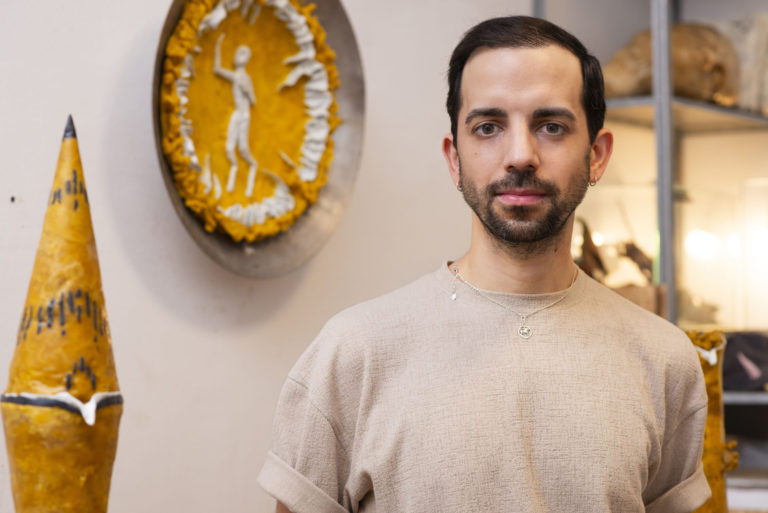
Portrait of Gideon Horváth – © Dániel Szalai
Gideon Horváth is a Hungarian–French artist based in Budapest, one of the best-known figures in his generation. Alongside his individual artistic practice, he is active across multiple fields of contemporary art. We discussed what independence means to him, how he views the effects of a scene marked by declining opportunities, and why exhibition spaces are able to pose a threat to authoritarian systems.
Nora Balkanyi: You describe yourself as an interdisciplinary visual artist working primarily with sculptural installations, often using beeswax. Why sculpture—and why wax?
Gideon Horváth: I am a tactile person; sculpture came to me quite naturally. There are people who support me in this direction, but I am essentially self-taught. I enjoy this intuitive approach—learning outside institutional frameworks and without adhering to the expectations of previous generations. Alongside wax, I have recently begun working with porcelain. These materials are often imagined as fragile or non-resilient, and I am interested in contradicting that perception. Beyond their immediate aesthetic qualities, I am also drawn to their histories and broader conceptual dimensions.
Alongside theoretical thinking, my own social environment is a constant point of reference: everyday life, the context in which I grew up. I am interested in how my semi-peripheral position being Eastern European shaped my experiences, my sense of otherness, and what kinds of legacies I can carry forward.
Locality is important to me—beginning from home, rather than importing Anglo-Saxon discourses word by word.
Fundamentally I am interested in subversive ways of thinking. How can ingrained concepts be examined from new perspectives? How can we draw strength from experiences such as shame or vulnerability without automatically rushing towards the notion of pride, which often functions as the normative opposite? And how might we rethink failure—not as something to be overcome, in line with the capitalist logic of “learning from it to become stronger.”
NB: You mention a subversive approach. What does the concept of independence mean to you in this sense?
GH: I do not want to turn this into a long philosophical argument, but my instinctive reaction is that I am not free, not independent, not safe, and not a “happy person.” I am relatively balanced, and I do experience happiness, but terms such as happiness, independence, or freedom are abstract and hollow when taken at face value. This is not how human existence functions, and it is not how creative life works either.
What I find particularly troubling is the empty oppositional stance adopted by many NGOs here in Hungary. They often operate under banners like independence or diversity without genuinely engaging with what these concepts entail.
In recent years, we have frequently used the term social imagination. Yet this kind of imagination is not activated by grand, declarative words. Tension is often neutralised when we imagine some abstract, liberated state, instead of addressing what truly needs to be examined: why oppression exists in our everyday lives, how it operates, and what it actually means.
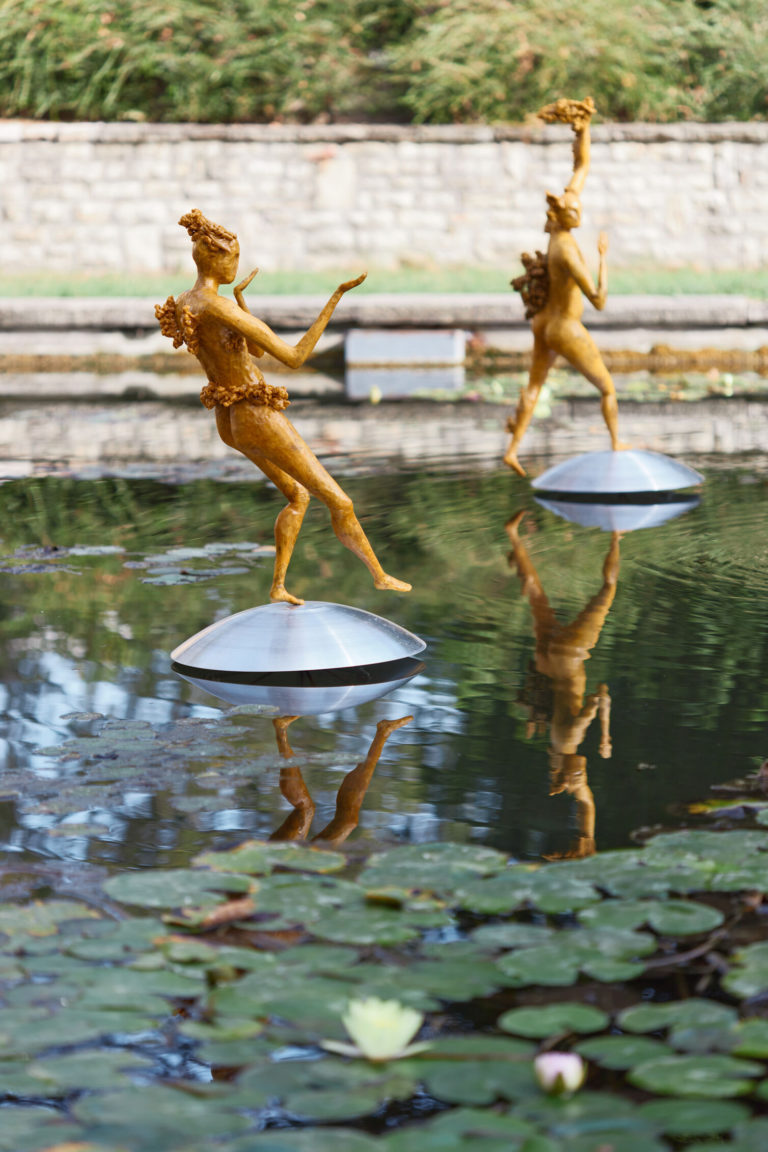
Memory That Could Have Been at the 1st Budapest Biennale of Contemporary Public Art - Budapest Gallery, BTM – © Dávid Biró
NB: In the local context, the notion of independence is most often understood as independence from the state and from its institutions—often both financially and professionally. Based on this definition, how do you see the independent art scene in Hungary?
GH: If we look at when the takeovers of the Ludwig Museum (Museum of Contemporary Art) and the Műcsarnok (Kunsthalle) took place, and when the Hungarian Academy of Arts (MMA)* gained significant power, it became clear that politics entered the art scene very early on in the current system, roughly 10-13 years ago. At the time, these centralising moves provoked a strong backlash. Over the past decade, however, many of these developments have gradually become normalised.
Back then, for an artist holding oppositional views, applying for an MMA grant seemed unthinkable. Today, by contrast, there are opposition-minded, progressive artists among the recipients. We have reached a point where many simply cannot afford not to apply: either they create with that funding, or they stop creating altogether and exit the field.
Strong gestures such as ideologically motivated boycotts rarely function on an individual level. Whether collective forms of resistance could generate a different kind of leverage is another question.
But on a personal level, I would not question anyone’s decision to apply to the MMA.
NB: To mention spaces of solidarity still standing, the commercial gallery that represents you is Longtermhandstand (LTHS). They describe themselves as an “international art gallery system” and “soul care centre”. They organise multi-location exhibitions, operating a hybrid system with occasional popup events, having two permanent locations called The Villa and The Hall. How did you come to work with them?
GH: There is no fixed model for what a career in fine arts should look like, although certain norms do exist. One of these is that if an artist becomes sufficiently visible, participates in a range of exhibitions, and develops a compelling body of work, gallery representation often follows—and can become one of the pillars of their livelihood.
Longtermhandstand is run by Péter Bencze and Réka Lőrincz. It is a young, relatively small gallery, but one that—as its name suggests—operates with a long-term perspective. This makes it possible for us to build something together. They are not afraid to rethink established rules. While a commercial gallery necessarily depends on sales, in this case there is also a strong curatorial vision and serious professional consideration behind the work. We have found a shared, direct language, which has been essential to the collaboration.
NB: From the outside, the gallery may seem small, but it appears to have a strong and lively community. Is that an accurate impression?
GH: Absolutely. The atmosphere is very family-like, and the artists actively support one another. The gallery is careful to ensure that everyone receives the attention they need and that each artist is in their right place. We sometimes have smaller parties for ourselves. As much as possible, we remain relatively insulated from the toxic forms of rivalry I mentioned earlier.
I do not want to idealise it too much, but in many ways the gallery functions like an island. Including the staff, there are no more than around twenty of us. When we travel to fairs abroad—in recent years, for instance, to Mexico City and New York—we all stay together. In a sense, it feels like going on holiday with friends.
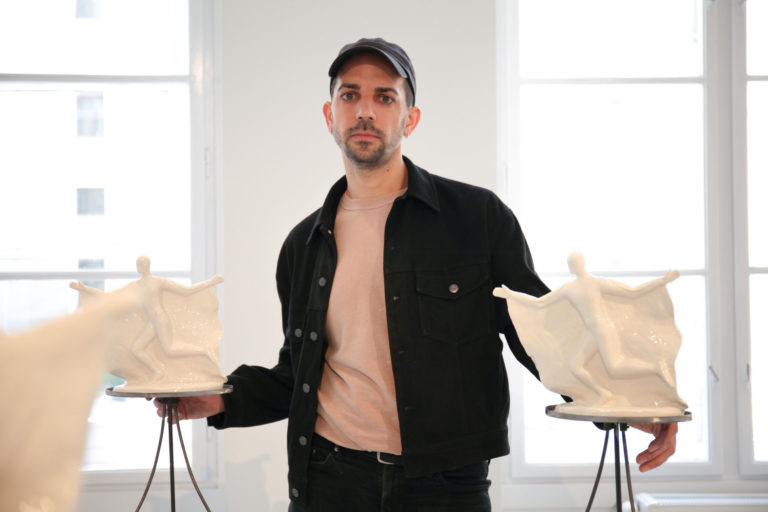
Portrait at the exhibition The Most Dangerous Person at OFF-Biennale Budapest 2025 – © Alexandra Kinter
NB: How large do you think the contemporary fine art scene is, including the audience?
GH: Small. I don’t know the exact numbers, but I don’t think it compares to the audiences for theatre, cinema, or live music. It is a highly elitist field and often difficult to access. At times, I don’t even fully understand certain works myself without investing considerable effort. At LTHS, however, it is important that visitors never feel intimidated or “stupid” when they enter the space.
NB: So the “belépési küszöb” (threshold for entry)** is generally high?
GH: Very.
NB: So why do you think fine art was one of the first cultural fields the regime sought to control?
GH: Perhaps precisely because of its elitism. It is a difficult-to-access, high-prestige field that sits at the top of the cultural hierarchy, like opera. By targeting it early on, you want to monopolise it. At the same time, if we look at the exhibition programme of the Ludwig Museum prior to the takeover, it becomes clear that despite its perceived inaccessibility, contemporary art can offer significant space for progressive and radical forms of thinking—something that poses a challenge to a centralised, increasingly autocratic system.
If prestigious institutions such as the Ludwig Museum or Műcsarnok would host exhibitions addressing for example feminist, anti-colonial, or queer themes, this would not merely represent a symbolic risk; it’d also reflect poorly on a conservative, right-wing government. Large exhibition spaces function as powerful sites of representation.
When the Ludwig Museum presented a Robert Mapplethorpe exhibition in 2002, images of naked male bodies were visible throughout the city. Today this is almost unimaginable.
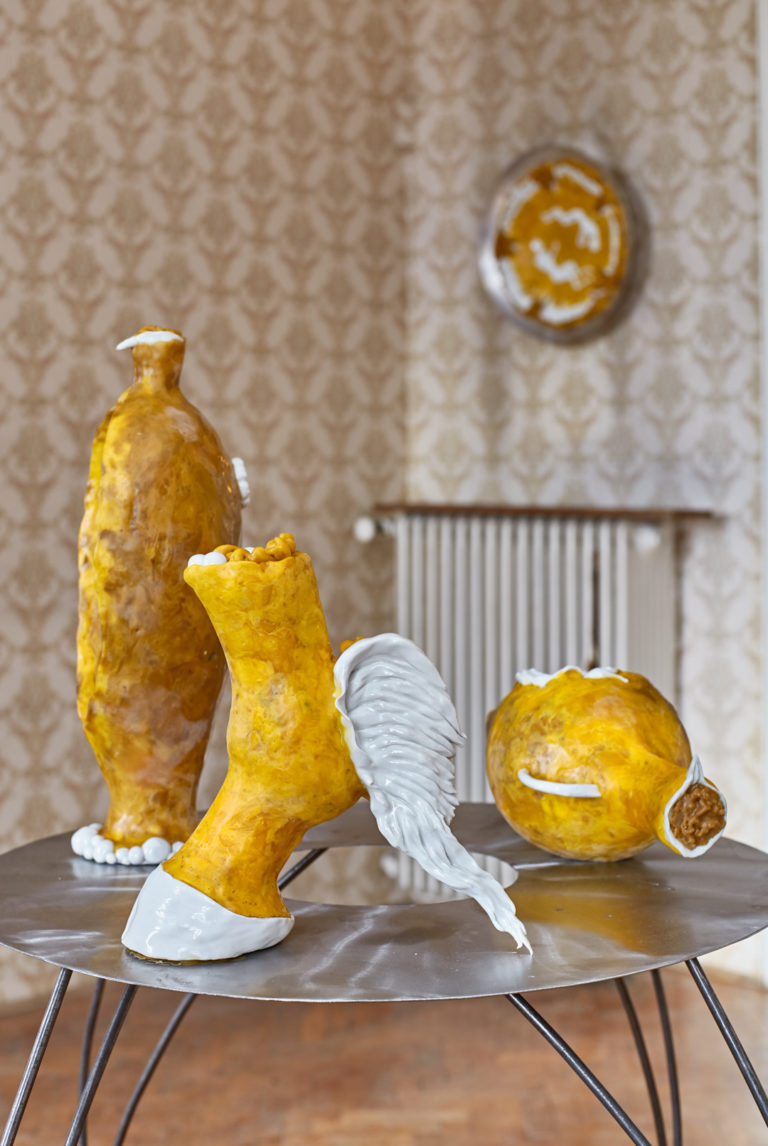
Pollinating Agents exhibition at Longtermhandstand Budapest – © Áron Weber
NB: You have worked in many different fields and roles, including contemporary dance, film, Trafó House of Contemporary Arts. What have these experiences given you?
GH: Working in film has given me a level of professionalism that I could not have acquired within the fine arts alone. There is a strong sense of collective functioning. Everyone knows their role, working with humility. A film crew operates like a machine in the best possible sense. I find this deeply inspiring.
It is also extremely important to me that I am able to work with director and screenwriter Ildikó Enyedi. I am her research and personal assistant, and in recent months my work has been largely logistical—coordinating travel, check-ins, and communication with festivals and hotels. It’s a bit like being in an office, but I genuinely enjoy working for someone else. It grounds me and prevents me from being constantly absorbed in my own ego as a creator. It is humbling—and necessary.
I have learned a great deal from Ildikó. She herself embodies an interdisciplinary approach, having been shaped early on by the visual arts and experimental film scene through for example Miklós Erdély, before entering the international arena as a successful filmmaker. Her most recent film, Csendes Barát (Silent Friend, which has already won several major awards, including from the Venice Film Festival), incorporates numerous experimental elements, both aesthetically and narratively.
I have also worked with choreographer and dancer Adrienn Hód, another prominent female contemporary creator, and OFF-Biennale (a renowned, independent, grassroots contemporary art initiative based in Budapest), which is led by women as well. I find it tremendously inspiring when large-scale projects are realised not through traditionally masculine modes of leadership, but through approaches that are decisive, yet quieter and often more subtle.
This interview has been edited for length clarity.
Forms of solidarity: project Helyindex
Hely[i] is an online project launched in 2022 by Bettina Bence and Barnabás Bácsi. The initiative set out to map, systematise, and make visible Hungary’s non-profit, independent, and artist-run exhibition spaces in a non-hierarchical approach. The concept was strongly inspired by the Vienna-based Independent Space Index. Since the launch of the project, the database has been updated several times. These updates have revealed not only the emergence of new initiatives, but also a steady decline in the number of independent exhibition spaces in Hungary—thus lending the project an additional, critical significance.
Based on the feedback received, the founders inform me that the site has indeed filled an existing gap. They have heard repeatedly that professionals were happy to recommend it to one another, and that it has also served as a useful reference. At present, the site does not function as an actively maintained, day-to-day platform, but rather as an archival and reference resource. Any future development of the project depends primarily on available capacity and resources.
Since 2024, hely[i] has been a member of the Reset! network.
References
* MMA (Magyar Művészeti Akadémia) is funded and influenced heavily by the state, representing ideologies close to the ruling party, Fidesz, in power since 2010. MMA got the ownership of Műcsarnok, the Hungarian Hall of Art / Kunsthalle in 2013, despite protests from the artistic community. This event was one of many in a broader, ongoing process often described as Hungary’s “culture wars” , the increasing political control over cultural institutions.
** The Hungarian term „belépési küszöb” (“entry doorstep/threshold”) describes how easy (“low”) or difficult (“high”) it is to enter and feel at ease in a social or cultural space, depending on the level of prior knowledge or experience required.
Published on March 10th, 2026
About the author:
Nora Balkanyi is a journalist based in Budapest, covering creative industry, media, and culture; currently freelancing as an editor at hvg.hu, media literacy trainer and cultural content manager; volunteer in JazzaJ hub for improvisational music since 2015.