Author: Deniz Kirkali
What does it mean to remain independent in a cultural landscape shaped by precarity, institutional pressure, and uneven access to resources? When alternative art spaces in Turkey are both vulnerable and essential, Bağımsızlar offers a lens into how independent initiatives survive, connect, and imagine collective futures.
Since the early 2000s, independent initiatives in Turkey have created alternative spaces for experimental and autonomous forms of production, filling the gaps left by institutional structures. Today, although the independent art ecosystem is more fragile in many ways, it continues to generate transnational networks of solidarity and alternative modes of production—demonstrating remarkable resilience.
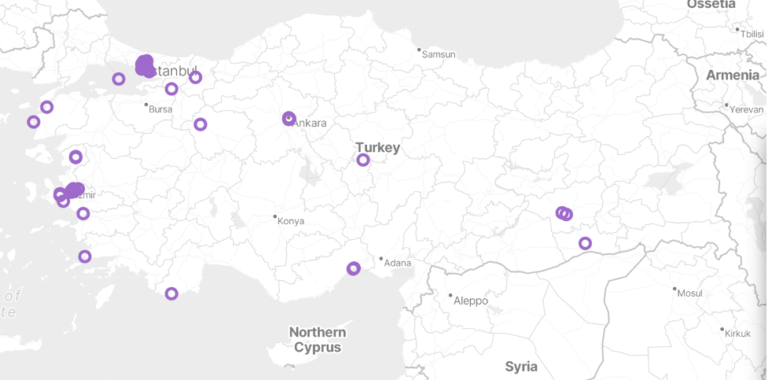
Bağımsızlar (“Independents”) is a platform that aims to increase the visibility of active independent organisations in the field of culture and arts in Turkey. It seeks to strengthen collaboration, a culture of sharing, and solidarity among cultural practitioners. It serves as a sustainable reference source for those working in the field, offering categorised data, and mapping the organisations in its inventory across multiple layers. Their endeavours include an online map of 159 independent initiatives across Turkey as well as a weekly radio programme at Apaçık Radio with guests involved with these initiatives.
We spoke with Gülşah Akın from the Bağımsızlar team.
© Bağımsızlar website
Deniz Kirkali: In your opinion, what does ‘independence’ mean within the arts and culture scene in Turkey?
Gulsah Akin: Our guests on our programme at Apaçık Radio have so far primarily approached the concept of independence through the idea of not being economically tied to any institution. This kind of financial independence grants initiatives, artists, or collectives a significant degree of freedom in all their decision-making processes. From this perspective, independence can be seen as the most essential condition for an organisation to realise itself; both in terms of its production and its mission. However, independence always carries within it an implicit concern which is a sense of precarity. As anyone even slightly familiar with the independent field knows, financial hardship often leads to uncertainty, which in turn creates insecurity around the continuity of an initiative’s activities. At the same time, independence also offers the greatest advantage in terms of defending and preserving one’s own stance, ideology, and perspective. In this sense, it is not only an economic condition, but also an ethical and political position.
DK: Within the context of Turkey, why is it crucial to continuously redefine and defend independence?
GA: Independence is something that should already be inherent to cultural and artistic organisations. It’s almost a necessary form of existence. It’s impossible to reflect art or culture beyond the framework of an ideology, because once that happens, what’s being produced is no longer art but propaganda. Therefore, defending independence means guaranteeing a pure, uncensored, and unfiltered form of artistic expression; one that directly represents the artist’s own voice.
When we look back at the history of art in Turkey, we see that state support has been one of its oldest traditions, dating back to the foundation of the Republic. There were painters sent to Anatolia, artist groups formed within the Academy, and movements shaped under the influence of state or academic institutions. Without delving into a full historical analysis, it is clear that the state and academia have long had a determining influence on artistic production. However, I believe that today’s independent formations, initiatives, and collectives have opened up an unprecedented diversity of perspectives and modes of expression in Turkey’s cultural history. So, I’m not sure if “redefining” is the right word—perhaps it’s more accurate to say that we are only now beginning to define what independence means in practice. Of course, I’m not an art historian, and I’m sure historians would have more grounded observations on this. But based on what I’ve learned and witnessed through my involvement in Bağımsızlar, this seems to be the case.
As I mentioned, state support has long been one of the oldest methods in Turkey’s art history. But today we are faced with a new kind of challenge. The danger is that artists and cultural producers who cannot find adequate financial support either disappear entirely or become dependent on larger institutions and organisations for survival. There needs to be a middle ground; a model that allows artists to sustain their practices without total dependence on major institutions or the state. At the moment, we rely on solidarity economies, the sharing practices of initiatives, and individual efforts. However, this model is not sustainable and further amplifies the precarity experienced by cultural producers. We are going through a time when we urgently need to find new formulas and ways to ensure continuity, stability, and collective support in the independent cultural field.
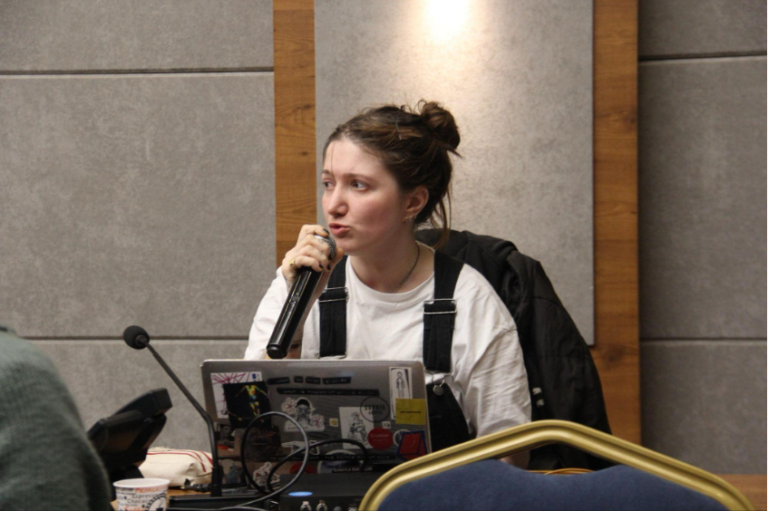
Gülşah Akın — © Özcan Yaman
DK: I think that among the fundamental challenges faced by independent cultural producers in Turkey are access to resources and sustainability. In your opinion, what are the key dynamics that enable independent organisations to sustain themselves?
GA: The issue of access to resources is deeply connected to the question of sustainability. The lack of financial resources directly threatens the continuity of independent initiatives. I think one of the fundamental problems here is visibility or the fact that people or groups who share similar concerns and values often cannot find each other. For this reason, human resources—in other words, volunteers and individuals actively engaged in this field—are crucial for sustaining organisations. Most independent formations usually emerge as side projects; people involved often have other jobs through which they earn a living, and they develop these initiatives as additional, voluntary endeavours. However, these kinds of projects require time, mental energy, and organisational commitment, which makes them difficult to maintain alongside daily life. When priorities shift, the initiatives that are highly dependent on individuals can pause or stop altogether. This shows us that sustainability requires more people, more shared responsibility, and collective commitment.
DK: Could you elaborate a bit on the tools that Bağımsızlar have developed in bringing together independent structures (such as mapping, classification, and participatory updating)? How does this approach transform the cultural-artistic memory in Turkey?
GA: First and foremost, we are creating a collective memory, an archive. Looking at the history of contemporary art in Turkey, we can see that it only really started to solidify after the 1980s. In this sense, what we are doing is leaving behind a kind of catalogue for the future. As you mentioned, our website uses a geographical mapping and classification system. We also hope that this can evolve into a network of solidarity. When you register your initiative on the website, you are asked to share certain details such as information about your capacities, tools, and what you can offer to others. For example, let’s say you’re an initiative based in Eskişehir. You might have a projector but no screen, and you can use the map to see if there’s another initiative in your city that could share theirs with you. So, in short, our main goals with the website are to strengthen solidarity and sharing, increase visibility, and create mutual support networks for independent cultural actors.
© Özcan Yaman
DK: What are your thoughts on the relationships between independent initiatives and institutional structures?
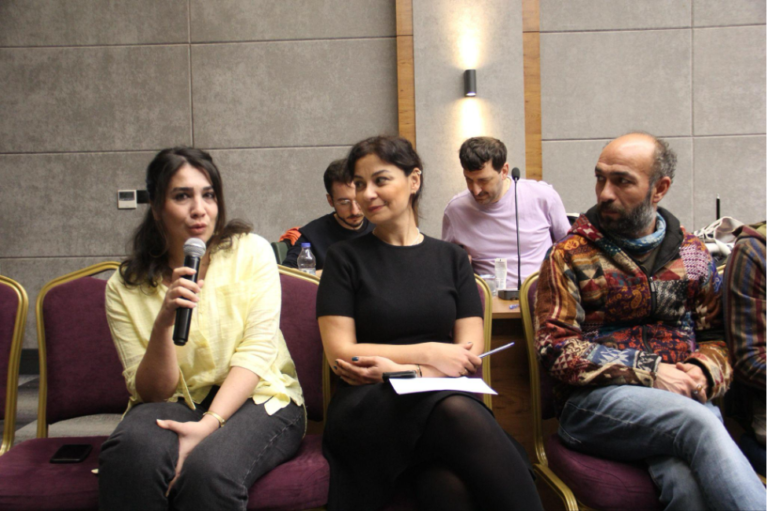
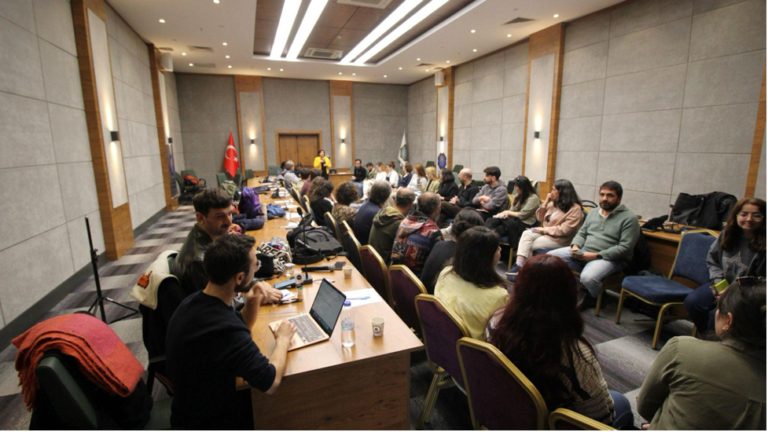
GA: From my observation over the past 5–10 years, this relationship has become increasingly fluid and permeable. Especially when funding bodies began including local independent initiatives (even those without legal entity status) within their funding scopes; more initiatives started receiving support. The spirit of independence often involves resisting formal structures, which is understandable. While being systematic is beneficial, it’s practically impossible to manage an initiative like a company, or to organise an exhibition like a state institution or museum. Independent initiatives operate through permeable, flexible processes in both structure and activities. One example I can share comes from local municipalities. At the end of March 2025, we organised Bahar Sergisi in Diyarbakır, supported by the Diyarbakır Municipality and initiated through the Bağımsızlar Communication Network, hosted at Merkezkaç Art Collective’s space. The municipality covered travel and accommodation for participating collectives and also organised a forum in Diyarbakır. Collectives from different parts of Turkey not only found a space for sharing and solidarity, but also made their presence visible in another part of the country. They exchanged experiences during the forum. I hope we can see more examples like this in the future.
DK: Do you have any plans for solidarity or knowledge exchange with international independent networks? What kinds of partnerships are needed?
GA: Honestly, we haven’t had time to focus on this yet. The density of independent initiatives in Turkey is quite high, and since we ourselves lack sustainable dedicated economic resources, our time and human resources are limited. However, in the long term, there is no reason why we wouldn’t pursue such collaborations. We hope to eventually establish partnerships and exchanges with international independent networks to strengthen solidarity and share knowledge across borders.
© Özcan Yaman
DK: Can you tell me a bit about the short-term plans for Bağımsızlar?
GA: At the end of 2024, with support from Sivil Düşün, we launched a new website called Bağımsızlar Hub. Our goal was to create a space for visibility and sharing for independent initiatives, publishing cultural events, exhibitions, workshops, and review articles from cities outside Istanbul. The project ended at the end of June, but we have not yet shared all the content we gathered. In the coming period, we plan to focus on this. Our programme on Apaçık Radio is ongoing, and we hope to continue discussing both new initiatives and issues in Turkey’s independent cultural scene. Additionally, if we can secure funding, we plan to organise a fair or gathering for independents.
Published on February 10th, 2026
About the author:
Deniz Kirkali is a curator and writer based between Istanbul and London. She has co-founded topsoil, a transnational curatorial and research collective, and Garp Sessions, a summer residency programme in Babakale, Turkey. She holds a PhD from Goldsmiths University.