Author: Matilde Moro
As Azerbaijan recalibrates its geopolitical alliances—cooling ties with Moscow while deepening cooperation with the West—the government is tightening its grip at home. New media restrictions, passed amid regional realignments and energy diplomacy, are accelerating a long-standing crackdown on independent journalism, leaving reporters in exile and transforming the press into an increasingly uniform tool of state control.
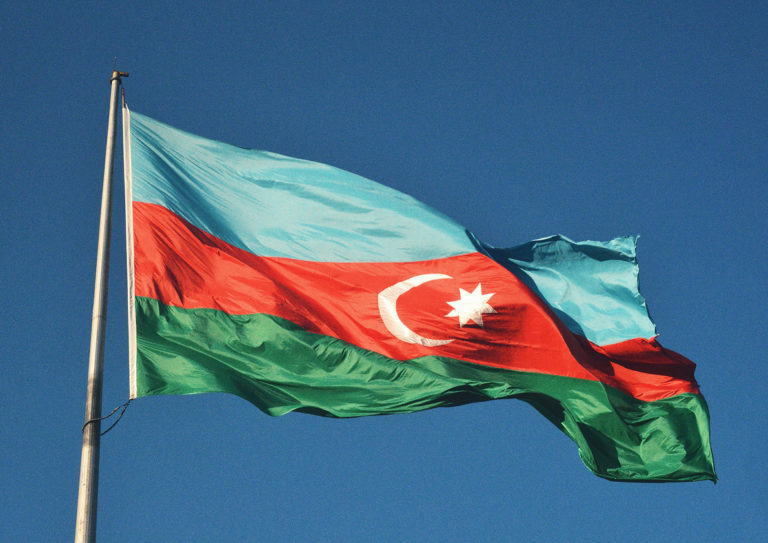
© Hikmat Gafarzada
Azerbaijan’s Updated Relations to Its Neighbours
A relatively small country in the heart of Caucasus, Azerbaijan has been in the spotlight for the past year as historically solid relations between Moscow and Baku unexpectedly seem to be at an all-time low. Since 2022, the relationship had been defined as an "allied cooperation," covering political dialogue, trade, energy, and transport. Tensions rose over the summer, after the deaths of Azeri citizens and brothers Ziyaddin and Huseyn Safarov following a Russian raid on an Azerbaijani enclave in Ekaterinburg in early July. Several Russian citizens of Azerbaijani roots were also arrested on the same occasion, some of whom appeared in court with clear signs of beatings. The episode sparked a spiral of provocations and arrests between the two countries. Relations had already begun to deteriorate back in December 2024, after the crash of Azerbaijan Airlines flight 8243 from Baku to Grozny, which crashed in Kazakhstan after being hit by Russian missiles, according to Baku and later confirmed by Moscow.
On the Western front, on the other hand, Baku’s relations seem to be going much better. After 30 years spent between wars and tensions, especially regarding control over the Nagorno Kharabakh region, which led to the 2018 war, Armenia and Azerbaijan have never been closer. Baku and Yerevan finally reached a peace agreement in August—due, in part, to US mediation. An essential part of the agreement was the so-called “Trump Route for International Peace and Prosperity.” This corridor not only connects Baku to the Azerbaijani exclave of Nakhchivan and then to Turkey, but links up with the infrastructure of the Middle Corridor, the main trade route between the Far East and the Mediterranean, passing through the Caucasus—crossing both Azerbaijan and Armenia. Part of the New Silk Road project, whose investors include the Asian Development Bank, the European Central Bank, and the World Bank, this is also the only realistic alternative for avoiding the transit of goods through and trade with Russia.
Azerbaijan is also playing an increasingly important role in the European supply chain of GLP, after trade with Russia stopped in 2022, with several deals being signed between EU countries (including Germany and Italy) and the State Oil Company of Azerbaijan Republic (SOCAR). This complex picture is transforming both Baku’s relationships with its neighbours and its image abroad—leading to further control from the State, especially regarding the information that is allowed both inside and outside of the country.
Media Freedom at an All-Time Low
In such a delicate picture, the government, led since 2003 by Ilham Aliyev (İlham Əliyev)—who succeeded to his father Heydar—is clearly very concerned about the global circulation of information concerning Azerbaijan. Thus, internal politics doesn’t seem to be going for the best, and this is particularly pertinent in relation to freedom of expression and attacks on the press and media. In 2025, Azerbaijan ranked 167th out of 180 countries in Reporters Without Borders' Press Freedom Index as domestic repression seems to be increasing. At least 25 media workers have been arrested in 2025. Amidst rising tensions with Russia, on June 20th, 2025, the Baku Court of Serious Crimes sentenced seven media workers affiliated with the independent investigative outlet Abzas Media to prison terms ranging from seven and a half to nine years. The—hardly plausible—charges included “currency smuggling,” “money laundering,” “tax evasion,” and forgery of documents. In December 2025, the European Parliament adopted a resolution condemning human rights violations in the country, including activists’ and journalists’ detentions. In this climate, many journalists and outlets are deciding to leave the country and keep working from abroad, often moving to neighbouring countries.
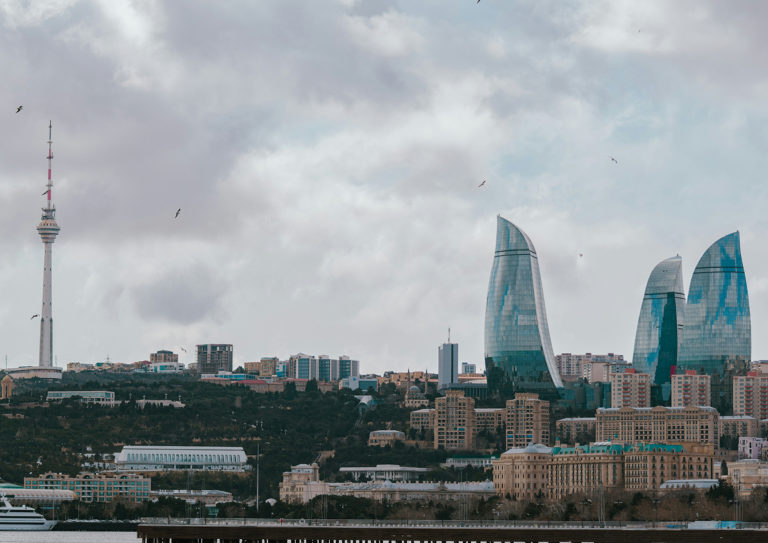
Baku — © Farid Salimov
Aytan Farhadova: An Exile for Her Work
I meet Azerbaijani journalist Aytan Farhadova in Tbilisi, where she has been in exile since 2019. For more than 20 years, Farhadova has been working as an investigative journalist covering the most problematic aspects of her country. Born and raised in Azerbaijan, she is originally from Zangilan, a small town in Nagorno-Karabakh. After fleeing in 2019, she continues her work from Georgia, despite the growing difficulties caused by the media blockade imposed by Baku.
And the situation seems to be getting even worse. Back in July, the Azerbaijani Parliament approved new restrictions. The changes make it even more difficult for journalists to do their job. Not only for independent media, for whom it was already impossible, but also for pro-government media: “Now,” explains Farhadova, “to work in the country, you must be registered in the National Media Register, otherwise you will be fined approximately €2,300. But the requirements have become almost impossible to meet: for example, you must have relationships and regular exchanges of news with at least 20 other publications, and have accredited journalists in at least five other countries. As a result, the media is becoming Aliyev's megaphone.” And of course, being registered also means being monitored.
This happens at a time when investigating critical issue would be crucial, and topics to look at are all but scarce: “There are so many issues to cover right now, from the relocation of internally displaced persons in Nagorno-Karabakh, who have been returning to their villages but whose relations with the press are controlled by the government; the gas issue; or Aliyev's conflicts of interest in at least one of the projects of new resorts on artificial islands in the Caspian Sea.” Yet, it has never been more difficult for journalists to work, resulting in an incredibly homogeneous—and rather boring—media coverage: “even the pro-government media is not allowed to cover most of the topics. In the last month, three times the top headline in all state media has been ‘everyone has received their pension.’ Three times in one month.”
It is not just about topics either, according to Farhadova. “There is also an increased control upon sources. It is becoming more and more difficult to work even from abroad. People are under constant surveillance and afraid to talk to the press. So, there is almost total control of the information coming out of the country too,” she reports.
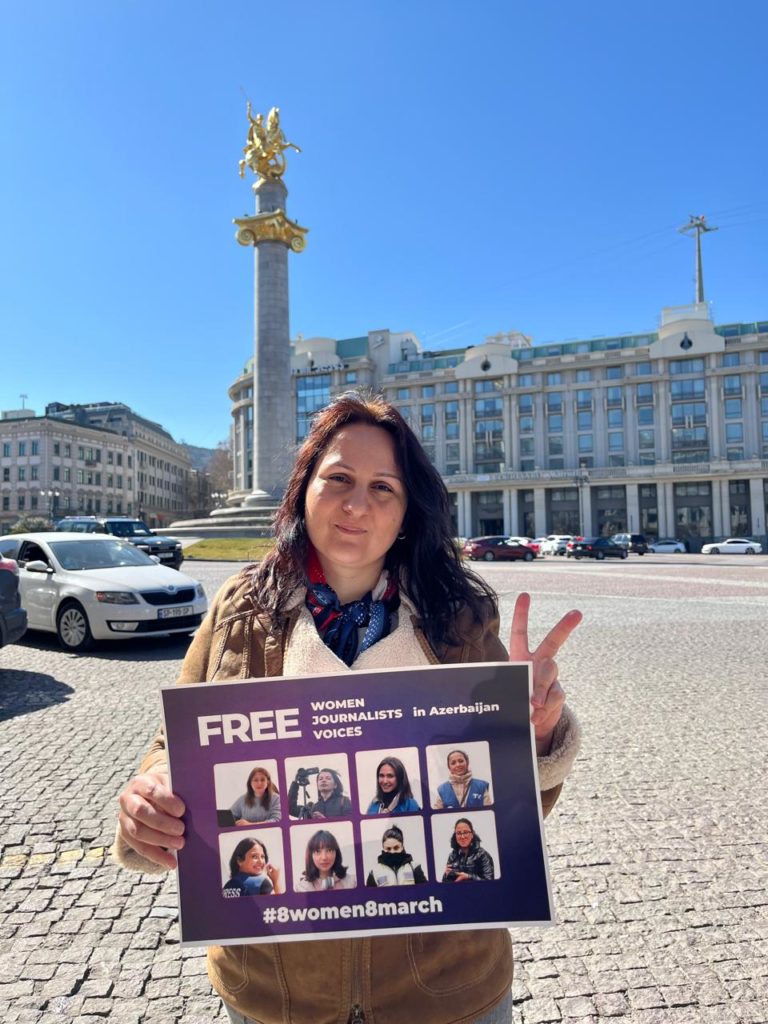
Aytan Farhadova during a protest in Tbilisi, Georgia — © courtesy of Aytan Farhadova
Azerbaijan’s Influence in the Caucasus Region
This situation contributes to an already complex landscape in the Caucasus region as a whole. On the surface, says Farhadova, the Caucasus finally looks more united and ready to cooperate with Europe. Yet, she argues, the crisis between Baku and Moscow could just be a show made at the EU’s benefits, and Aliyev would never really turn his back on Putin or vice versa: “After the crash of flight 8243, Aliyev claimed for months that Putin would apologise, but this never happened. The whole affair seems suspicious, starting with the fact that the media were prevented from contacting survivors and relatives of the victims.
In any case, “we must start from the assumption that Aliyev would never really jeopardise his relationship with Putin.” The connection between Russia and Azerbaijan is solid, she argues, as it is with Turkey, “and the tension seems to me to be engineered for the sake of international relations: Aliyev has everything to gain from a hypothetical feud with Putin. The way I see it, Putin is granting Aliyev greater legitimacy to further oppress his people. At the same time, Aliyev gains a better position vis-à-vis the European Union. The fact is that all this is happening at the expense of the people.”
“I see a sad story repeating itself,” she says, “even what is happening here in Georgia today is what I saw happening ten years ago in Azerbaijan: first the law on NGOs, then the law on the media, restrictions, arrests. The increasing surveillance in Tbilisi has been in place in Azerbaijan for years. And Turkey is taking the same path.”
If this is the case, journalists, activists, and professionals like Farhadova are increasingly becoming the antibodies to a more repressive system—supporting and learning from each other.
Published on January 27th, 2026
About the author:
Matilde Moro is a freelance journalist currently based in Tbilisi, Georgia. She has published reportages from Ukraine, The Occupied West Bank, Albania, The Slovenian-Italian border, the Italian-French border, collaborating with Italian and international publications like Editoriale Domani, L’Espresso, and Unbias The News.