Independent artists, writers, and cultural organisers once nurtured a fragile space of freedom in Belarus, but since the once again rigged 2020 elections they have been recast as “extremists” and “terrorists,” forced into prisons, blacklists, or exile for daring to speak. Five years on, their networks abroad are not only keeping Belarusian culture alive; they are transforming it into a cross-border force that challenges the regime’s repression, preserves memory, and offers resisting Belarusians a different vision of their future.
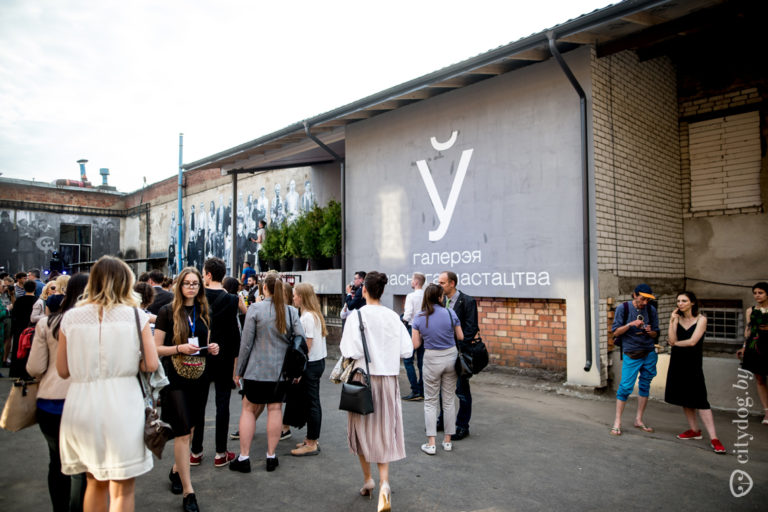
At the opening of the independent contemporary art gallery “Ў” at its new location. Minsk, 2018. The gallery started its work in 2009, and was closed in the autumn of 2020 – © Citydog.by
In the last 5 years, many “terrorists and extremists” have been added to the international wanted lists in Belarus—people whom the Belarusian state considers a threat to stability and national security. A dozen of the Belarusian Council for Culture’s workers are present on this list, while with our daily work, we contribute to the preservation, development, and international support of Belarusian culture in Belarus and abroad.
Аmong the political prisoners, we find 29 journalists and 154 cultural figures.
Until 2020
Until 2020, the state did not consider my peers and I as threats, but rather supported our activities—it taught me at university, master's and postgraduate studies, paid me a salary as a cultural journalist in a state-run newsroom, and was not against my international travels on scientific and journalistic matters. It was quite normal to work in state media, but also to publish under your own name in independent ones. Looking ahead a little, today you could go to prison even for a public agreement with a non-state media outlet.
Then, Alyaxandr Lukashenka[1]’s regime pretended to be friends of the West; in exchange for economic “buns,”[2] it expressed loyalty to democratic changes in permitted areas, forms, and formats, allowing civil society to form and develop, and cultural figures to feel like actors on a European scale. In the 2010s, world-famous artists came to Minsk one after another, independent art galleries opened, and private publishing houses began printing books in Belarusian. Belarusian artists also participated in European art biennales. At the Minsk Book Fair, huge stands were set up by Germany, France, the USA, and Great Britain, and even state-owned Belarusian publishers travelled to fairs in Vilnius, Frankfurt, and Paris. We had our own independent crowdfunding platforms molamola.by and ulej.by where money was raised for cultural projects, while independent cultural centres and private music clubs existed.
People sometimes ask me if I understood that I was living under a dictatorship.
Of course I did, because against the backdrop of this conditional flourishing of independent culture in Belarus, there have always been semi-official “black lists” of writers and musicians, and dozens of political prisoners appeared after each presidential election. But then it seemed that if you don’t meddle in state affairs, then the state won’t meddle in your life either. And your small but very well-groomed flowerbed of independent culture will flourish.
But 2020 has shown how fragile and imaginary this “agreement” was and how terrible revenge awaits anyone who encroaches on the most sacred thing in Belarus—the change of power.
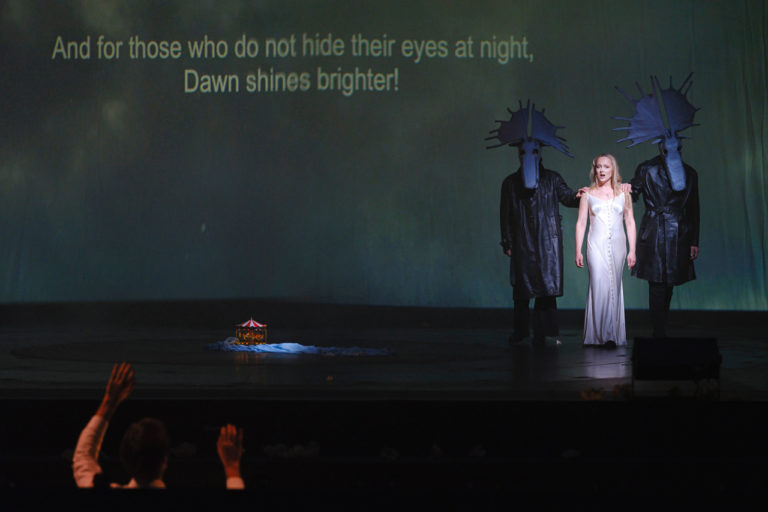
A scene from the opera “The King Stakh’s Wild Hunt”, based on the novel by the classic Belarusian writer Uladzimir Karatkevich, staged by the Belarus Free Theatre (London, Barbican, September 2023) – © Linda Nylind
2020 and Its Aftermath
After the 2020 presidential elections, which were once again clearly rigged, a powerful wave of protests rose. They lasted for more than 4 months. Every weekend, tens and hundreds of thousands of Belarusians took the streets, serving as a strong signal of the people's disagreement with the absurd actions of the authorities. In response to the protests, bloody and brutal repressions began. So strong that the repressive machine has still not stopped today.
But what is the role of culture within the protests?
Cultural figures picked up the protest wave and began to turn the marches into carnivals. Music, posters, unexpected and creative carnival costumes, songs, and slogans. Going out to protest almost meant coming to a festival or holiday. The almost folk song "Kupalinka" became a protest song, and Viktor Tsoi's "Peremen", performed with the bagpipes, turned into an anthem of Belarusian freedom. Belarusians gathered for yard concerts, threw parties—the country was literally buzzing.
The violent repression against protesters (police beatings, terrible prison conditions, unfair trials) didn’t go unnoticed, and cultural figures wrote and signed an open letter against this state violence.
However, one news after another, we saw independent media outlets being destroyed and shut down. Artist Roman Bandarenka, who entered into an open confrontation with security forces in the yard of his house, was killed. Arrests and searches were being carried out on those who participated in the protests and were involved in the election campaign. Entire theatre groups were being fired. Step by step, the infrastructure of independent culture was destroyed, and artists were forced to flee or remain in Belarus under a daily storm of imprisonment. Everyone who expressed disagreement with the authorities, violating the “agreement,” must pay for disobedience in the eyes of the Belarusian state.
It didn’t happen in one day. This was a gradual purge. The power came to literally everyone, and still can. You can wait and hope that fate will pass you by, you can go underground, or you can literally pack 2 backpacks and leave the house. My husband and I did the latter.
In the aftermath of 2020, we became birds without nests—“Birds without nests” is one of the characteristic metaphors of Belarusian literature. At least 220 independent cultural organisations have been liquidated in Belarus; they are gradually moving abroad and are already starting their activities in Poland, Lithuania, Estonia, Ukraine, Germany, and Georgia.
Solidarity with repressed creators is still strong, collections on crowdfunding platforms are working well, and Belarus is receiving attention on the international stage.
In the fall of 2020, the Belarusian Council for Culture was also created, at that time, it was called the Belarusian Fund for Cultural Solidarity and worked as the team of emergency help (financial and consulting) for those who were repressed and were looking for a new life abroad.
This is a time when everyone wants to believe that emigration will be short. That the repressions will soon end, that we will soon return to Belarus, return to our places. Some people believed that the regime didn’t have much time left. Any moment now—we would push a little harder, and Lukashenka would step down. Others hoped that the repressions would soon come to an end (as had happened in 2006, 2010, and 2015), that the arrests would turn into a show for a single spectator, and that most political prisoners would be released without having to serve their enormous sentences in full.
But in February 2022, with the full scale invasion of Ukraine, we acquired a new layer of identity—we became “co-aggressors.” We were recorded as allies of the regime, after which we entered the fight even more fiercely in order to distinguish ourselves more clearly from official Belarus and the Russians. Both among Belarusians in exile and among those who remained in Belarus, a strong wave of solidarity with Ukraine arose after February 2022. In Belarus, people were harshly punished for supporting Ukraine and received yet other long prison sentences. It is worth mentioning the anti-war project Belarusian Hajun and the case of the “railway partisans.”
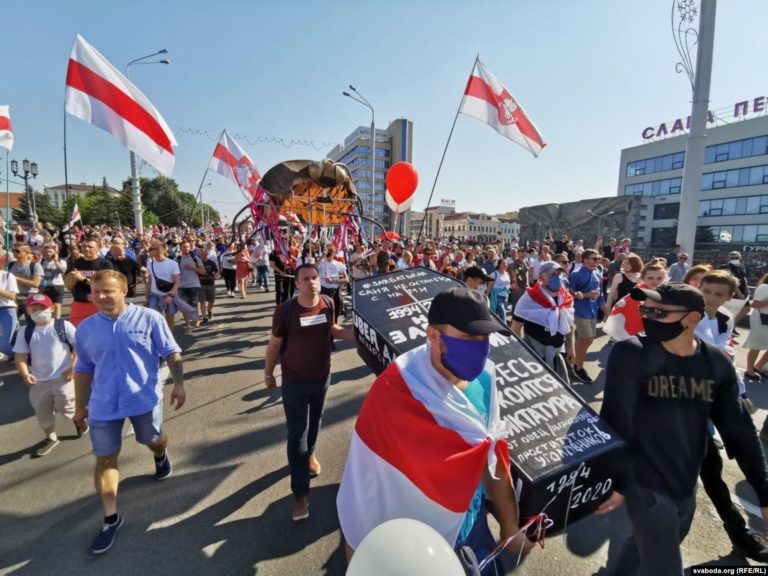
To the march that took place on Alyaxandr Lukashenka’s birthday, protesters brought “presents” – a coffin for the dictatorship and a large cockroach figure (cockroach is one of the popular nicknames for the Belarusian president). Minsk, August 30th, 2020 – © Radio Free Europe / Radio Liberty (svaboda.org)
Five Years After the Protests
A few years later, we realised that we needed our own infrastructure of independent culture—and began to create it. Today, we have the Belarusian Institute of Theatre (bringing together actors and directors), the Independent Belarusian Film Academy (uniting film professionals), the Belarusian Book Institute, photography communities, and the Museum Laboratory (for specialists in museum studies). All of these organisations operate abroad. One of our most important goals is to preserve the connection with Belarus, which is why many of our projects are, in fact, cross-border.
We have a forum of cultural organisations and are developing models of alternative financing of culture. We have our own publishing houses and bookstores in many European cities, we organise festivals here, and have our own meeting places.
We have international success, we enter international networks, and make new contacts. We have a large European programme, ArtPower Belarus, which supports Belarusian culture. The programme has a budget in the millions of euros, thanks to the European Union. We are developing, making our voice stronger, and hoping to take an even more important place.And we have not forgotten the abuser from whom we escaped. After all, even today, more than a hundred and a half cultural figures are behind bars in Belarus. Among them is Nobel Peace Prize laureate Ales Bialiatski. We still receive news about deaths and illnesses in prison. Among the deceased is performer Ales Pushkin. According to human rights activists, 1,900 Belarusian cultural figures went through politically motivated persecution from 2020 to 2024. In total, more than 100,000 cases of repression have been recorded in Belarus.
Books continue to be banned (today the list includes 258 publications, some of which we once studied at school in literature lessons), and the list of extremist materials (where you can find the Belarusian Council for Culture’s website and social networks) is a doc file of almost 2,000 pages. Belarusian national symbols and evidence of Belarus' European heritage are being systematically removed from the public sphere and the education system. Instead, we see militarisation, a connection with Lukashenka and the 'Russian world', and all the consequences that entails.
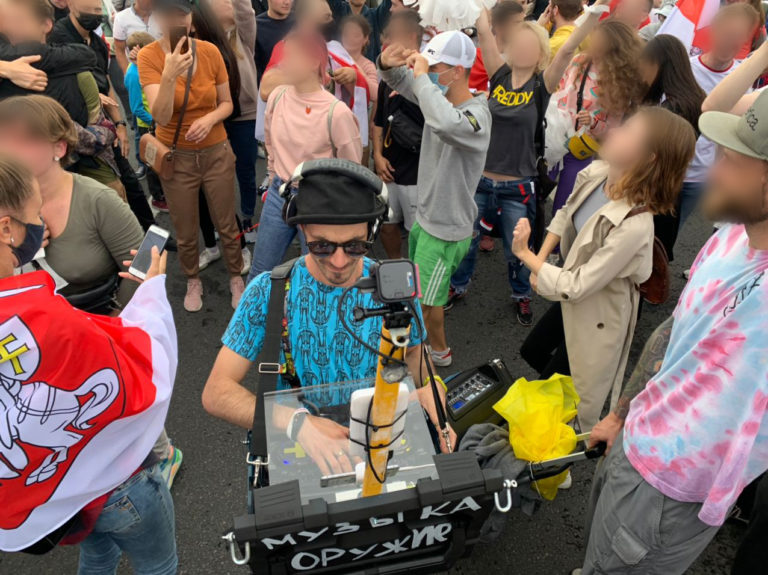
DJ Papa Bo Selektah and his homemade mobile disco machine during the protest march and the #music_is_a_weapon action in Minsk, August 2020 – © DJ Papa Bo Selektah Archive
Returning to the new Belarusian extremists and terrorists; Where did these long lists come from, and what was the reason for their inclusion in the criminal register?
The answer is simple: These are all the people that the state once raised and kept on a leash, either long or short. They were convenient because they were silent, but they turned into enemies. This is because they started speaking out and wanted to be taken seriously.
///
P.S.: I have not seen my relatives for more than 4 years. I have never seen my niece, who was born in the summer of 2021, 2 weeks after we left Belarus. More than anything in the world, I want to swim in my native lake, in my grandmother's village.
My parents do not know where I work and what exactly I do. The official version is “writing about Belarusian culture” for the media.
For being a “member of an extremist formation” and literally creating “extremist materials” every day, I face up to 12 years in prison in Belarus.
The parents and relatives of my colleagues from the “internationally wanted criminals” lists are periodically visited by the police.
My parents don’t ask many questions, probably because deep down they know the answer. Because it simply can’t be otherwise.
Now you understand why I’m publishing this text anonymously.
References
[1] Alyaxandr Lukashenka is the current president of Belarus, and has been since 1994.
[2] Among the key benefits, I would highlight trade and access for major Belarusian enterprises to the European market (this primarily concerns Russian oil refined in Belarus and potash fertilizers, which are among the country’s main raw-material resources), access to international financial instruments (IMF loans and EU assistance aimed at modernising logistics infrastructure and border checkpoints), and investments in the IT sector (Belarus’s Hi-Tech Park offered tax incentives for foreign investors and favourable conditions for the work and development of Belarusian IT specialists).
Belarusian Council for Culture, Key Actors of Independent Belarusian Culture: on the Border of Space and Time, Baseline research report 2023
Belarusian Council for Culture, State Policy on the Destruction of the National Memory of Belarusians (2020–2024), spring 2025
Belarus Banned Books (project by Belarusian PEN)
Monitoring and chronicle of human rights violations in the sphere of culture (Belarusian PEN)
Published on December 2nd, 2025