

Author: Nora Balkanyi
We summarise a dozen expert opinions—editors, journalists, reporters, media researchers, and political scientists, both in leadership positions and working on the ground—following the Hungarian elections that resulted in the downfall of Viktor Orbán's government. After a decade and a half of democratic backsliding and political pressure, how do they view their situation?
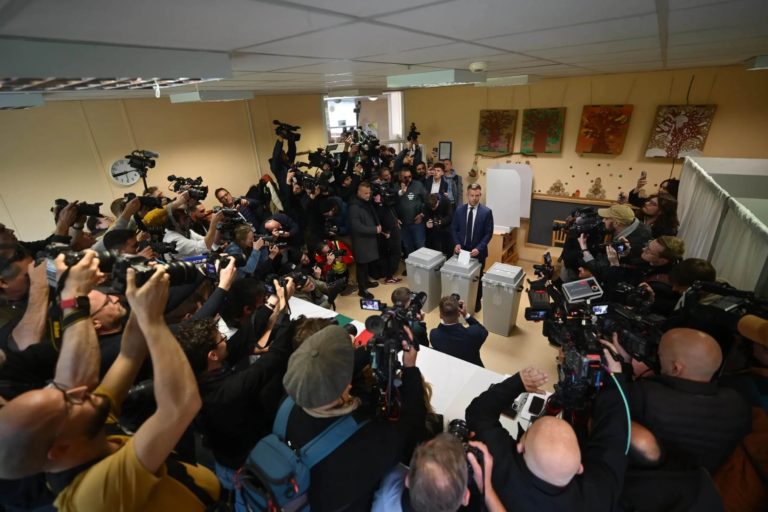
Péter Magyar votes on the 12th of April — © Péter Magyar / Facebook
“It's as if we had learned to dive at a depth of 100 metres, only to find ourselves suddenly brought back to the surface. Sure, normal life happens there, but we had adapted to the pressure of the deep. That causes serious disorientation.”
The editor-in-chief of HVG, one of Hungary’s oldest print and online independent outlets, used this image when asked about journalistic identity at an event held on the 10th of June by Mediaforum[1]. After years spent being forced into the role of “opposition” and perceived enemy, as the fresh Parliament debates a new media law[2] and Fidesz mouthpieces collapse one after another, the Hungarian press is witnessing historical time, learning how to operate within a new political reality.
You Have To Live Here To Believe It
Only a few months have passed since the April 12th elections, in which a relatively new opposition party, Tisza, led by Péter Magyar—a former Orbán ally and the ex-husband of Hungary’s former justice minister—won a landslide victory over Viktor Orbán’s party, Fidesz. Many previously attacked or occupied professions are now trying to process what has happened and chart a path forward. The independent media is no exception: opinion pieces, comments, interviews, podcasts, and professional forums have proliferated as journalists navigate through the transition. The ongoing discussions and debates among media workers voice anger, hope, exhaustion, uncertainty, cynicism, relief and pride simultaneously.
“You have to live here to believe it.” What began as the slogan of a national tourism branding campaign years ago, became a bittersweet saying among circles critical of the Orbán regime. At a professional event some years ago, I listened to a well-known professor of media law describe how colleagues struggled to understand Hungary’s situation at international conferences: the Orbán era distorted the media market to a degree for which there is virtually no European precedent. To quote Zsombor Pál, a senior editor at news portal 24.hu, alongside the denying or significantly hindering access to relevant data and decision-makers, one of the greatest obstacles to real journalism was “the government’s advertising spending practices,” as it “poured money into media outlets it favoured and controlled—and only into those—, unconstrained by any considerations of efficiency, audience reach, or market logic.”
Without open censorship, the regime used economic, legal, bureaucratic, and sometimes outright unlawful means to discredit and silence independent media, while its own propaganda roared through hundreds of outlets. Its messages were repeated across every available old and new media channel. From billboards through tabloids and television news broadcasts or influencer campaigns to—until it was possible—paid ads tailored for social media[3].
Orbán, as any other good populist, believes that agenda-free journalism does not exist, nor do impartial media outlets. Anyone who exercised criticism was labeled “opposition” (or “fake news).” The notion, however, that journalism exists primarily as a tool for exercising power predates Orbán, but has become even more deeply entrenched in Hungarian public discourse after sixteen years of relentless propaganda.
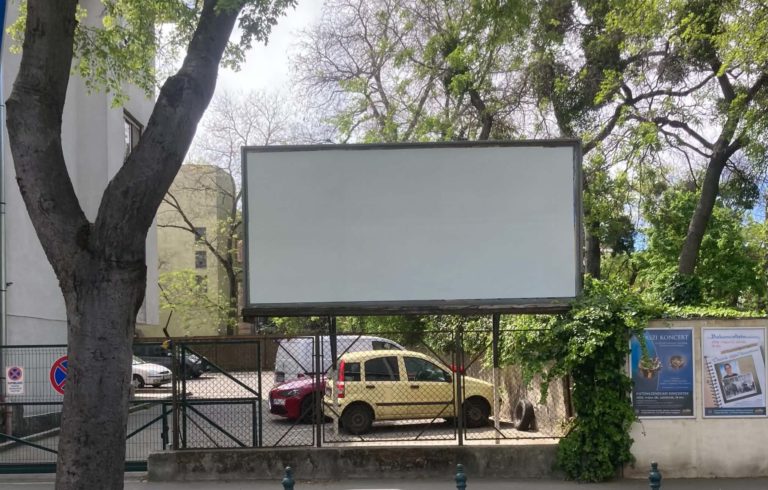
An empty billboard in Budapest after the general elections in April 2026 — © Nora Balkanyi
Back To The Public
In Hungary, after the soviet regime’s fall back in 1989, public media always had connections with the leading party, but Orbán’s system operated at a whole new level. Until the very last period, the flagship news programme of Hungary’s public broadcaster warned viewers that a Fidesz defeat would bring war from neighbouring country Ukraine, with Tisza sending Hungarian men to their deaths. The whole public media system, which solely in the first half of 2025 operated on a 80,3 billion forints public money budget (around 227 million euros), was widely regarded on the opposition side as a really bad joke. Meanwhile the country didn’t have its own Ministry for Education or Health.
Understandably, the future of a state-owned public media service thus became one of the most hotly debated issues. When the question comes up at Mediaforum’s event, the editor-in-chief of 444.hu—whose outlets and person had been among the primary targets of the previous government’s attacks—responds with frustration. “We’ve tried this nonsense many times before. Why do we think it’s going to work now? From day one, people will start stealing again—the little stool, the curtains, whatever. We don’t need to spend billions in public money maintaining these large structures, especially not when the country’s economy is in the state it’s in.”
Others, including some who previously worked in public broadcasting, can imagine a new model: a decentralised system that may cooperate with independent outlets and is designed around the needs of the twenty-first century. Such editorials could genuinely focus on informing the public while producing valuable content that cannot survive on market logic alone. At any rate, the new Tisza government has promised—according to its own formulation—to “give public media back to the public.” It is still debated whether the new media law will suffice.
“It is important to remember that even exemplary media regulation on paper does not guarantee media pluralism or freedom of the press in practice,” says Eszter Neuberger, a media journalist at Lakmusz.hu, when asked about the broader framework established by the 2024 European Media Freedom Act.
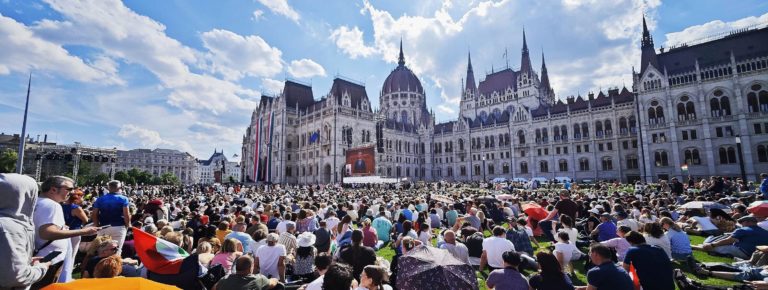
Celebration of the new government, the Hungarian Parliament — © Péter Magyar / Facebook
Cogs in the Machine
Another recurring question when talking about public media is: how journalists should relate to the former workers of propaganda outlets? Waves of layoffs are sweeping through the whole sector that had been sustained and used by the previous regime. For independent media professionals, it is close to impossible to imagine that the former employees of these media would now simply begin behaving as journalists. There were so many editorials used by Fidesz, with thousands of workers varying from hardcore Orbán enthusiasts who attacked independents aggressively to nameless working bees: what exactly counts as collaboration, where should the boundaries be drawn?
One contested issue is whether distinctions should be made between e.g. lighting technicians and decision-making editors, or between entertainment and hard content. As Zsombor Pál put it, “I try not to relate to them. Being a cog in the propaganda machine is an entirely different profession. I’m more forgiving toward editors of cooking shows than news editors though.” At Mediaforum’s event, a participant who had previously worked for a state-owned classical music radio station (Bartók) repeatedly argued that not all branches of public media should be treated alike.
All journalists we listened to or asked gave an unequivocal “no” when asked whether future cooperation was conceivable. “The seed of the thought hasn’t even crossed my mind.” “First, we would need to agree on the most basic professional principles.” “Without an apology, it’s going to be difficult.” “If someone has already thrown the profession to the trash for money once, I see no guarantee that they won’t do it again.” “I draw a line. They should face the consequences for what they did to this beautiful profession.” “ When it becomes impossible to work within professional journalistic standards, you can go and do something else—there’s always a choice.”
As government influence advanced over the years, large numbers of journalists left outlets often at considerable personal and financial risk. Some found positions at other independent organisations, some launched new outlets against all odds that have since become successful, while others left the profession altogether.
“Brand Erosion”
The current flux is reflected in the efforts of media owners linked to the fallen regime to rescue and rehabilitate certain propaganda outlets. One of the country’s main commercial television news programmes (TV2 Tények) sacked former anchors and the news director—all well known Orbán supporters—because of, as they put it: “brand erosion” and “the ongoing revitalisation of infotainment programmes.” This is the same programme whose presenters pushed propaganda so ridiculously that many of its broadcasts became raw material for memes.
Some we talk to reasonably expect that a newly formed free market would help cleanse the landscape and these kinds of “rebrandings” will be failed attempts. At this point, financially sound international owners are gone, and big advertisers could decide either way. We still have to wait and see.
Another good example describing this part of the former media landscape is the cry for help. Alongside Fidesz politicians, some openly argue that the formerly pro-government outlets—presented as right-wing, patriotic, or conservative—now collapsing without the state support should be financed by the country's “national bourgeoisie” (despite the fact that this elite amassed their wealth through systemic corruption). So far, it doesn't seem that this will happen though.
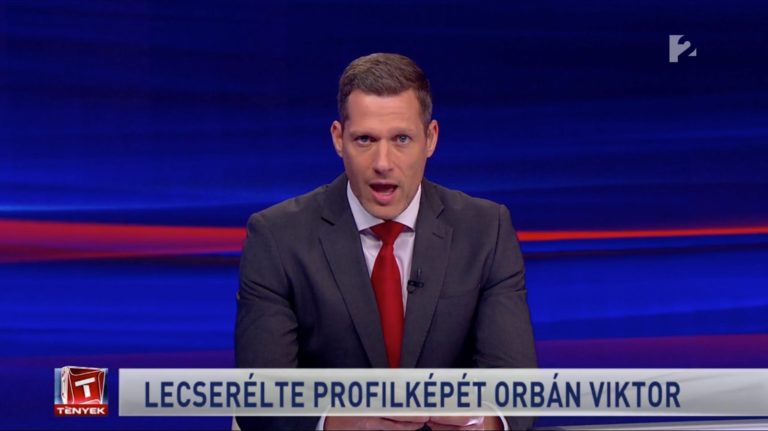
Former news anchor breaking the news that Viktor Orbán changed his profile picture on Facebook — © Last Days of Tények / Facebook
A Democracy Project
“In theory, we are now witnessing the best of all the plausible scenarios we held onto while persevering in this profession: a government with a strong mandate promising to put the furniture back where it belongs in democracy’s living room,” says Zsombor Pál. He also adds that this still is a limited market, facing global challenges. Another journalist, Zsolt Sarkadi from news portal Telex.hu, who previously escaped an occupied editorial makes the same point: “News organisations must continue to compete with Google and Facebook for advertising revenue—and will likely soon have to contend with AI companies as well. In this struggle, even a newsroom the size of The New York Times does not have particularly favorable odds, let alone us.”
One positive consequence of the past sixteen years is that independents have been forced to innovate to stay alive: in terms of creativity—shaped by the mentioned global challenges, the dominance of the video format, politicians creating their own media channels, or emerging new media players such as news influencers—and in means of operation as well. Today, Hungarian editorials work with a variety of models: subscription-based (paywalled), reader-supported (free to access), or hybrid approaches, some as for-profit firms set out to compete on the market, others as smaller non-profits with no ad revenue.
This diversity can also generate tensions, different models come with different tax obligations and funding opportunities. At the same time, a national news portal with a big newsroom and newly designed video studios inevitably faces different strategic considerations than small local press organisations or investigative journalist crews exploring crime. “Until 2026, quality journalism functioned as a kind of ‘democracy project’—a cause worthy of support, an act of solidarity,” says editor-in-chief Gergő Zsiborás from Forbes Hungary. “The critical mindset of the independent press remains intact, but in the absence of ‘oppression,’ it now has to reposition itself as a product that people are willing to pay for.”
When asked whether the independents will have to compete harder now against each other for supporters or subscribers, most answered that they need to do really good work, as readers reward that. They must move beyond the “surrogate opposition” role, communicate effectively about how the press works, what independence means, and continue investigating both the former regime and the new one. At the same time, most do expect a significant restructuring and a possible decline in reader support, further challenging editorials.
The new prime minister’s constant, overwhelming, and talented use of social media together with his communication skills only adds to the labour. “News organisations will have to innovate if they want to move beyond operating primarily in a reactive mode. It may sound strange after all these years, but in some respects the media has grown comfortable. More often than not, it was enough to say: ‘We are fighting Fidesz’,” a well known senior editor now running a journalism teaching programme, Zsófia Mészáros from Pelikán Projekt, tells us.
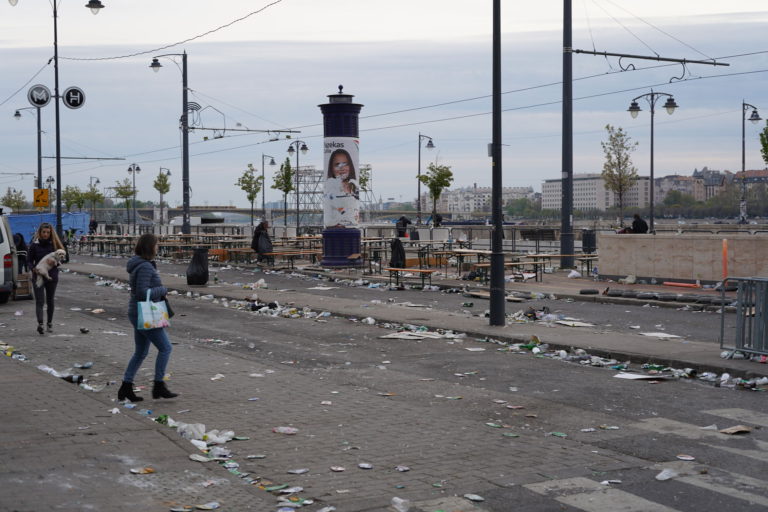
The day after the general elections in the streets of Budapest with a damaged Fidesz campaign poster — © Wikimedia Commons
New Environment, Old Role
“I have only ever known the Orbán era as a journalist. I do not know what it feels like to be free; I only know the struggle for freedom,” Noémi Martini from HVG representing Generation Z tells me when asked about her role. “When a system that has oppressed us collapses before our eyes, it suddenly becomes difficult to define ourselves. This sudden freedom feels overwhelming. At the same time, my role as a journalist has not changed. Just as before, my job is to watch those in power and ask questions. To provide resistance when necessary, and to remain critical.”
It was an article and an interview made by attacked independents that marked the emergence of Péter Magyar—by 444.hu and Partizán. The need for diverse quality journalism in democratic societies is evident. The question is whether there will be enough intention, proper legal structures, and an economy to sustain it.
References
[1] Association of independent Hungarian media outlets.
[2] The proposal on reforming the media law was submitted by representatives of the Tisza Party on June 12th, 2026.
[3] For those interested in a deeper account of what has come to an end, the February report The Repression of Independent Media in Hungary, 2010–2025 offers a detailed overview of fifteen years of developments (The study was jointly prepared by the Rule of Law Lab at New York University School of Law and the Hungarian Mérték Media Monitor.)
Thank you to the following contributors to this article: Noémi Martini (HVG), Zsófia Mészáros (Pelikán Projekt), Dániel Mikecz (TK Centre for Social Sciences), Eszter Neuberger (Lakmusz.hu), Zsombor Pál (24.hu), Gergő Zsiborás (Forbes Hungary), Zsolt Sarkadi (Telex).
Other quotes are from an event held on the 10th of June by Mediaforum Association of independent Hungarian media outlets.
The quotes have been edited for clarity.
Published on July 7th, 2026
About the author:
Nora Balkanyi is a journalist based in Budapest, covering creative industry, media, and culture; currently freelancing as an editor at hvg.hu, media literacy trainer; volunteer in JazzaJ hub for improvisational music since 2015. Some of the people quoted in this article are her current or former colleagues.
