

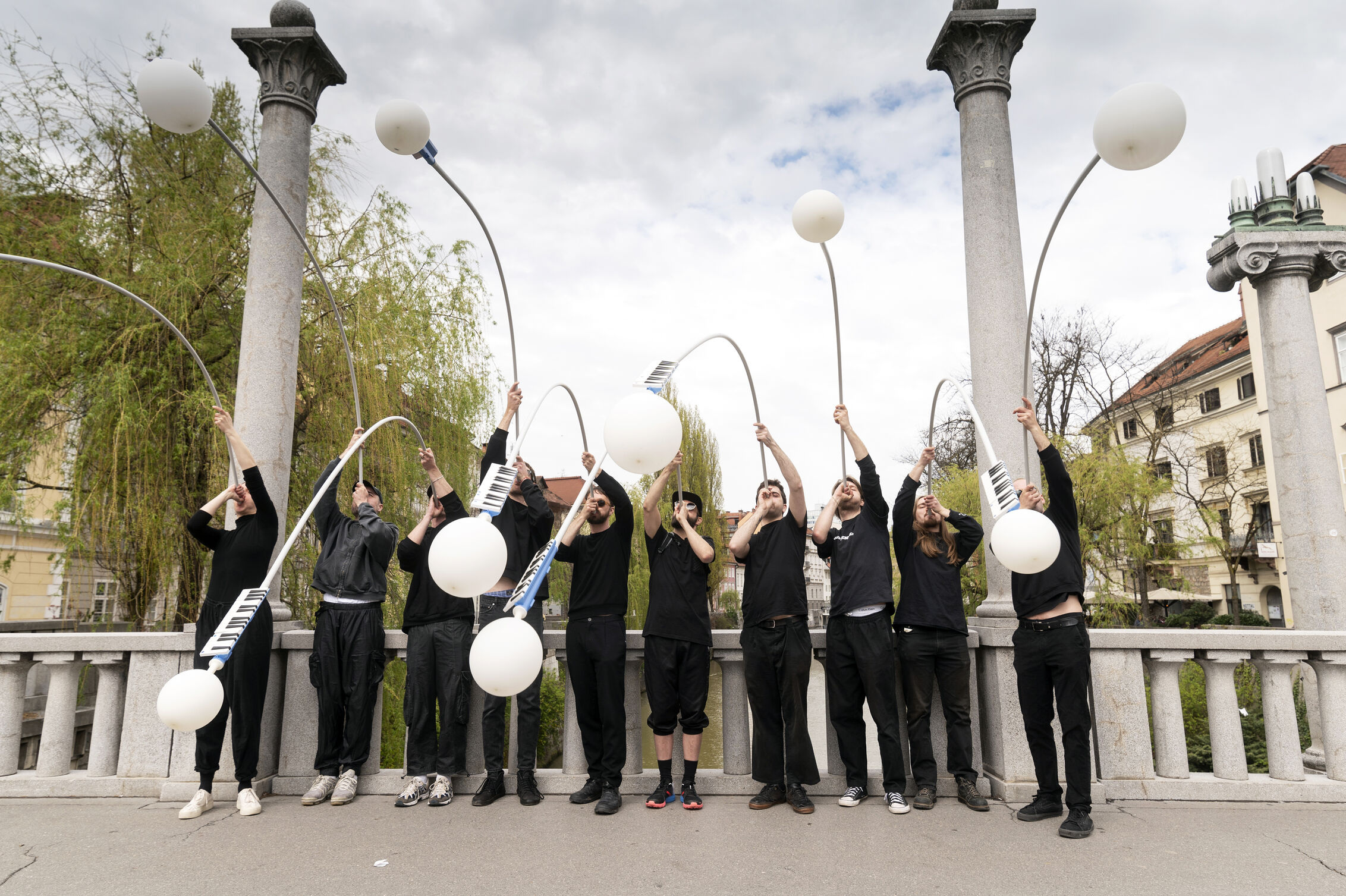
Author: ALMARE
This series of interviews is conceived and curated by ALMARE, an organisation based in Turin dedicated to contemporary practices that use sound as an expressive medium. ALMARE works at the intersection of music and art through the conception and production of events, new commissions, and educational programmes that contribute to a broader critical reflection on the present.
The aim of this series is to provide a glimpse of the diversity of models and practices Reset! members and like-minded independent cultural organisations adopt to sustain ambitious cultural programming in complex and precarious contexts, with a particular focus on the relationship between curatorial practices, sustainability, and organisational models. These interviews have previously appeared in Italian in the journal of cheFare as part of the project Next Generation You 2023 (NGY) promoted by Fondazione Compagnia di San Paolo.
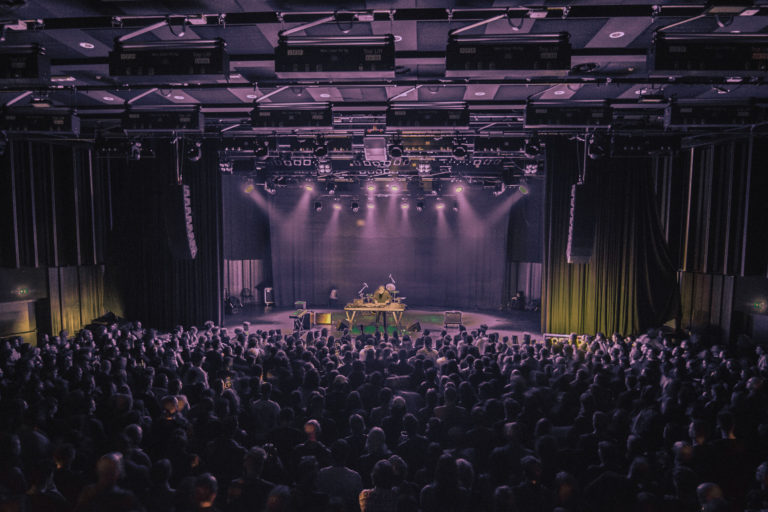
© Marcel Obal
It's a gray October Monday afternoon in Ljubljana. We are in the Slovenian capital for Suzanne Ciani’s concert, part of the off-programme of the Sonica festival. Truth be told, we came here driven by our interest to peep into the festival’s inner workings and, most importantly, get to know the people animating Sonica, their desires and fears, as well as shed some light on the enigmatic non-profit association behind it all: MoTA - Museum of Transitory Art.
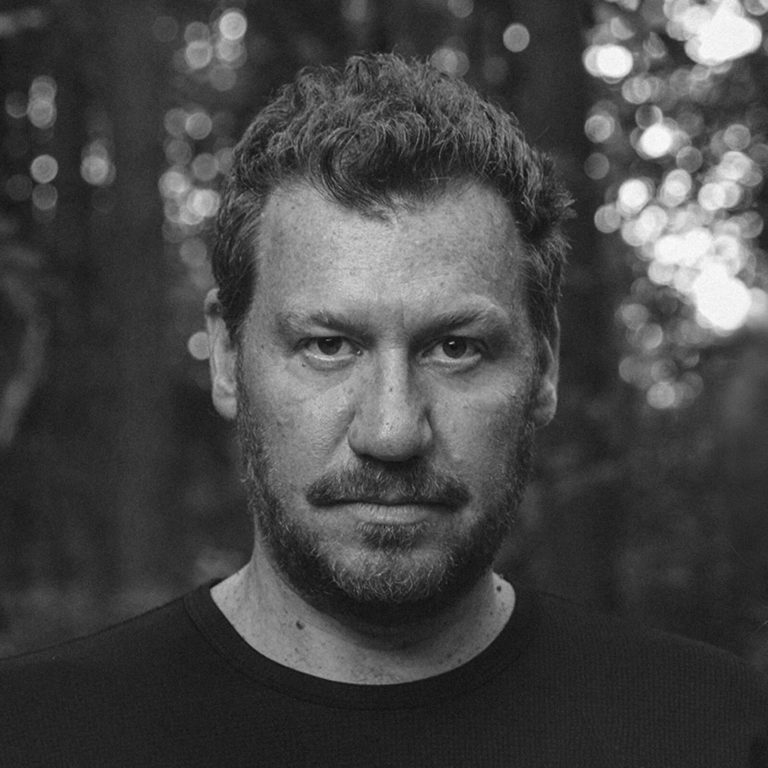
We meet MoTA's founder Martin Bricelj Baraga at Kino Šiška, one of Slovenia's first modernist buildings, an elegant Soviet movie theatre converted into a full-fledged cultural centre in 1994. While we settle on the foyer sofas, it doesn't take Martin long to fill the room with his resounding laughter. Right from the start, Martin gives us the impression of a warm-hearted guy, who takes his job very seriously. We started by talking about Sonica, which reached its seventeenth edition in April.
ALMARE: Can you tell us about the beginnings of Sonica?
Martin Bricelj Baraga: It all goes back to the late nineties, to the first steps I took to turn my many passions into reality. I'm a visual artist—that's the field I come from. I had just founded a studio called CodeSign, where we worked in art and design, but we were also very passionate about electronic music. At that time, several electronic music festivals had just been born, Sónar being one example. But around here, in Ljubljana, there were mostly just house and techno parties. There was drum and bass too, of course, but we didn't like that much. We felt that if we didn't organize a festival ourselves, there wouldn’t be anything that would be interesting for us. So we started organising events. But they weren't just parties—they were real events, each with its own curatorial concept. Those parties were the first seeds that would later grow into Festival pomladi and then Sonica.
© Igor Bijuklić
ALMARE: The integration of the two languages of visual arts and music — now taken for granted and showcased in hundreds of festivals worldwide — was a hallmark of that era... How did the parties evolve into a festival, and how did the festival preserve its multimedia lineage?
MBB: It all happened very fast. Our previous festival was Festival Pomladi (Spring Festival), an open-air event that started in Tivoli City Park and ran for eight or nine years, occupying several public spaces around the city—we even made it onto the main road in the centre of Ljubljana. Eventually we were reaching 5,000 admissions, yet we had no interest in selling beer or taking a commercial approach. During the Festival Pomladi years we hosted interesting AV artists like DJ Yoda and Plaid from Warp Records—there was strong interest at the time in breakbeat and other less represented genres.
The festival's artistic direction was still fairly "popular," attracting wide audiences, but I was drawn to more experimental forms, so we gradually began adding art forms that moved in that direction. SONICA was born out of this need. Even though it was originally conceived as an exhibition, we called it a "festival" because that was the only way to receive support—in reality it was closer to an exhibition, a laboratory. In the space we had at the time, we hosted ten media art installations, some of which we commissioned ourselves (Felix's Machines). We opened the first SONICA with artists like Tim Hecker and Byetone, alongside all the installations inhabiting the same space.
Back in 2008 or 2009, that kind of research was a novelty—it felt abstract, almost unthinkable. That was when our organisation underwent a total transformation: new name (MoTA), new programme, new team. We also launched our first residency programme. In short, we kept adding elements, always asking ourselves: "What's missing?"
ALMARE: Speaking of things that are missing: let's talk about the fundamental question—funding. What was the economy of the early editions of the festival?
MBB: The first edition of Sonica ran on a budget of only €1,500! And in the beginning of Festival Pomladi we relied on many friends who played for free; other bands also came for very little... I remember a friend lent us a huge sound system for only 250€. A few years later we installed a much bigger system, and the festival started to gain attraction—but at its peak, we actually lost the support of the City. And we were organising a free festival for the city! It was only a few years later, once we started bringing in artists with bigger fees, like Clark and Nôze—a now-forgotten French duo—that we had to introduce an entrance ticket.
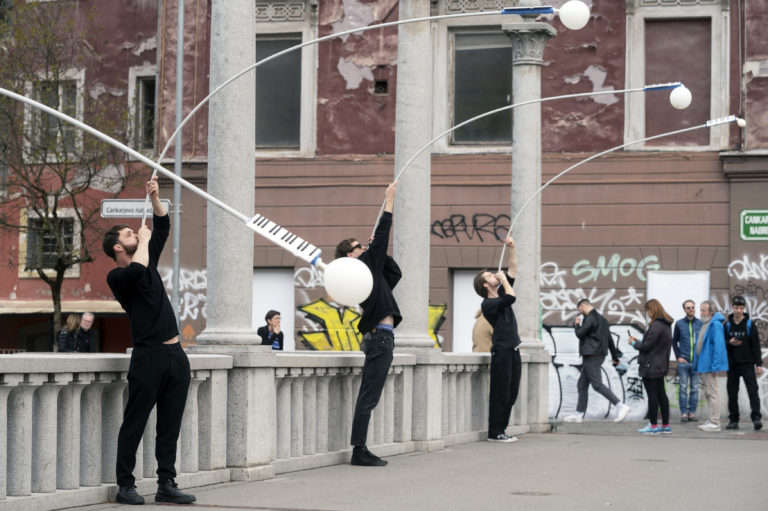
© Katja Goljat
ALMARE: Soon before Sonica was born, Festival Pomladi was the first free festival in Ljubljana to offer a high-level open air experience in the city park, but the City discontinued its support. Why wasn’t the City interested in what you were doing?
MBB: The fact that the City of Ljubljana wasn't interested struck me. You know how it works, right? You do it because you want to, not for the money. You do it for yourself and for the community—for the city too. That's when we started trying to expand our boundaries, to focus on internationalisation of our activities and projects.
ALMARE: So is it from this need that T.R.I.B.E. was born? Can you tell us about T.R.I.B.E. and your other networks?
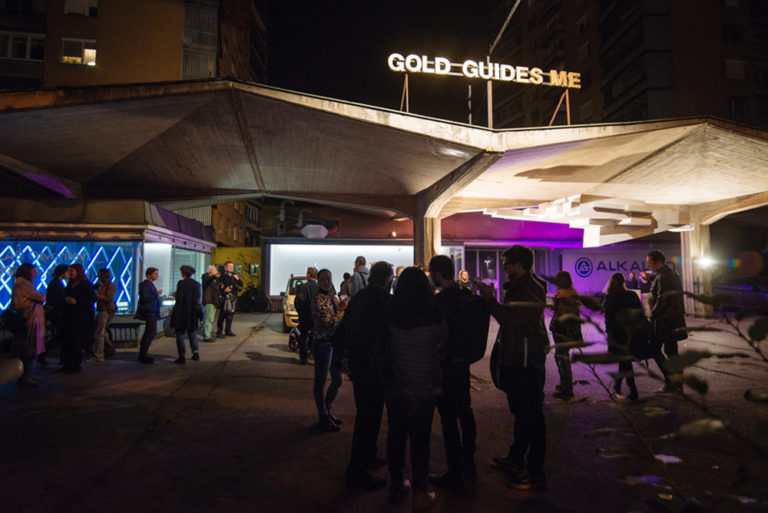
MBB: As I said, I'm an artist, art is an international language, and Ljubljana is a small city. I've always traveled abroad for my work, and T.R.I.B.E. was born from that same need. It was a platform created to connect media labs and artist residency spaces across Eastern Europe and the Balkans—a network that encourages exchange between artists and countries that used to be connected but aren’t so much anymore—T.R.I.B.E. stands for Transitory research initiative for Balkan and East. Nonument, another project in MoTA's orbit, also started as a network of creative individuals, artists, architects, art historians and cultural activists. It's a special project dedicated to “ruined, forgotten, destroyed, or abandoned building heritage.” The awareness and desire to grow something bigger has always defined our projects.
© Katja Goljat
ALMARE: So, a quick recap: from design and visual arts to research-based music, from parties to festivals, even a museum. Now MoTA is also involved in European networks like SHAPE+ and ICAS (International Cities for Advanced Sound). But let’s go back to Ljubljana: what are the relationships between the City and MoTA today, and what are the new complications you face, economically and bureaucratically?
MBB: In a few days we're going to receive the results of our application for funding from the Ministry of Culture for our new four-year programme. But what I'd say is that the biggest challenge today is actually overproduction. The entire system is designed in such a way that each project is evaluated through its own scoring system, through a checklist… like we're back in school. It has to meet so, so many criteria. I understand that qualitative and quantitative measures are necessary, but it's becoming too much! At the European and national level, but also at the City level, bureaucracy could surely be simplified. Let's be clear: we're lucky. In Slovenia, we still have a socialist heritage of public support for the arts. In this very building there are 20 organisers, 130 organisations that are actually supported by the Municipality, the State, and so on. It's fantastic, but I think the entire system is designed in such a way that the independent cultural sector has to work within an overproductive framework. If you run a larger-scale festival, you must have a certain number of people involved: one full-time person, at least five concert series, two new productions, a public programme, and so on. Every organisation has to become a small cultural centre. It's a demanding task that takes a kind of fanaticism. I mean: the desire to create, the desire to do—that's a beautiful thing, but people risk burning out.
A few days after our conversation, Martin texted us saying that unfortunately MoTA did not receive support for its overall programme, but only partial support for the festival. When asked for an update prior to publishing this interview, we find Martin wary: “Following the change of government,” he told us, “even previously accepted Ministry of Culture programmes are now in jeopardy — so once again, it's a highly uncertain atmosphere in which cultural creators have to operate.”
Published on September 1st, 2026
About the author:
Founded in Turin in 2017, ALMARE is an organisation dedicated to contemporary practices that use sound as a means of artistic expression. It operates at the intersection of music and art through the conception and production of events, new commissions, and educational programmes.
Grounded in collaboration and interdisciplinarity, ALMARE fosters artistic experimentation that contributes to broader critical reflections on the present.
ALMARE’s activities engage diverse audiences, with the aim of making artistic experience an accessible space for knowledge and participation.
