

Author: Nora Balkanyi
“No sponsor, no hype, just the scene and the community.” A grassroots micro-festival channelling all its wonderful volunteer energy in one wild direction, Varázs Garázs has become a lively hub for Hungary’s garage rock scene. Now in its third year, it doesn’t plan to stop. We spoke with the organisers about community building as well as all the good and the bad that comes with total freedom.

© Gergő Manhertz / Varázs Garázs
“2.5 months of rushing around, 1.5 days of building, and one hell of a weekend.” That’s how the lead organisers thanked the roughly 50 volunteers whose work gave its soul to the third Varázs Garázs (VG)*. “It took so many hands, so much time, energy, and love to make all of this happen. A huge hug and thank you to every one of you. We’re taking a little breather now, but we’re already dreaming again.”
Taking Control
“At the first Varázs Garázs, we built a papier-mâché pony that has since become our mascot,” says Niccoló Cina, guitarist and frontman of garage rock band Hocuspony, and one of the leading organisers of Varázs Garázs. “It symbolises the whole festival and our ethos, too: even if a bunch of non-experts come together, they can do anything—even build a huge, spectacular papier-mâché pony.”
The power of building something from scratch is not unique to the festival or the band, it also defines the organisers’ way of life. “Independence is our wealth,” adds Ingrid Nagy, Hocuspony’s 360-degree manager and VG’s other lead organiser. “This is essentially how we live our lives: we are pretty much unplugged from the system.” Ingrid and Niccoló met around the time of the Covid pandemic and began building Hocuspony—currently consisting of Niccoló, Ádám Nyőgér, Tamás Börönte, and Ferdi Gressai—as part of Budapest’s fuzz-heavy rock scene.
The long tail of the Covid era, compounded by the economic and energy crises, has put the music industry and hospitality sector under serious pressure worldwide, hitting the live music scene that is essential to niche genres and small bands especially hard. In Hungary, a familiar legacy sported by the previous regime—corruption and politically driven, unprofessional cultural decision-making—has made things even more difficult for the independent sector.
“Everything simply became more expensive, and people were flat broke,” Ingrid sums up. “Those live events that survived started relying on big-name acts to secure a steady income. As a result, performers working in experimental genres, who nevertheless bring prestige, were pushed into less desirable slots with smaller budgets,” adds Niccoló. “The opportunities for the subcultural scene have dropped to around 20-30% of what they were.”
Thus—just like another example in the contemporary dancing scene in Budapest, U500 Festival—VG was born out of decline. “The idea came from Niccoló: wouldn’t it be great to put together our own party, one we could shape entirely to our own taste, the whole shebang?” Ingrid recalls. “Festivals and clubs were dropping like flies, and we kept getting rejection messages with Hocuspony. We were thinking about how we could take control of our own lives.”
© Gergő Manhertz / Varázs Garázs
The Island and The Screen
From the very beginning, Varázs Garázs has operated solely through ticket sales, merchandise, and resources from the Hocuspony band. The crew doesn’t operate as a formal entity and no one is employed. It started on one of Budapest’s Danube islands, Népsziget, in a less frequented former shipyard site and industrial area. “Our friends worked here at a large film production workshop called Artoid, where they built sets for major American productions like Dune or Alien. We used to hang out and think about how great this venue is. There were some smaller electronic gatherings, but we wanted to test the place with live music. Our friends said, ‘Sure, give it a try.’”
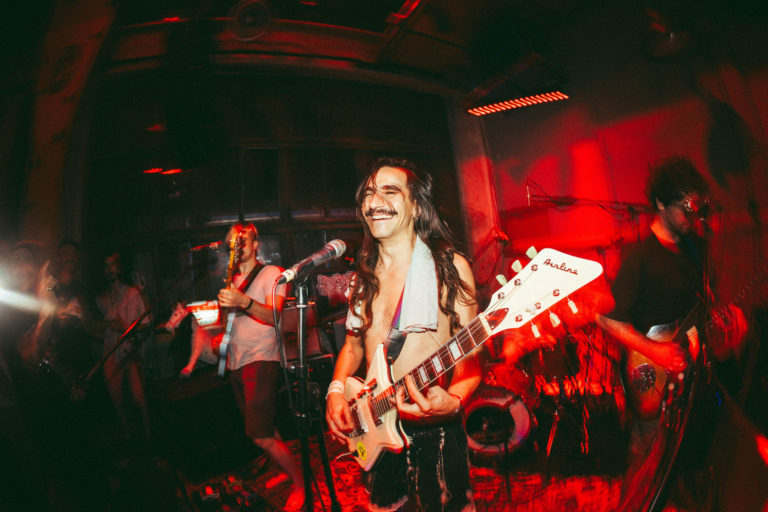
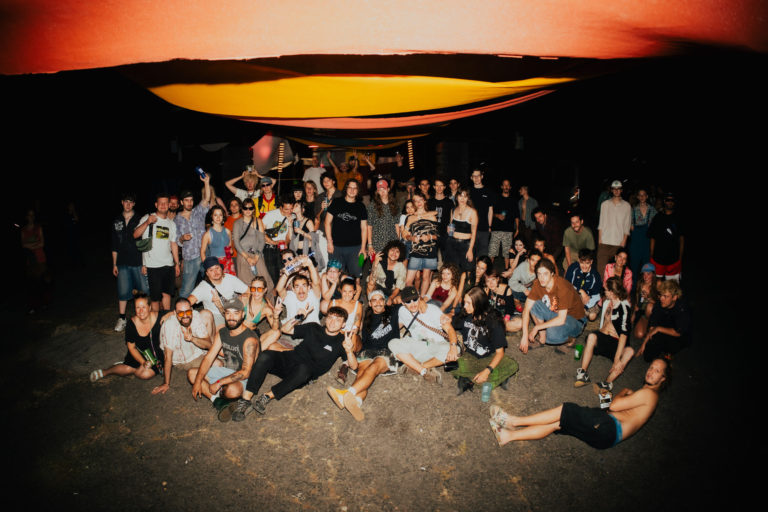
The DIY spirit of the first VG still defines the event. “The community around us was amazing from the start; everyone brought whatever they could—from the jam jars we put candles into, to the professional sound equipment.” The party eventually attracted more than 300 people, put together by a small crew of around ten, with particularly cheap tickets to support and give the opportunity to young people to attend. For the second year, the organisers wanted to stay in Népsziget, which led them to Atno, a former bike repair shop, which has since grown into a well-known alternative indoor-outdoor club venue in Budapest.
“We were looking for a place where we could be loud, with the technical setup and a bar already in place.” The static, analogue light installations special to VG’s atmosphere also fit perfectly with Atno’s metal structures and glass windows. The team grew by only a few people, but with 300-400 guests, the venue was already so packed that they could barely let anyone else in.
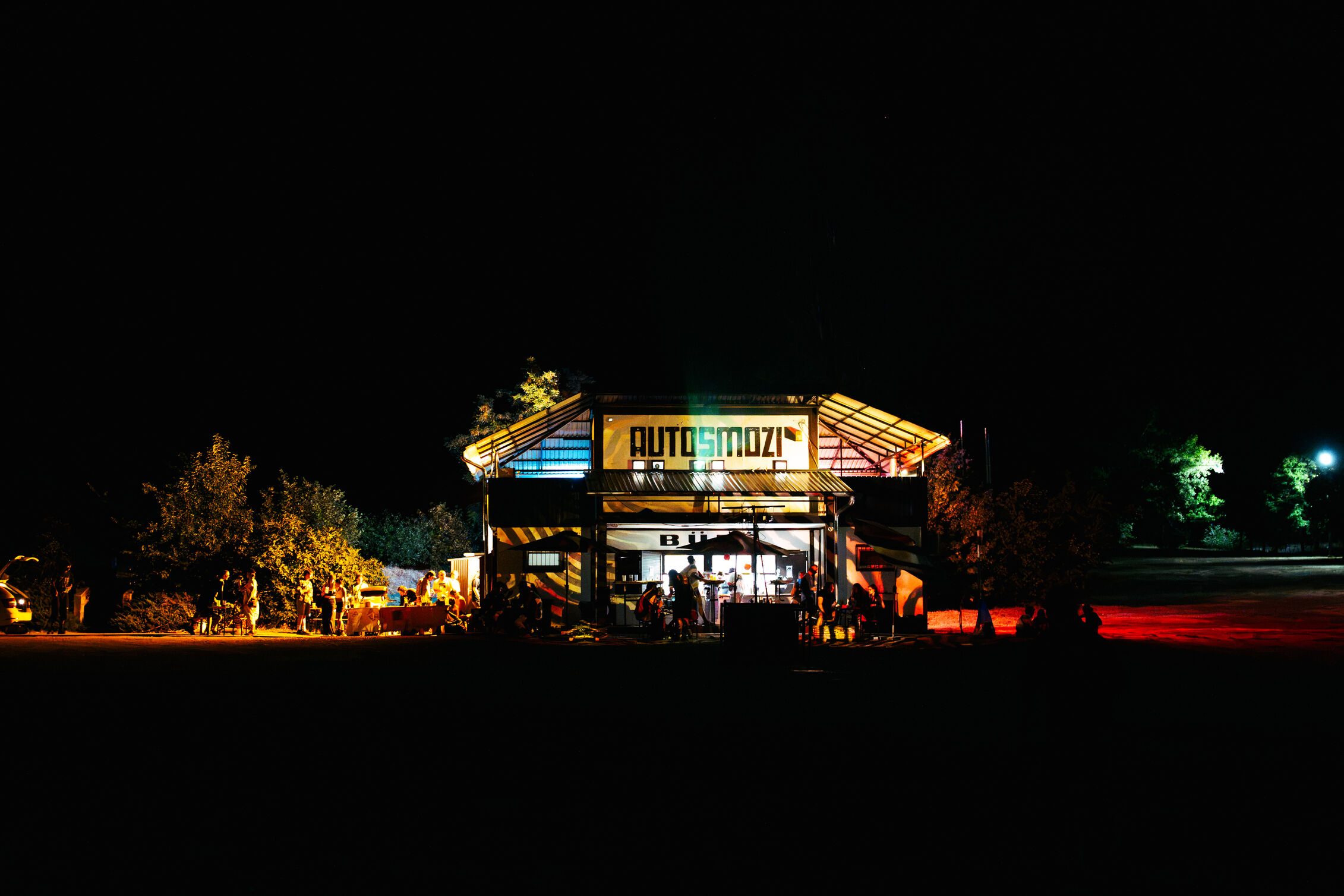
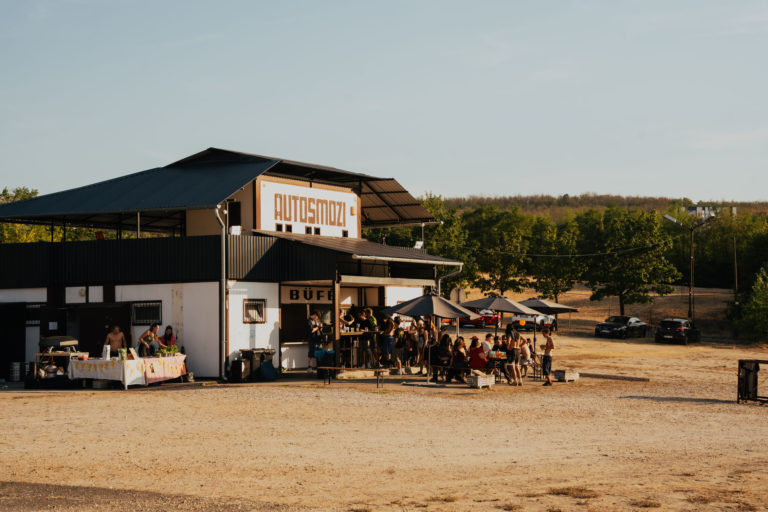
The third edition took a bigger step this August: a two-day event required new location and infrastructure. In the end, after plenty of online research, phone calls, and visits to local government offices, the crew found the venue at the last minute with a little help from AI. “When we went to see the Ring and found out that its huge projection screen was still operational, we decided that we had to have this place.” Ring is a little-known drive-in cinema in Mogyoród, near Budapest, featuring a 20+ metre-wide movie screen. With around 200 total attendees, VG 3 featured 16 concerts, four psy DJs, as well as self-described chaotic daytime workshops ranging from making kombucha to building fuzz pedals and guitars.
Everyone Needs a Base
Ingrid moved to Budapest to study from Sülysáp, a small town near the capital. She worked in a variety of jobs and trained as a hairdresser before learning the profession somewhat euphemistically known as 360-degree music management. This all-round approach is typical of underfunded alternative artistic scenes. Among other things, she handles booking, works as a tour manager, organises community events, and takes care of communications.
Niccoló comes from Kecskemét, a city of around 110,000 people in central Hungary. He worked behind the bar at a club where he fell in love with live music. He eventually started making music himself alongside his work as a hairdresser and moved to the capital in 2010 in his twenties. “I’ve worked in a variety of places, including a popular luxury salon, but that environment wasn’t for me. There was a dissonance between my underground music life and my civilian life, and I wanted to bring these two worlds together,” he says.
© Gergő Manhertz / Varázs Garázs
This desire led to Fuzzzio Salon—a studio apartment in Buda that has served as a base for VG and Hocuspony for the past four years. Fuzzzio is located above a ruin bar and art-house cinema, Bem, in one of Budapest's central spots that has blossomed in recent years. “Part of the apartment is a hair salon, and there are two other rooms that operate now as rap music studios. That's a scene I know less about—just recently I realised that an MC who has been known since the 1990s came to us to record.”
Over the years, Fuzzzio has hosted all kinds of collectives: some people know it as a tattoo studio, while others have come here for tooth gems. “It’s a large rented apartment rather than a street-facing venue. That makes the atmosphere a little more intimate—that’s what everyone who joins us is looking for,” says Ingrid. The studio of hip-hopper underground Berlin Hotel Collective is also at Fuzzzio, organising smaller private events. Music videos have been shot here, young filmmakers have worked here, and at the time of our interview, the entire place was covered in tree branches as part of the decorations being prepared for VG. “We open this place up to young creatives, trying to give something back to the community through the Salon, too.”
Harder Waves
This approach to community building and giving back is fundamental to the VG organisers. They say that choosing to build rather than retreat in response to shrinking opportunities is also fueled by the sense of change in the air. “It feels like some kind of revival is starting again in our field,” they say. “We’re also motivated to build around our own vision because we have something to draw from.” The backlash that bands suffered in favour of productions built around individual performers has by now become an established trend, shaped by everything from the dominance of social media and streaming to fundamental economic difficulties and the popularity of hiphop.
That said, now the noisier, heavier, guitar-driven directions are experiencing a stronger wave again, led by bands such as Brooklyn’s Geese, Baltimore’s Turnstile, or Australia’s King Gizzard & The Lizard Wizard. “Being in a band can be a real hassle, but it gives you experiences and a sense of collective creativity that nothing else can,” says Ingrid. “It’s not just distorted-guitar music that’s making a comeback; the ways in which the guitar itself is being used are expanding,” adds Niccolò. “Varázs Garázs is guitar-based, because this is our field, but there’s a fundamental need for other genre-specific festivals and platforms that make room for a wide range of musical styles too, so that it’s not always the same ten top artists rotating through every lineup.”
© Gergő Manhertz / Varázs Garázs
Spoiled for Choice
Kristóf Samu, the heart and soul of the bar, is a core crew member who brought another musical genre into VG’s palette. “I never thought I’d get to experience this, but I’ve always dreamed of building a space where the spirit of the original Woodstock and the feeling of the first Goa trance parties could come together.” This year, Kristóf brought DJs to the festival for the first time, adding a musical strand from the psy-trance scene, another part of the small-festival landscape that has been gaining momentum lately.
Both Niccoló and Ingrid, who are in their thirties, emphasise the importance of giving today’s youngest generation the kinds of experiences they themselves were able to have in Budapest in the 2010s, before the years of crisis set in. “We were spoiled for choice when it came to live music when we were young,” says Niccolò. “There are still fresh bands today that can get a huge boost from an underground gig like the ones we got to experience—and now we can give them this core experience through VG. If young people don’t get to go through all this thrill, there’s nothing to build on. One of our main jobs is to create this opportunity for them.”
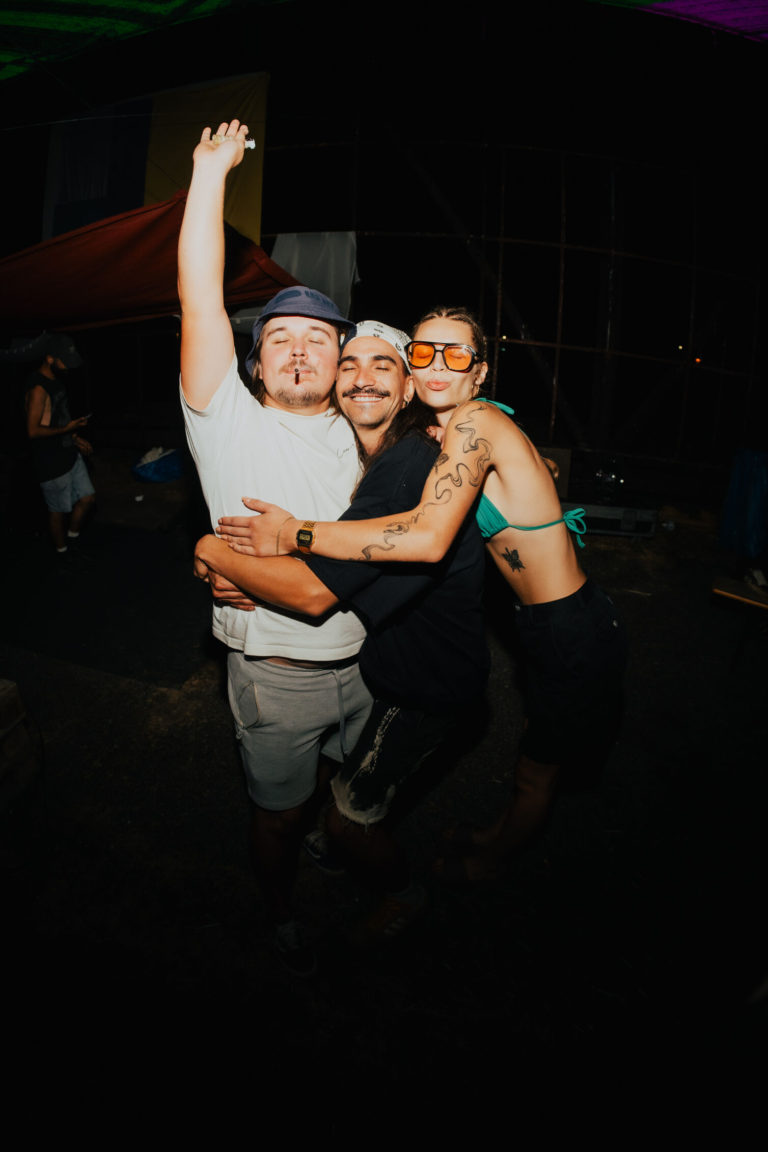
Speaking about that new generation, another member of the core team is Bence Szij-Pethes, who leads the video crew while still in high school, just before his final exams. He plays drums himself, but says he is more connected to the scene through its people than through music. He met Niccoló and the others through Fuzzzio and soon became part of the community as a videographer. He attends a media-focused high school, but says he learned everything on the ground and at what he calls the YouTube Institute. He has already made several award-winning music videos and also works as a video reporter for Balzac, one of Hungary’s best-known student media outlets.
© Gergő Manhertz / Varázs Garázs
Click in the Head
“Big festivals with big budgets depend on sponsors and major artists. It’s like learning to ride a bike with training wheels,” Niccoló sums up. “Our independence means we don’t have to answer to any external pressure,” he adds. “I’d be lying if I said we never get close to burnout, but as long as we still have something we need to get out of ourselves through music, as long as we have strong visions, we have to make them happen. A festival like this always requires something to click in your head.”
While the Hungarian version rhymes, Varázs Garázs literally translates “Magic Garage.”
The quotes have been edited for clarity.
Published on September 8th, 2026
About the author:
Nora Balkanyi is a journalist based in Budapest, covering creative industry, media, and culture; currently freelancing as an editor at hvg.hu, media literacy trainer; volunteer in JazzaJ hub for improvisational music since 2015. A former crew member of Bánkitó, one of Hungary’s best-known small festivals, now discontinued in its original form.
