

Author: Nora Balkanyi
Meet Bratislava-based improviser and composer Štefan Szabó, a key organiser in the Central and Eastern European experimental music scene. He is one of the founders of n:ear, a small Slovak festival of experimental and improvised music in the beautiful natural surroundings of Banská Štiavnica, attracting around 50–100 people since 2020.
We talked to Štefan about the political situation in Slovakia, why he likes bringing people together in the same room, and what it means to spend a couple of hours playing a five-hole flute with a friend from Hungary.
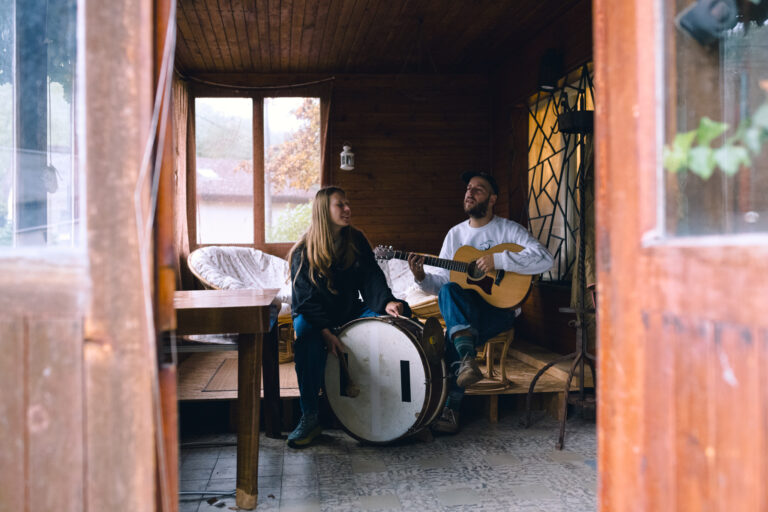
Adela Medé and Štefan Szabó — © Kvet Nguye
Štefan Szabó started learning guitar as an adolescent—“not at the age of six, but sixteen”—and studied at different institutions around Europe in his twenties. This way he has no ingrained sense of what music should sound like or what should be considered beautiful. Besides playing and organising, he also teaches guitar, trying to pass this freedom on to kids.
Štefan is now based in Bratislava (Pozsony), the capital of Slovakia, but grew up in Rimavská Sobota (Rimaszombat). It’s a small town of around 20,000 people, about 30 kilometres from the Hungarian border, made of a small community of Slovaks, Hungarians, and Roma people. “My dad is Hungarian, my mom is Slovak, so both identities were always natural for me. Slovaks don’t hear an accent, but when I talk to Hungarian people, like you, I can feel them wondering where I’m from.[1]
Nora Balkanyi: When did you first encounter improvisation?
Štefan Szabó: There was a Roma family with three children whom I used to go play football with. One of them played the synthesizer, another the drums, and the third a guitar. This was in a housing estate neighbourhood. People would gather outside the buildings, a bit like in a village. They’d bring their instruments and play in front.
I just went up to one of them and asked him to show me a few things on the guitar. We didn’t play songs. You could say we were improvising, but at the time I was just trying to put chords together in whatever way I liked.
In high school, my cousin introduced me to all kinds of music on CDs and MP3s including rock, jazz, or experimental music. I didn’t even try to play something like it, but somehow it got inside me. Later in my college years, we had a trio and I went to a concert where one of our band members played. A prepared bass guitar was lying on the table, one person was singing a folk song, another was playing the accordion as if breathing, and someone recited some John Cage poem over it.
I was like, wow. I’d never experienced anything like that live before. The band was called NE:BO:DAJ.
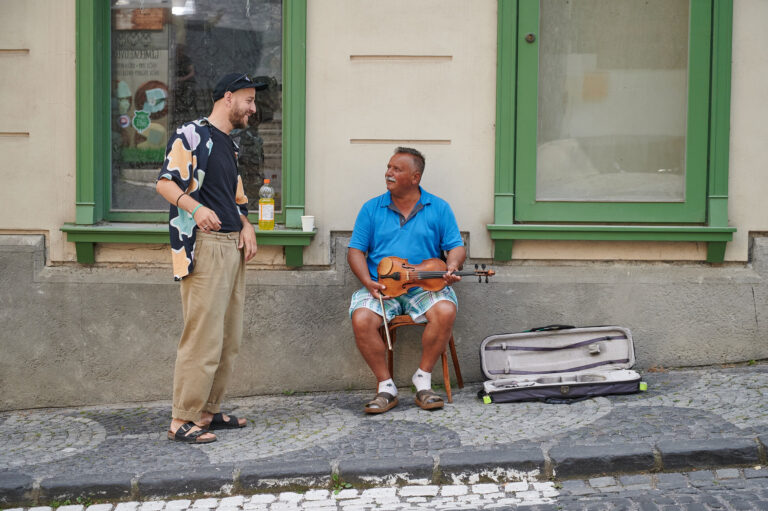
Štefan with a street musician from Rimavská Sobota — © Slavo Uhrin
So you moved around quite a bit, but I got to know you as a guitarist and organiser in Bratislava’s improvised music scene. How did you start organising?
I like bringing people together. When people make music or listen to it together live, I think that’s a statement in itself. So at home we started a project with my good friend Dávid Petráš, called Project Ruiny (Project Ruins). He is from Lučenec (Losonc), about 30 kilometres from Rimavská Sobota. There are lots of abandoned buildings there, and in our town too. We started to bring mainly musical performances and discussions to these places: we held events in an old secessionist villa, a socialist student dormitory, a former castle building, or a silo at a sugar factory and brewery. Then Covid came, and there was no more Project Ruiny.
Later we started the Hudba v kruhu concert series (Music in a circle). There was a lot of music we liked at the time and wanted to bring to the area, so we applied for funding by the Slovak Arts Council. Dávid’s father had a brewery and restaurant where we started out. Bill Frisell, Marc Ribot, Thomas Morgan, Eric Chenaux came—it was quite bizarre, these are pretty big names for Losonc.
What do you like in organising?
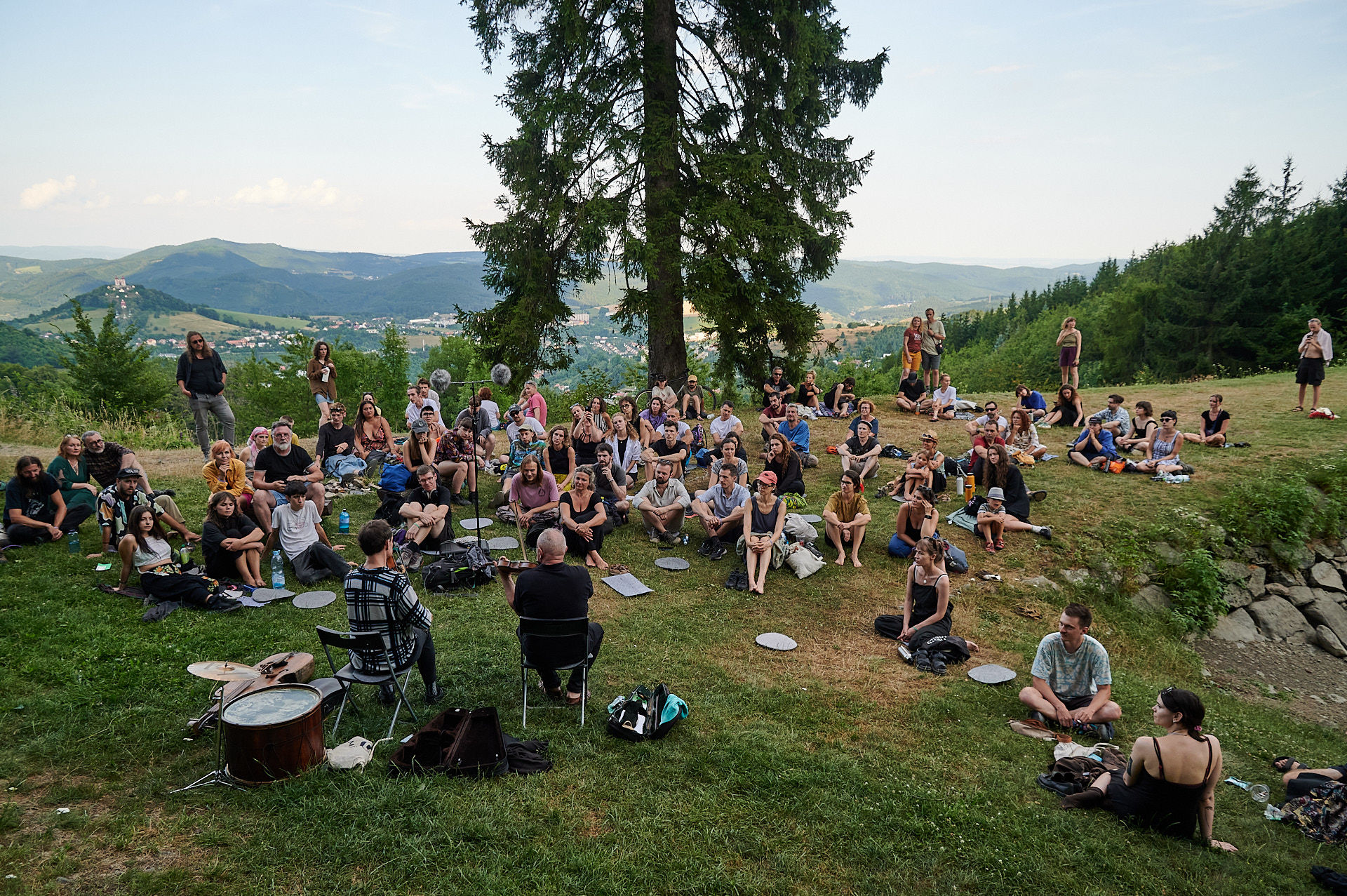
I like the imaginative part of it the most. It’s a creative process, compositional and sometimes also improvisational. You are choosing venues, putting people together, and what is the most important, you are bringing something you really love to other people, together with other people. We could be sitting in a circle, with the choir up on the balcony, or we can do a concert in a forest—maybe we end up driving to get some army tents in case it rains and that’s good too, because then we can talk about silly things along the way.
How did you start to organise a whole festival?
Once I played at a place called Eleuzína in Banská Štiavnica (Selmecbánya), and the organiser, Marek Pavlík, asked whether I wanted to help curate the musical programming. I said yes, and I really liked the work. So we discussed joining forces to create a whole festival in the summer inviting other venues, like Hájovňa.[2] That became n:ear in 2020.
How did you get funding, or did you work voluntarily creating n:ear?
Since Marek had already applied for state funding with Eleuzína, he knew the system at the Slovak Arts Council (FPU) and we could get some funding to start n:ear. But there’s a lot of volunteer work.
How many of you are in the crew?
After Marek left, my friend Dominika Moravčíková, an ethnomusicologist and writer, handled the non-musical part. For the fourth and fifth edition we also invited a great friend and even better curator, head of label mappa, Jakub Juhás, who did the programming for an evening. The others are more involved in sound engineering or production. Let’s say there are three to five of us.
Is Banská Štiavnica a good place to be a home for n:ear?
Lots of people ask why Banská Štiavnica. For me it’s nice to get back there every year, because this is where it started, but the town is becoming one of the go-to places to visit in Slovakia on the tourist map. It became a bit… too wonderful. I wouldn’t say it’s like Venice, but it’s starting to become something like that.
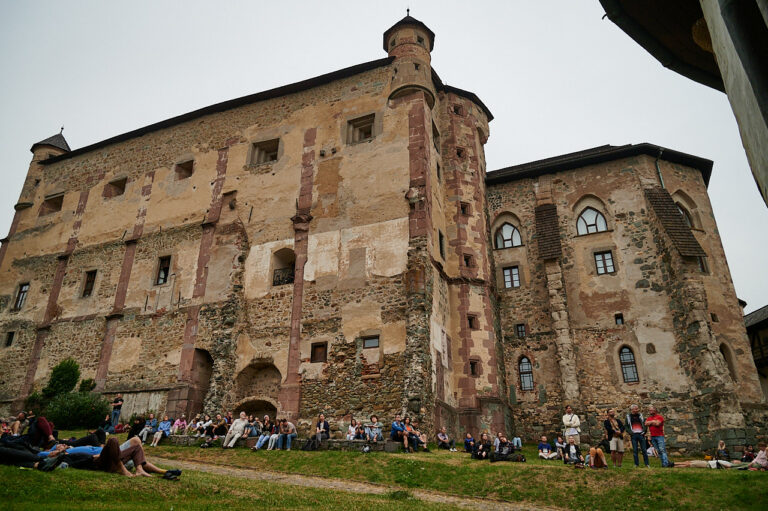
n:ear — © Slavo Uhrin
Too touristy compared to what you’d expect from a city holding a festival connected to the underground?
Yeah. This shows up in lots of things, like accommodation. If you contact a hotel and say there’s going to be a festival in July and we’re bringing 30–50 performers, and that we’d like to book rooms at a discounted rate or through some kind of barter, they say they’re not interested because they’re already fully booked for the summer season. But we manage, the underground will survive all the time. There is also a DIY festival based here, which needs to be mentioned: it’s called Realshit and it started three years after us, organised by gen-Z without any state funding.
Somebody told me that the city might give us a little funding if we moved it to May. They would be happy to have something happening in spring too. The problem is that Banská Štiavnica lies in a basin, so the weather can be unpredictable and the whole outdoor programme depends on it. There’s UH Fest in Hungary, Next here in Slovakia, or Ensemble in Poland, all traditionally held in autumn. There isn’t one festival in the middle of the summer that’s entirely experimental. You guys have something…
Inota, yes, at the very end of summer. But a completely experimental festival in peak summertime… that was what I felt was missing. That vibe. Let it be somewhen people can go swimming too, listening to something abstract from a lake.
You mentioned UH, Next, the Ensemble. I know you travel to Budapest a lot, but what do you see: how well established is the experimental and improvised music network in the region?
Just yesterday, I spoke to fellow Hungarian musician Robi Kerényi to ask if he could play a melody for me, after I’d bought a five-hole flute. He said he could record it, but it would be best if I came to his house in Budakeszi, and that I’d be very welcome. And that is great.
We know about each other, but that’s the minimum level: respecting the events and dates. Inviting and going to each other’s events is another level. Being in personal contact, going for a beer or a coffee, that’d be ideal. Considering how close we are to each other, we could communicate better.
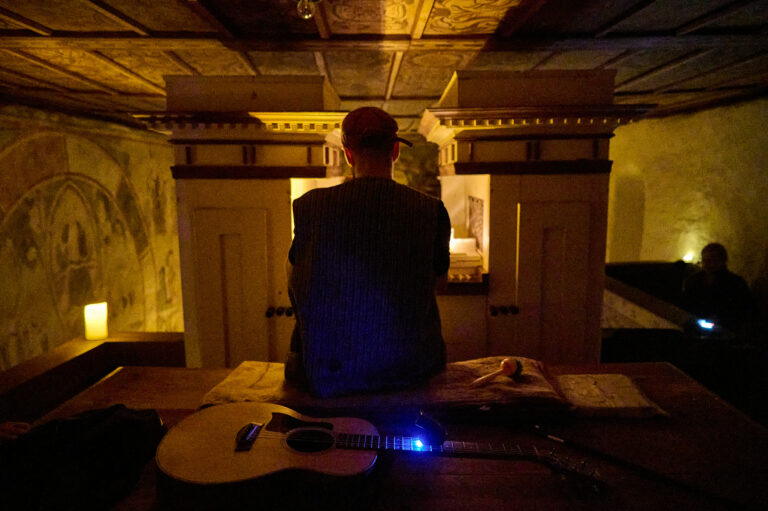
Organ concert in Kraskovo — © Slavo Uhrin
You were on a hiatus this year with n:ear–why?
All open calls for funding applications were postponed and we wouldn’t have known until June whether there would be a festival in July. You can’t take a risk like that.
The situation for the contemporary and independent art scene has worsened significantly since Robert Fico’s return to power in 2023. How are things now?
With the current people in power, it’s become something like what you had at home in Hungary, only much faster. They’ve been in power for three years now, but they took everything over within six months. They simply knocked on the doors of the heads of national cultural institutions and took their places—even if someone opened the door in their pajamas. And that was it.
For example major cultural centres had three-year funding agreements: Tabačka in Košice (Kassa), the New Synagogue in Žilina (Zsolna), or A4 and Nová Cvernovka in Bratislava. The authorities then decided not to pay the final year’s funding. The contracts had already been signed, so in the end they couldn’t go on with this plan legally, but the threats are present. So… This has happened here.
What does independence mean to you in this kind of environment?
It’s difficult. If we don’t depend on state funding, what do we depend on? The people who come to our events and each other. If you say “dependence”, it sounds pejorative, but it can be a beautiful, natural thing too. It's raining… it’s not bad, it’s natural.
When there was a boom around the Slovak Arts Council, and it was thriving, lots of cultural centres were established throughout Slovakia. It’s different from Hungary: you always say that apart from Budapest, there are like three or four places to play our kind of experimental music. In Slovakia, there are at least twenty places where they’ll let you play and pay you thanks to state funding–but that’s both good and bad.
Sometimes we organised a concert and there was no promotion. The event went ahead, and we got our fee, but there was no community. The organisers themselves weren’t interested; they just had to do it because they received year-round funding to run a cultural programme. Now it’s becoming clear who will actually carry on. I’m curious to see what happens. Maybe it’ll end up like in Hungary, with only four places left.
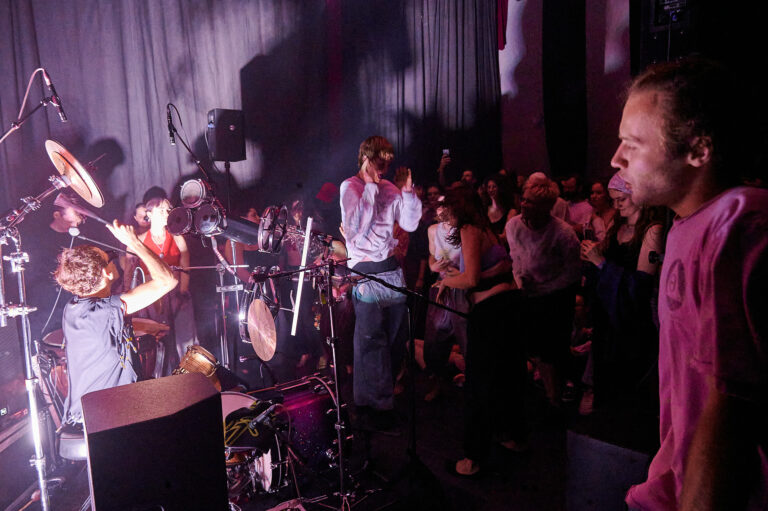
Alex Lazaro at n:ear — © Slavo Uhrin
In my experience people running these places are enthusiastic and keep pushing because there’s no alternative. This scene will never be something that can sustain itself within capitalist logic.
That’s why the DIY structures in Prague are a huge inspiration to me, as is JazzaJ.[3] You all have jobs, but the fact that you’ve been able to keep doing something like this for fifteen years is really something to me. I can see that sometimes you have more energy, sometimes less, but you’re always organising things in your heads.
I think it’s kind of a lifestyle too.
Yeah, well, what else would you do? It’s the same as asking what else I’d do when I go and practise the furulya. I just know how crazy good it feels when you learn a new melody.
Notes
[1] Štefan speaks Hungarian very well in a distinctive dialect that is impossible to translate into English, but we tried anyway—ed.
[2] A cultural and tourist centre located at a saddle called Červená Studňa—ed.
[3] JazzaJ hub for improvised music in Budapest, a member of the Reset network, where the author is a volunteer—ed.
Current works
“Our collaborative album with Adela Medé, titled Dalok (Songs), was released in early October. After more than two years of weekly meetings, during which we talked a lot, sang even more, and learned Hungarian folk songs, the album’s release was not an ending, but rather a milestone along the way. It was released by 42far Records.
Our new duo with Michaela Antalová explores the common ground between the organ and the furulya. We spent a week in residence in Trenčín this summer, working on the music. A few weeks ago, we performed it at the UH Festival.
Our curatorial work continues with a concert series in Bratislava. The concerts take place every other Sunday in a pub-like atmosphere—primarily in acoustic settings—featuring the folk genre. The series is called u strún and we warmly welcome everyone.”
This interview has been edited for length and clarity.
The cities in Slovakia are referred to by their Slovak names, with the Hungarian versions in parentheses.
Published on November 10th, 2026
About the author:
Nora Balkanyi is a journalist based in Budapest, covering creative industry, media, and culture; currently freelancing as an editor at hvg.hu, media literacy trainer; volunteer in JazzaJ hub for improvisational music since 2015. JazzaJ collaborated with Štefan Szabó for example on their tour through the V4 countries.
