

This article is part of Reset! Yearly Focus 2026: Digital Independence
Author: Zsofi Borsi
How shadowbanning and reliance on Instagram impact feminist independent media, and what can be done about it.
© Lazy Women
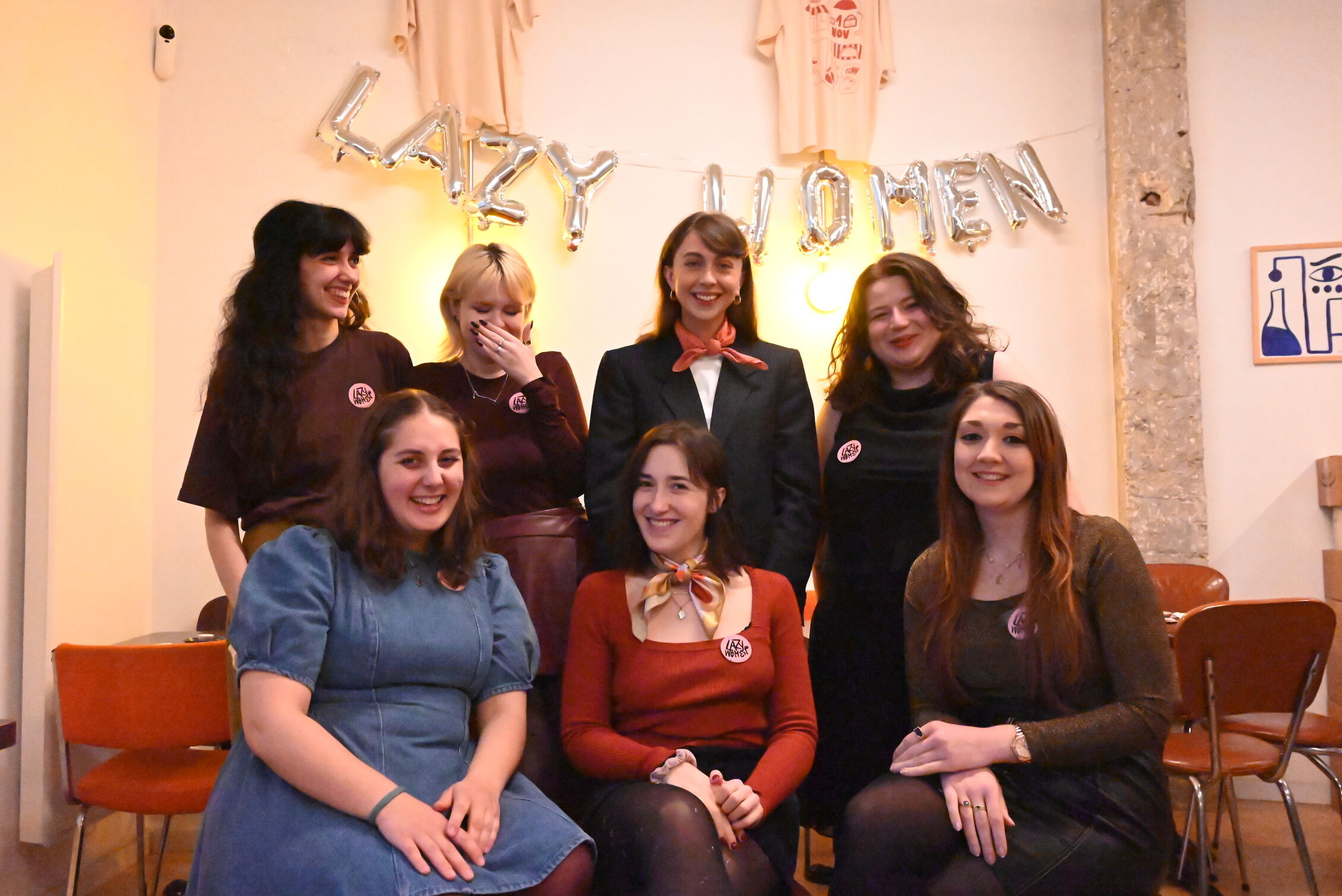
Lazy Women is an international feminist media platform, founded in 2020 by a group of Central-Eastern European women. Since our beginning, we have experimented with various formats and platforms, while keeping long-form written articles at our core, exploring how the personal is political and challenging productivity culture, often by providing an underrepresented perspective in the global, Western-dominated feminist media landscape.
Our main platform for popularising and mass-disseminating the articles we release has always been Instagram, as well as the most prominent channel for us to gain visibility and reach our target audience–young women curious about feminism, but who do not necessarily know where to start or do not feel represented.
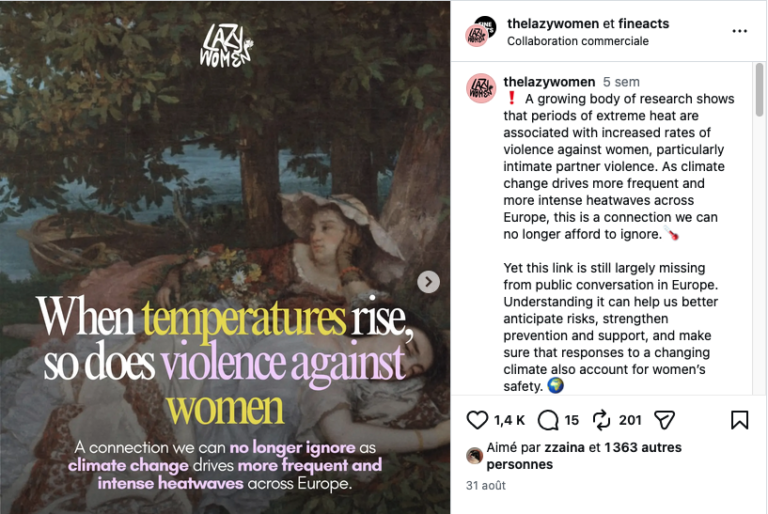
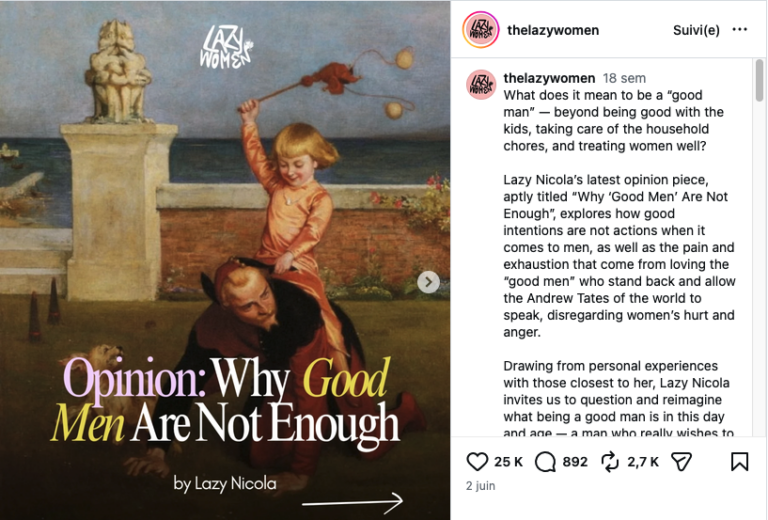
Recently, we have cracked the code of how to reach mass audiences on Instagram without having to sacrifice the formats we like or constantly follow trends; we gained over 20k followers just last year, and were even followed by Rosalía. Some of our posts have reached 25-30K likes and millions of impressions.
Censorship Creeping in
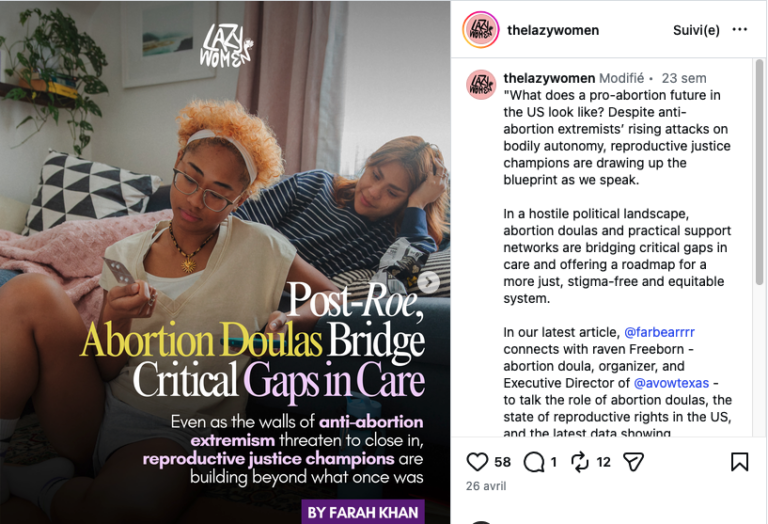
Yet, every time we try to talk about explicitly LGBTQI+, queer, women’s reproductive health, or sex work-related topics–which I would argue are some of the key things on the agenda of today’s feminist Zeitgeist–something doesn’t quite work out. Instead of the usual thousands, these posts repeatedly reach maybe a couple hundred people in the first hour, and only our followers.
We then re-evaluate: should we have censored the word queer, or sex, or abortion, or women’s bodies, or even the word autonomy? But where do you really draw the line?
Heavily reliant on audience growth to continue existing as an independent, non-profit media, we are susceptible to algorithms, and it’s a slippery slope. The risk is real: self-censorship and leaving tricky issues aside, thereby masking and reinforcing the patriarchy and the softening down of women’s issues.
© Lazy Women
What Is Shadowbanning?
The issue in question is, in common terms, called shadowbanning. This is not an official term ever confirmed by Meta, but rather a user-generated expression for Instagram’s “vaguely inappropriate content” policy, which dramatically reduces posts’ visibility by hiding them from its Explore page without warning.
As the researcher Caroline Are found, Instagram used “shadowbans to hide pictures and videos they deemed inappropriate without deleting them, preventing freelancers, artists, sex workers, activists, and, overwhelmingly, women from reaching new audiences and potentially growing their pages.” She argues that social media platforms hold the tools to distribute said visibility, tools unequally available to users performing different actions and to different bodies from different racial and socio-economic backgrounds, engaging in different types of labour.
Additionally, in a more recent study by The Markup, related to the Israel-Hamas coverage on Instagram, they found no evidence of ideology-based shadowbanning, meaning that the visibility of accounts they tested did not change significantly upon posting and engaging with political content. However, they found that “Instagram deleted captions using our hashtag, suppressed hashtags, suppressed non-graphic photos of war, shadowbanned comments, and denied users the option to appeal when the company removed their comments.” While the study didn’t look at feminist content per se, it still points to larger mechanisms at play when it comes to Instagram’s strategies to suppress content identified as ‘political.’
Why Feminist Content Gets “Caught”
In addition to the aforementioned suppression of ‘political’ content, Instagram argues that its AI-driven algorithm is discouraging sex-related content only as a means of crackdown against nudity. This is where the story for feminist content gets complicated, because it faces a form of double discrimination. Not only is feminism inherently seen as political, but also its content forms often use sexuality and bodily visibility to promote women’s rights to bodily autonomy, gender rights, and empowerment in general.
One highly “discriminated” topic is abortion, something we talk about often in various formats on Lazy Women. Indeed, according to the Guardian, in the days and weeks after the US Supreme Court overturned Roe v. Wade in June 2022, several abortion rights groups had their Instagram and TikTok posts removed or accounts suspended, while Instagram and Facebook deleted the posts of users who mentioned abortion pills.
Another one is plus-sized and queer bodies, as argued by feminist and writer Chanté Joseph, noting that the platform’s AI learns to adopt biases that reinforce misogyny and racism, creating barriers for certain groups in the digital realm.
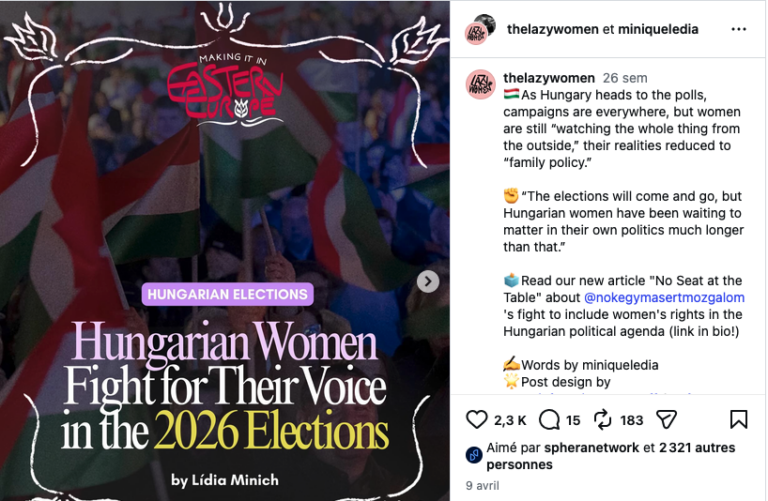
While algorithms fluctuate and AI biases evolve, one of the most annoying parts of this is the uncertainty that looms over digital creators–and even in 2026, our experience hasn’t changed: try talking about sensitive women’s issues, and see how it performs compared to posting city guides, book releases, or relationships and men.
© Lazy Women
So, What Can You Do?
The question arises: what can a small independent media platform actually do to combat this? Of course, there’s the straightforward approach–quitting the platform and opting for alternative channels. But I’d argue that this in itself is not going to solve your problem, only make yourself less visible and, unfortunately, in today’s media logic, prevent yourself from funding, opportunities, and growth.
Instead, I collected a small list of alternative strategies that can help you learn to coexist with AI, algorithms, and other forms of online discrimination against women’s agendas:
- Don’t quit, but diversify your platforms. Don’t hold all your eggs in one basket. Invest in your Instagram strategy, but equally experiment with other platforms at the same time–build your own website. Substack is a great channel as well to build out a sustainable and paid audience, where the algorithm works differently, and their business rationale is built up in a way to maximise their help for you to succeed.
- Alternate between “viral-potential” and educational content. We have found that our more serious, educational content generally gets better reach and is less likely to be de-prioritised by the algorithm if it is timed right after a viral-worthy post: something that tackles a pop culture phenomenon from a strong feminist angle (such as our recent critique about the Odyssey).
- Keep up your posting rhythm. The current algorithm favours creators that post on a very regular basis, so don’t spend too much radio silence between posts. If something flops, just continue keeping up the cadence, and usually your audience numbers after a potential shadow-ban will be up again within a week’s time.
- Continue talking about the issues you care about. Don’t mistake the number of likes for the worth of your content or its general quality. Tag relevant accounts (for example, in our case, women’s organisations) that are likely to re-share your post, which can then get to a broader audience even if your initial numbers aren’t picking up simply based on the algorithms.
- Speak up when you see content being censored, no matter what format it is in, to raise awareness about biases that exist online. Urge and ask for help from your community. Team up with other media to reach a larger audience and get yourself heard. This is what My Voice, My Choice, with now over 1M followers, did in their campaign to make the right to safe and free abortions available for all persons in Europe, and they hit some crazy numbers even when talking about a topic that is bound to be discouraged by the algorithm (albeit they got locked out from their account for 3 months with no explanation from Meta and had to operate through a back-up). Document the patterns that you see, and ultimately: resist letting platform performance determine editorial priorities.
© Lazy Women
Rethinking Digital Independence
In the context of this issue, it’s important to consider what we really mean by digital independence–and what over-reliance on Meta products means in terms of editorial choices and the topics that get to the top of the agenda. In our view, true digital independence would mean that we could talk about these topics without staring out “sensitive” words or having to think about switching our content up to cater to the algorithm.
At the same time, our recent growth and virality show that blaming the algorithm for every single flop or the lack of growth is also not a constructive approach–and that building an editorially unconstrained, feminist community on a platform like Instagram is possible. But it takes time, dedication, a constant keeping up with trends, and a taste for experimentation.
Our advice for small media in a similar boat is: keep making your voice heard, and don’t give in to the forces to become “cool” at the cost of speaking your own truth.
References
John Costine, "Instagram now demotes vaguely ‘inappropriate’ content," TechCrunch, 2019
Chanté Joseph, "Instagram’s murky ‘shadow bans’ just serve to censor marginalised communities," The Guardian, 2019
Carolina Are, "The Shadowban Cycle: an autoethnography of pole dancing,nudity and censorship on Instagram," University of London, 2020
Tomas Apodaca and Natasha Uzcátegui-Liggett, "How We Investigated Shadowbanning on Instagram," The Markup, 2024
Carter Sherman, "Groups helping Americans find abortion pills report Instagram ‘shadow-banning’," The Guardian, 2025
Published on October 20th, 2026
About the author:
Zsofi Borsi is the founder of Lazy Women. Originally from Hungary and now based in Paris, she works in community building and writes about culture, feminism, and the systems shaping our lives. She is a political scientist by training and has previously worked at the European Commission and the OECD.
