

Detailed report of the event,
Brussels, September 2026
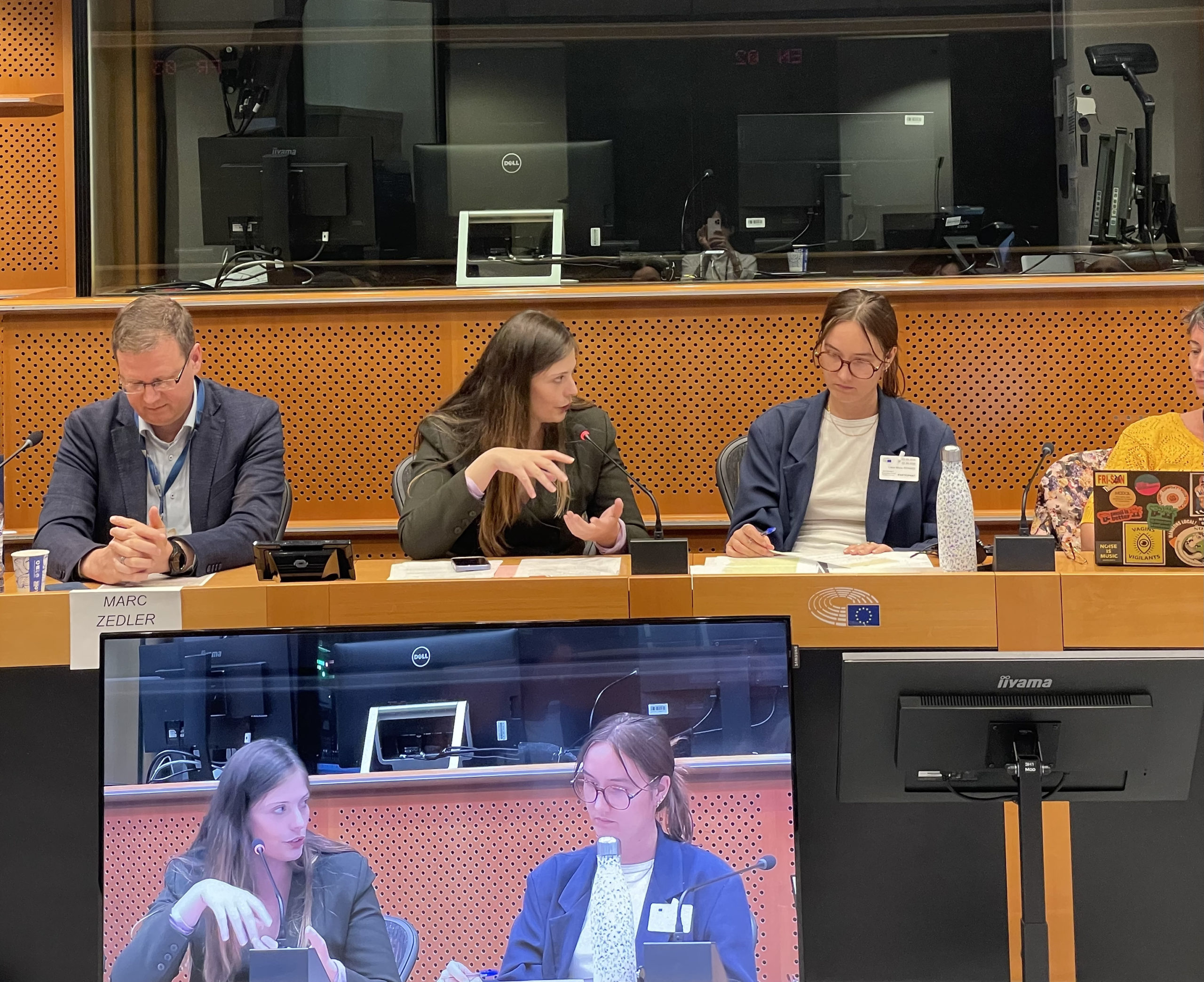
Representatives of Europe’s cultural sectors, policymakers, and competition authorities gathered at the European Parliament for the event Safeguarding Cultural Pluralism in Europe: Addressing Ownership Concentration across the Cultural Sectors.
Hosted by MEP Emma Rafowicz, Vice-Chair of the European Parliament’s Committee on Culture and Education and AGORA EU co-rapporteur, the event was organised by Live DMA, Reset! network, and SMA. It brought together representatives from music, media & journalism, publishing, and independent cinema, alongside policymakers working on culture (DG EAC) and competition (DG COMP), and several CULT Committee members of the European Parliament.
The meeting marked a new stage in the work initiated with the publication, in early 2026, of maps documenting ownership and corporate influence in Europe’s live music sector. Following their circulation through the press, music industry events, television and documentaries, the event aimed to translate the evidence gathered into a wider European policy discussion.
In live music, the maps show how a limited number of groups have established positions across festivals, large venues, promotion, booking, ticketing and audience data.
“Most small and medium-sized venues in Europe remain independent or locally owned. However, they may remain numerous while having less influence over the conditions through which artists circulate.” – Erica Romero Pender, Project Officer, Live DMA
Musician Frederik Sioen described how the concentration of major festivals, venues, booking agencies, and ticketing services affects artists in concrete terms. Independent acts often struggle to access major stages without working with agencies connected to dominant groups. He described how package booking deals reduce the places available to independent acts, while low festival fees leave less income for musicians and crews.
“I don’t get any information from my own fans. Do we have to give away our data for free to a US company?” – Frederik Sioen, musician
The integration of venues, booking, and ticketing also creates dependence throughout an artist’s career. Artists may perform for their own audiences without receiving access to their data, limiting their ability to understand and communicate directly with their fans. At the same time, increasing ticket prices restrict access to concerts. The result is fewer opportunities and less income for independent artists, greater control by dominant companies and reduced access for audiences.
Although the discussions began with live music, the testimonies demonstrated that ownership concentration is a shared structural issue across cultural sectors.
In cinema, and very similarly to music, Sebastian Naumann described the large number of European companies and films that gives the appearance of a fragmented market. Yet market shares reveal a very different picture: an oligopoly dominated by US companies. According to figures from the European Audiovisual Observatory, just 136 films accounted for 80% of admissions, out of approximately 2,500 films produced in Europe that year.
This concentration matters because cinemas depend on a mixed programming model. High-profile releases and their marketing budgets attract audiences and stabilise revenues, enabling cinemas to programme independent, European, and diverse works. When major studios merge, release fewer films, and reduce their commitment to the distribution, this balance is threatened. Their market power therefore gives major studios significant influence over the programming choices and economic conditions of independent cinemas. Naumann illustrated these concerns through a comparison with Disney’s acquisition of Fox, reporting a subsequent reduction in releases in the markets examined. He used this analysis to discuss the possible consequences of the proposed Warner-Paramount transaction. He also emphasised the importance of access to Warner’s extensive film catalogue and of maintaining a commitment to theatrical distribution.
More figures were reported from the publishing sector by Merlin Jacquet-Makowka from the french collective Déborder Bolloré: the 4 largest French publishers report turnover almost five times greater than all other publishing houses combined, and they hold 70% of distribution as well. Same in Germany: only 2% of publishers account for 70% of the entire market. In Italy, 50% of books go through a single group before reaching the readers. And in Spain, the biggest publisher owns the biggest bookshop chain and the biggest distribution network. The list goes on.
In France again, all the independent houses were driven out of the market share in the 1970s and engaging in concentration is now the only way to survive for these groups. Today, these groups are also connected to television, education, and other media.
“The centre of this vertical integration is no longer the book itself; it is information.” – Merlin Jacquet-Makowka, independent publisher, spokesperson for Déborder Bolloré collective
These publishing groups are interchangeable. They are constantly buying and selling each other. Their staff, their structures, and their practices have become standardised and optimised for it. That also means standardisation of production, products, and thus standardisation of consumption and culture itself. Jacquet-Makowka called for clear structural thresholds to limit concentration and further research into policies supporting diversity, including fixed book prices and public services for book distribution. He also urged an update to the European Parliament’s 2023 resolution on the future of the European book sector to address concentration explicitly.
In media and journalism, concentration carries an additional democratic risk: by shaping access to information and the diversity of public debate, it can directly influence elections and political power. Researcher Sabri Derinöz argued that the sector therefore benefits from specific safeguards under the European Media Freedom Act, as well as monitoring tools such as EurOMo (Euromedia Ownership Monitor). These instruments may not prevent concentration, but they make it more visible and provide a basis for public action.
“No Member States are immune to the media market concentration. The Media Pluralism Monitor 2026 report shows that most of the European countries have at least a medium risk for media plurality, and several countries have a high risk for media plurality.” – Sabri Derinöz, media researcher
Derinöz questioned whether the new safeguards were sufficiently robust to counter the pace of concentration. He illustrated this through the Rossel-IPM merger in French-speaking Belgium, describing the tension between the economic sustainability of newspapers and the protection of ownership diversity and editorial independence. He stressed that maintaining several newspaper titles does not necessarily preserve a genuine diversity of editorial voices.
“Any policy in favour of diversity will be doomed to fail if it does not address the problem of concentration head-on.” – Merlin Jacquet-Makowka, independent publisher, spokesperson for Déborder Bolloré collective
Cultural organisations, journalists, publishers, and artists contribute to the circulation of ideas, representations and political opinions. Concentrating control over culture therefore means concentrating the power to determine which voices are heard, which stories circulate, and what people are able to imagine, with direct consequences for freedom of expression, artistic and editorial independence, access to culture, cultural sovereignty, and democracy. Therefore, concentration in culture cannot be assessed in the same way as concentration in an ordinary goods market.
In this context, a priority is to develop a more coherent regulatory framework capable of addressing the specific effects of concentration on cultural diversity and pluralism.
This summer, a coalition of 20 European cultural and civil society organisations led by Live DMA and Reset! network sent a joint letter addressed to Commissioner Glenn Micallef to call on him to work with Executive Vice-President Teresa Ribera and DG Competition to ensure that the revised EU Merger Guidelines reflect the specific realities of cultural markets. Their demands include making cultural diversity and plurality operational criteria in merger assessments.
Marc Zedler, Deputy Head of Unit at DG Competition, specified that he was speaking in a personal capacity. He explained that cultural diversity can be considered as a quality parameter in merger assessments, but that intervention requires evidence of its relevance to competition and of the harm a transaction would cause. He described its explicit inclusion in the draft revised Merger Guidelines as a clarification of existing practice and cautioned against expecting a fundamental change.
Zedler also cited the referral of UMG-Downtown to illustrate how transactions initially falling within national jurisdiction can be reviewed at European level. He invited cultural organisations to contact DG Competition with evidence and concerns about relevant transactions. The discussion raised the possibility of more formal cooperation between cultural policymakers and competition authorities, without identifying an agreed mechanism. Where competition law cannot address the cultural, democratic, or accessibility consequences identified, complementary sector-specific rules should be considered, and better coordination between cultural policymakers and competition authorities should be orchestrated.
Ticketing provided a concrete example of the need for complementary instruments. Responding to a question from Lison Renard, MEP Rafowicz argued that dynamic pricing should be excluded from cultural sectors because of its consequences for affordability and access. She mentioned discussions with colleagues in the Parliament’s Internal Market and Consumer Protection Committee. Zedler explained that he did not consider merger control the most suitable instrument for addressing this particular concern, reinforcing the discussion about additional rules.
Effective regulation depends on reliable and regularly updated evidence. Participants therefore supported the creation of a permanent European observatory responsible for monitoring ownership and concentration in the cultural sectors, drawing on the experience of the European Audiovisual Observatory and existing media ownership monitoring tools.
The live music maps have brought together information that was previously fragmented and difficult to access. However, acquisitions, investments, and corporate relationships change so rapidly that such maps can become outdated shortly after publication.
“It is not the work of stakeholders and associations to collect all this data. It is the role of public authorities.” - Emma Rafowicz, MEP, CULT Committee, co-rapporteur for AgoraEU
Public monitoring, developed in cooperation with the sectors concerned, must be accompanied by adequate funding for independent and locally rooted cultural organisations. Discussions on AgoraEU and the next EU budget highlighted the need to make independence an operational funding criterion and prioritise small and medium-sized organisations, including those working in music, book, and independent news media. Public support should also strengthen independent ticketing, distribution, and other alternative infrastructures, while developing redistribution mechanisms that direct resources towards smaller and grassroots organisations.
During the open floor, David Kardos, from the Center for Sustainable Media, asked how much European funding reaches concentrated groups and whether the ownership patterns presented also apply to Central and Eastern Europe. The organisers described acquisitions of regional promoters in those markets—that are starting to become concentrated—, while acknowledging the maps’ stronger coverage of Western Europe. No figures on funding recipients were available during the discussion. Rafowicz linked the question to her efforts to extend independence criteria across cultural funding.
Mark Dempsey, from ARTICLE 19, called for greater urgency and earlier intervention against concentration. He challenged the emphasis on prices in competition enforcement and urged a broader assessment of exclusionary practices and access to culture. He also called for closer cooperation between DG CONNECT and DG Competition on media pluralism and invited participants to connect with the anti-monopoly coalition.
Jess Partridge, Executive Director of the European Music Managers Alliance, emphasised the consequences for future artists. Small and medium-sized organisations provide essential entry points, support, and access to information during artists’ development. She warned that weakening this part of the ecosystem would undermine future careers, and supported stronger merger guidance, monitoring, and coordination between cultural and competition policy.
Osama Arshad from Brussels By Night asked whether the Foreign Subsidies Regulation could address the concerns raised about foreign ownership, and how future EU funding would reach local cultural organisations. Zedler, noting that he was not a specialist in that regulation, considered the proposed use beyond its existing scope and stressed the need for rules designed around clearly defined objectives. Rafowicz outlined priorities including support for small, locally rooted organisations, simpler funding procedures, and programme desks. She also discussed maintaining culture within other EU funding instruments. The specific arrangements for national and regional partnership plans remained unresolved.
In her closing remarks, Rafowicz connected ownership concentration with the freedom of imagination: who has the power to create, which narratives circulate, and whether people can encounter different ideas and perspectives. Alongside stronger monitoring and public funding, she called for new European antitrust rules for cultural sectors. Her proposals included separating production, publishing, and promotion activities, restricting ownership across multiple segments, and limiting the presence of groups deriving most of their revenues from other activities.
The discussion brought together three recurring priorities: reliable public monitoring, adequate support for independent and locally rooted organisations, and stronger regulation addressing concentration and its cultural consequences. It also identified questions requiring further work, including coordination between institutions, the distribution of public funding, and the design of additional safeguards. Rafowicz concluded by calling for alliances to defend the freedom of imagination.
The event established three interdependent priorities: specific rules capable of addressing concentration in cultural sectors on both horizontal and vertical integration, a permanent observatory providing the evidence needed for public action, and adequate funding for independent and locally rooted organisations.
No single instrument will be sufficient. They must operate together through an ambitious support towards cultural and media independence, to protect pluralism and ensure that artists, organisations and audiences retain access to a genuinely diverse cultural ecosystem.
