


This article is part of Reset! Yearly Focus 2026: Digital Independence
Author: Matéo Vigné
For years, digital journalism has promised to democratise information. Platforms were intended to add value to reporting by allowing stories to emerge directly from the ground, bypassing the filters of traditional media institutions. However, the world has increasingly witnessed the limitations of this promise. Financial models have collapsed into attention economies driven by algorithms, while the philosophical foundations of online media have slowly shifted away from public interest towards platform optimisation, engagement metrics, and advertising revenue. As a result, journalism has become narrower, more unstable, and increasingly difficult to sustain without compromise.
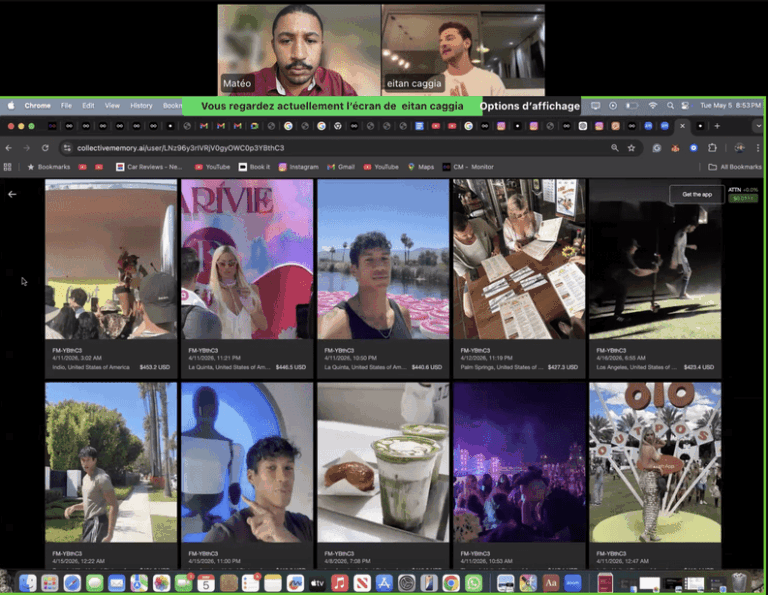
Interview with Collective Memory — © Matéo Vigné
Amidst the decline of digital reporting, Collective Memory came to the fore: a community-driven journalism and documentation platform where users can capture and share verified moments in real time. Eitan Matteo Cagia is the co-founder of this platform, which has over 10,000 active members. The platform shares real-world stories and events and boasts one of the most diverse and engaged communities of user-generated content worldwide, based on the principles of transparency, decentralisation, and direct participation.
Matéo Vigné: Did you create Collective Memory because of a lack of transparent platforms where people could tell real-world stories?
Eitan Matteo Cagia: To be honest, the way we consume content today is broken. You don’t know whether what you’re seeing is real, fake, AI-generated, edited, or manipulated; you can’t trust your eyes anymore. We wanted to create a platform where everybody has the same set of tools, where people can only capture and upload things in the moment. That changes the entire dynamic. And when you add an economy on top that rewards quality and important content, culturally and financially, it creates something fundamentally different.
MV: Was it your way of reclaiming authenticity online?
EMC: We wanted something cleaner and more real. My partner was one of the first employees at Wix.com. He experienced the early internet as a place for exploration and discovery. Back then, the internet felt human. You could connect with people and discover things outside your own reality. But as corporations optimised everything for profit, that spirit slowly disappeared. I felt the same evolution with YouTube and Instagram. In the beginning, it was about people and experiences. Over time, it became about how platforms could extract profit from users.
MV: Are you personally committed, or did you become aware of this issue through other circumstances?
EMC: The project is deeply personal. Today’s conflicts in Palestine or in Ukraine are devastating, and the media environment has become intolerable. Whether on television or social media, you couldn’t trust what you were seeing anymore. Everyone was pushing a rigid narrative. And when wars begin, one of the first things people do is dehumanise the other side. They tell you the other side are monsters, animals, people you should hate.
What we wanted with Collective Memory was to restore a layer of humanity. When you scroll through the platform and see daily life in Iran, Israel, Gaza, Russia, Ukraine, people cooking dinner, spending time with family, going to work, you realise that everyone is simply trying to live a normal life. That basic humanity is missing from today’s media ecosystem. Algorithms reward outrage, hate, and division. We’re not claiming the platform will solve wars, but it can help people understand that there are humans on every side of a conflict.
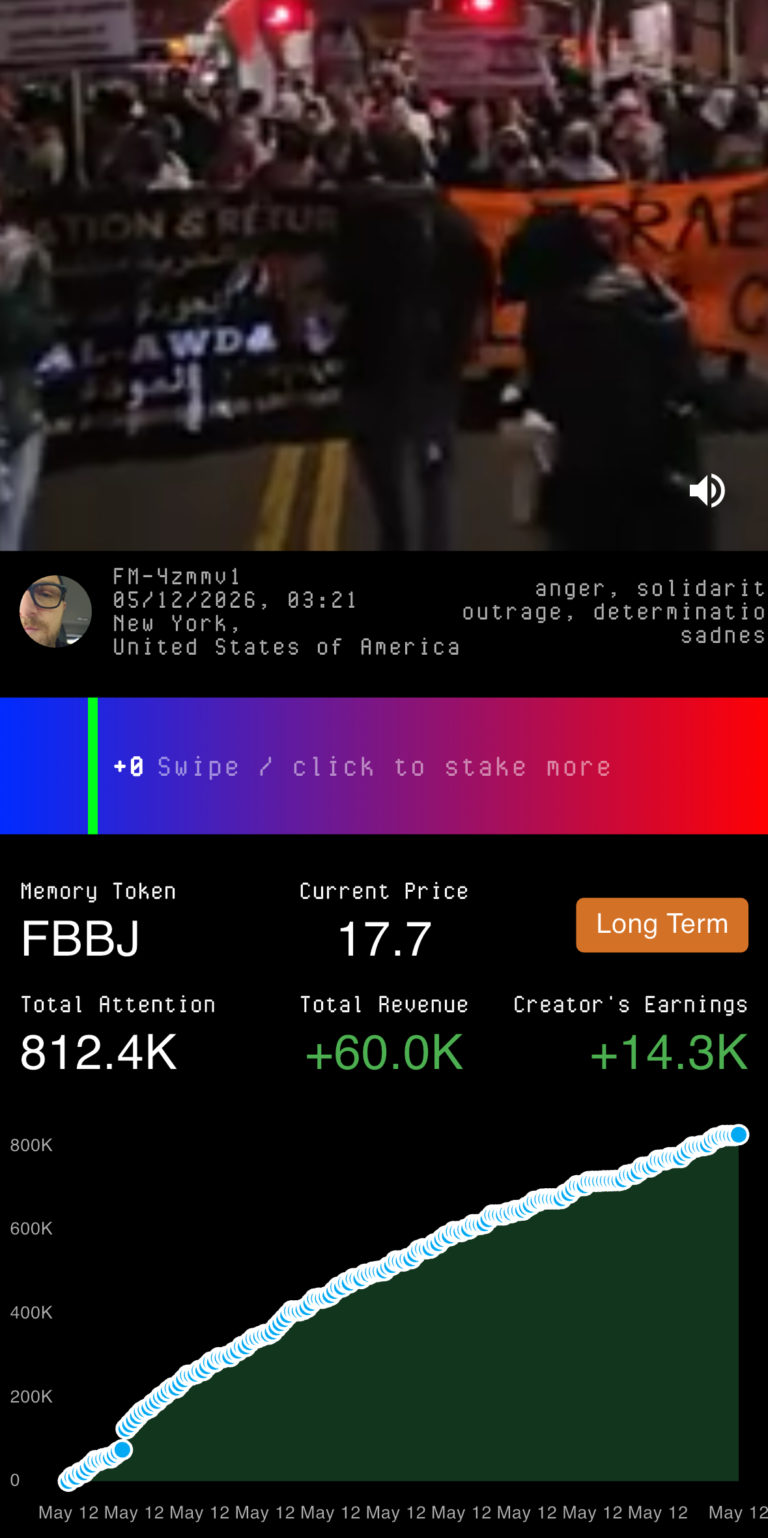
© Collective Memory website
MV: Who is behind the platform?
EMC: So we started Collective Memory two years ago. Initially, it was a very simple app where people shared moments in real time from different places around the world. At the same time, the co-founder and CEO, Jonathan Saragossi, was developing a technology called “Value Link,” which eventually became the financial infrastructure behind the platform. It allows people to invest in memories and content directly. Overall, we’re around fifteen people from very diverse backgrounds, all deeply passionate about building something meaningful.
MV: Could you guide us through the features that make Collective Memory a truly democratic digital space for reporting?
EMC: When someone posts content, people can stake “Attention”, our token, into it. Staking Attention increases the visibility of that content. There’s no hidden algorithm; everyone sees the same feed. The key difference is that users have to put real money behind what they believe in. That creates accountability. People are much less likely to promote misinformation when they have actual skin in the game. And everything is public on the blockchain. If a corporation suddenly injects huge amounts of money into pushing a narrative, everyone can see it. Our goal isn’t to decide what’s true or false. It’s to give people access to all perspectives and let them think critically for themselves.
MV: You’re trying to reclaim the attention economy by incentivising cultural participation and community-based journalism?
EMC: If you bring something valuable to the platform, it doesn’t matter if your account is new or old, people can immediately invest in your content. Creators receive earnings directly into their wallets. They can withdraw funds monthly, and we even built a debit card connected to the wallet so creators can spend what they earn directly. I believe we’re one of the first social media platforms to do that.
For investors, staking Attention makes them partial owners of the content. The earlier you invest, the larger your share becomes. Revenue generated from advertisers or external injections gets distributed between creators and investors. The important thing is that value comes from outside the system, advertisers, licensing, and brands, not from users losing money to each other.
© Collective Memory website
MV: It completely changes how we think about content creation and journalism on social media platforms…
EMC: Exactly. Because everybody sees the same feed, we try to balance three things on the platform: culture, intimate personal moments, and journalism. When these coexist, social media becomes genuinely interesting and human. People naturally become citizen journalists. If something important happens near them, they document it. We’re also developing tools specifically for journalists. One project is called OpenWire. Traditional news wires are collapsing, and staff photography is disappearing. OpenWire allows photojournalists to monetise content directly through verified licensing. Everything is timestamped, geolocated, and mapped. News organisations can directly license material from journalists, and 99% of the revenue goes to the creators themselves. We’ve already deployed prototypes in Gaza, Ukraine, and among protest journalists in the United States.
MV: But if everyone can contribute freely, how do you prevent the platform from becoming another toxic social media space?
EMC: We don’t heavily moderate in the traditional sense. It’s an 18+ platform. We allow nudity, graphic documentation from war zones, and difficult realities, but we don’t allow extreme hate speech, child endangerment, or gratuitous violence like executions. Every piece of content uploaded is analysed and given a risk score. If something crosses a certain threshold, the visual itself might be hidden while the metadata and evidence remain visible. We believe that even horrific events should leave a trace and a digital footprint. But the real safeguard isn’t moderation, it’s the economic model.
MV: AI is at the centre of every conversation today. Is this how it fits into Collective Memory?
EMC: We use AI in two main ways. First, every piece of uploaded content is analysed and automatically described. That helps moderation and creates a searchable record of what exists on the platform. Second, advertisers or users can create bots that inject Attention into specific content categories. For example, a clothing brand could reward people wearing white shirts in Paris over the next few days. But the larger idea is that we’re building a massive database of verified human experiences, timestamped, geolocated, authentic content. That’s extremely valuable for future AI systems because it provides real human data instead of synthetic internet noise. And importantly, if AI companies license this data, the revenue goes to the creators, not just to the platform.

© Collective Memory website
MV: How do you position yourself between the American model of deregulated free expression and the European model of regulation and safety?
EMC: Honestly, neither fully fits us. Europe focuses heavily on identity verification, GDPR, and strict controls. But we believe that over time, authentic participation itself becomes a form of identity verification. If someone uploads thousands of verified memories over the years, all timestamped and geolocated, it becomes incredibly difficult to fake who they are. You can fake an ID temporarily. You can’t fake an entire life consistently. So we want the platform to remain open while still creating accountability through transparency and long-term participation.
MV: Do you think all digital spaces will look like this in five to ten years?
EMC: Genuine things will always hold more value than fake ones. Real art is worth millions, while a print costs ten dollars. Real luxury items hold value while counterfeits don’t. We should treat information the same way. Right now, online content is like junk food. AI slop and endless memes are enjoyable in moderation, but they can’t be your entire diet. Eventually, people will crave cleaner, more authentic information ecosystems.
I think we’re reaching a tipping point. People are beginning to understand the psychological effects of endless doomscrolling. We don’t necessarily need billions of users. Because the content is real and verified, the value per user is much higher. Ultimately, we want the infrastructure itself, the Attention economy, and verification layer to become something other people build on top of. Maybe someone creates a music platform. Someone else builds a dating app. Others build journalistic tools. The goal is for Collective Memory to become foundational infrastructure for authentic digital interaction.
MV: What gives you hope for the future?
EMC: People are waking up. A year ago, when I explained this project, people thought I was crazy. Now they immediately understand what we’re talking about. And honestly, seeing how people use the platform gives me hope. You suddenly realise there are normal people everywhere, not caricatures created by media narratives. People have families, hopes, dreams, and communities. Seeing humanity from places you would never normally access is incredibly powerful.
Published on May 26th, 2026
About the author:
A freelance journalist (VICE, Konbini, Resident Advisor), radio presenter, strategic communicator, and artistic director, Matéo Vigné is a music lover who grew up in Marseille with parents who told him the best anecdotes from the early years of rave parties in electronic music. A compulsive digger and writer, he is equally interested in counter-cultures, social and environmental justice, alternative movements, and the fiercest sounds.
