

Author: Manon Moulin
Croatia’s independent cultural and media scene is facing growing pressure as far-right mobilisation and attacks on progressive and antifascist voices reshape the public space. Threats against cultural events, political campaigns targeting independent organisations, funding pressures, and growing self-censorship are narrowing the space for artists, journalists, and cultural organisers to address politically sensitive issues. Yet across the sector, independent initiatives continue to organise and defend spaces for open and inclusive cultural expression.
© Zabrij Radio
This year, in 2026, Andrej Plenković has become the European Union’s longest serving head of government. He has been Croatia’s prime minister since 2016, winning three elections in a row with the Croatian Democratic Union (HDZ), the country’s conservative party. While Plenković has governed in coalition with the liberals and Serbs social democrats in the past, after the last elections in 2024, he formed a government with members of the nationalist party Homeland Movement (DP). This new position for DP is both the consequence and the cause of the rise of the far right in Croatia. Indeed, the country has been the ground of nationalist resurgence in the last years, with recurring cases of history revisionism—praising for 1940s fascist Croatia, called Independent State of Croatia (NDH) lead by the fascist Ustasha organisation—and online and physical attacks on all progressist and antifascist ideas. Of course, this context is the Croatian manifestation of a global shift towards the far right. Nevertheless, this shift and the national political context have had concrete consequences on Croatia’s independent culture and media, trying to defend a social space that is open and inclusive.
Far Right Threats, Institutions’ Abandon
The attacks against independent culture and media in Croatia have become increasingly visible over the past year. The controversy around the “Piti Peta Hofen Show” at the Festival uličnih čarobnjaka in Istria is a telling example of how quickly a cultural event can become a political target. After fragments of the performance were circulated online, the show became the subject of political condemnation and a wider media controversy, while the same performance had already been presented in Split in 2023 without similar reactions. This highlights how much the context in which cultural work is received has changed.
For Sanja Burlović, coordinator of the Autonomous Cultural Centre Attack, the case illustrates a broader dynamic: “What began as an online campaign was thereby transformed into a much wider public controversy,” she explains, with artists and organisers placed in a negative and politically charged context. The concern, she argues, is not that audiences criticise or disagree with artistic work. It is when criticism develops into “intimidation, organised pressure, threats of violence or attempts to prevent a cultural programme from taking place.”
The “Piti Peta Hofen Show” is not an isolated case. Burlović points to the cancellation of part of the Nosi se festival in Benkovac in 2025 after pressure and threats from far-right veterans’ groups, as well as the continuing pressure against FALIŠ in Šibenik. In the latter case, organisers were warned of a possible “Benkovac scenario,” but nevertheless went ahead with the screening of Mirotvorac, a documentary about Croatian peace negotiator and anti-war Josip Reihl-Kir. These examples show how subjects dealing with war, nationalism, reconciliation, and antifascism remain particularly sensitive in the country.
For Burlović, however, the central problem is also the response—or lack of response—from public institutions. “When political leaders do not clearly condemn such attacks, this inevitably contributes to their normalisation,” she argues. She says that the Ministry of Culture and Media has not publicly condemned attacks against independent cultural events and describes its response more broadly as failing to protect artists and cultural organisers facing political or far-right pressure.
The consequences can therefore extend beyond individual incidents. In 2026, Attack itself became the target of a political and media campaign over a safer nightlife project funded by the City of Zagreb. A campaign that included harm-reduction information was presented by right-wing political actors as “safe drug use,” with the organisation subsequently criticised in Parliament. For Burlović, the episode demonstrated how “a legitimate educational and cultural programme can be deliberately taken out of context and turned into a political weapon.”
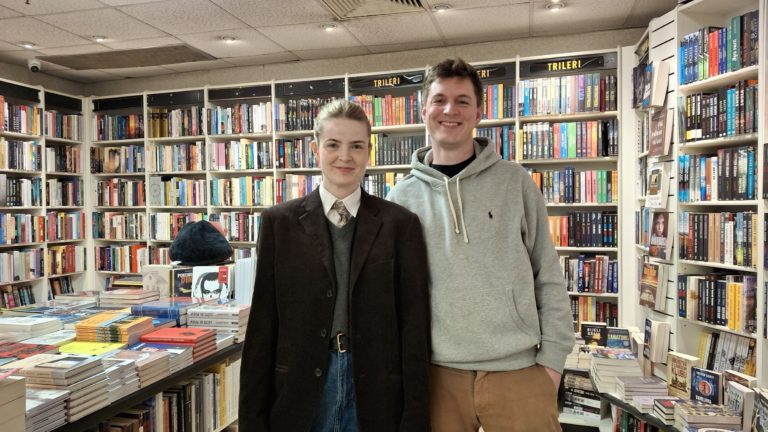
Kelly and Ivan, co-founders of Zabrij Radio — © Zabrij Radio
(Self)-Censorship as a Consequence
In this situation, the most difficult consequence aren’t only the programmes or publications that are criticised and attacked, but those that never happen in the first place. Burlović points to the city of Velika Gorica, where in 2025 organisers of a festival were personally targeted after including a performance by Siniša Labrović, an artist known for work addressing anti-nationalist and anti-patriotic themes. The festival was eventually cancelled. More revealingly, according to Burlović, the organisers did not want to speak publicly about the threats and pressure that had led to the decision.
This silence is itself part of the problem. When people become afraid both of organising a programme, but also of explaining why it was cancelled, pressure becomes difficult to document and challenge. It also encourages others to take the path of anticipation. Burlović says that some organisations, particularly in smaller communities, are already “giving up on certain topics or withdrawing from them altogether”, while larger organisations in Zagreb are becoming more cautious about the subjects they address.
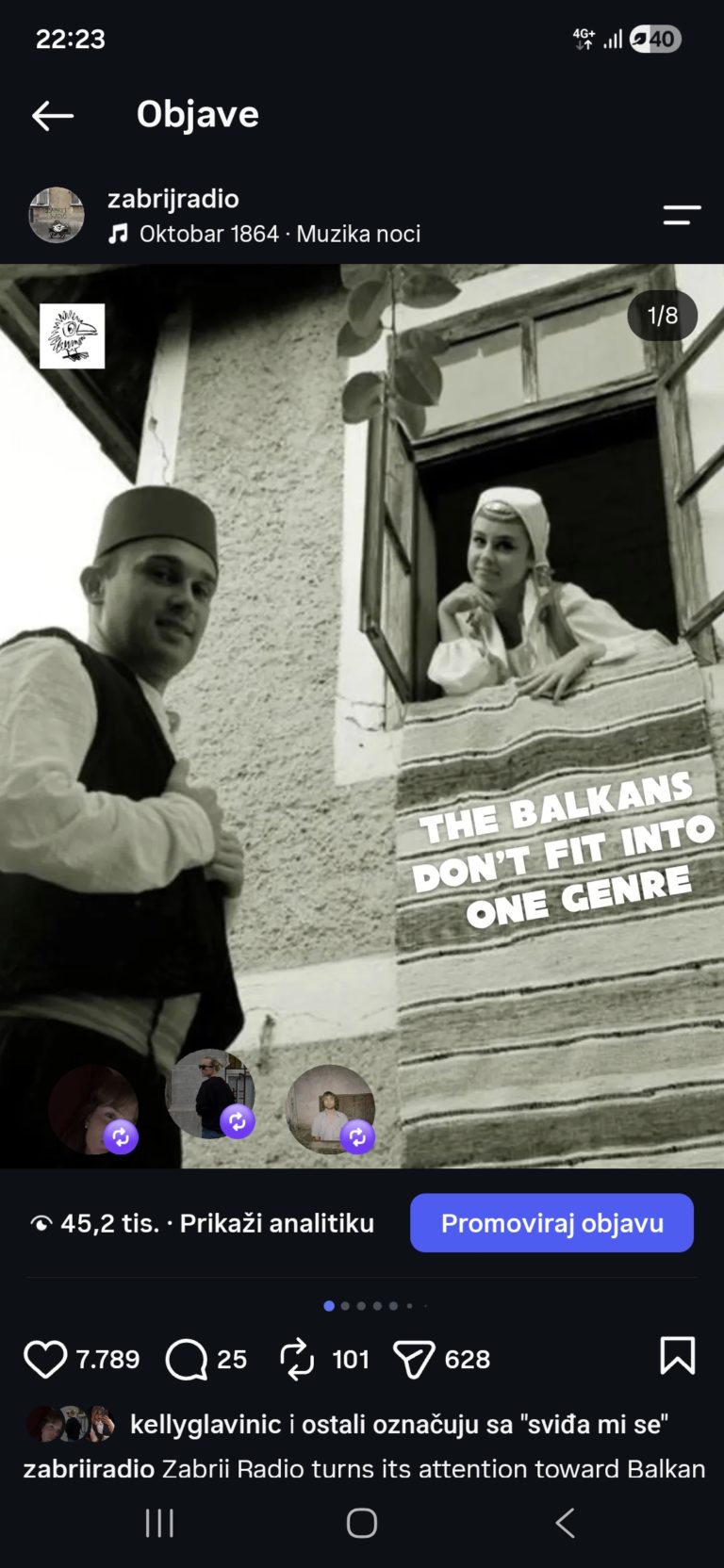
Ivan Čipčić, co-founder of independent Zabrij Radio describes a similar process. He recalls an important cultural institution warning applicants to be careful about what they presented and to consider possible “provocation.” Although cultural workers pushed back and the institution eventually reconsidered its position, he sees the episode as revealing: institutions themselves can begin anticipating political backlash. “People don’t necessarily need to be explicitly told what they can or cannot do,” he says. “Sometimes the fear of creating problems, losing funding or attracting unwanted attention is enough to make an institution more cautious.”
The dependence on public funding makes this particularly sensitive. “How can you openly criticise the hand that feeds you without risking the support you depend on?” Čipčić asks. Even very small grants can be essential for organisations, creating a situation in which publicly criticising cultural policy or political actors can feel financially risky. In 2026, the Ministry of Culture and Media withdrew funding from Attack’s programmes after 25 years of support, officially citing an issue concerning the organisation’s formal contract for its venue. Burlović argues that the requirement had not appeared among the call’s eligibility or evaluation criteria, leaving them without concrete explanation and with a significant funding loss.
The effect can also be seen among artists who take public political positions. Burlović points to the case of music band Elemental, who publicly called on fellow artists to take a position on the national promotion of nationalist singer Thompson. According to Burlović, the band subsequently experienced a significant reduction in performance opportunities, while some smaller event organisers became reluctant to book them because of fears of becoming targets.
The same logic extends to journalism. Burlović points to a journalist who had been publicly questioning and challenging the political narratives and policies of those in power and who recently received death threats. For her, this is a warning that the pressure is not confined to cultural spaces: “When journalists are threatened because they question those in power, while artists and cultural organisations are attacked for addressing uncomfortable subjects, we are dealing with a much broader problem concerning freedom of expression.”
The result is a form of censorship without a censor. As Čipčić puts it, “That is how self-censorship can develop, not through an official ban, but through a constant calculation of what is worth the risk.” And, as Burlović continues, “every time an organisation gives up a programme or avoids a subject because of fear, the space for independent culture becomes a little smaller.”
© Zabrij Radio
Resisting by Continuing and the Need for Sustained Collective Action
Despite this pressure, the independent cultural and media sectors have not disappeared. In fact, one of the most immediate forms of resistance is simply continuing to work, programme, publish, and organise events. Independent organisations continue to programme politically sensitive work and create spaces for communities that are increasingly targeted in public discourse.
For Burlović, this persistence is significant: “Resistance, for me, is also in the fact that people continue to work and deliver their programmes despite threats of violence,” she says. Attack’s own history illustrates this approach: for almost three decades, the centre has relied on self-organisation, DIY culture, and community-building to create spaces for people and practices that have often remained outside mainstream cultural institutions.
Čipčić points to a similar logic in smaller initiatives. He mentions Zagreb’s Super Klet as an example of a cultural space built through community participation rather than institutional direction. Zabrij Radio itself emerged from this DIY approach, beginning as a small project and creative platform. “We didn’t wait for anybody’s approval. We sat down, made plans, and started working,” he says.
But continuing individually may not be enough. Burlović sees solidarity within the sector, but also exhaustion and passivity produced by precarious working conditions. “The problem is how difficult it is to turn that solidarity into sustained collective action when everyone is already struggling with precarity and a lack of resources,” she says. The same small size that allows organisations to know and support one another can also make them vulnerable: smaller groups depend on relationships with more established organisations and on limited funding opportunities.
This is why, for Burlović, resistance needs to move beyond moments of solidarity following individual attacks. “Individual organisations cannot change this situation on their own,” she says. What is needed is “a more organised and sustained defence of the independent cultural sector.”
Ultimately, the question is not only whether Croatia’s independent cultural and media sectors can survive individual attacks. It is whether they can continue to maintain spaces where progressive and anti-fascist subjects can be addressed, where artists and journalists can challenge dominant narratives, and where communities can organise outside the political and cultural mainstream. In this sense, sustaining resistance requires broad collective solidarity dynamics, and public institutions that actively defend the space in which independent culture and media can exist.
References
"Croatia parliament approves new coalition government with nationalists," Euractiv, May 18th, 2024
The Chain of Music (Venues) Pluralism: DIY Handbook for Independent Clubs, AKC Attack & CK13 Teams, 2025
Vuk Tesija, "Croatian Leaders Condemn Far-Right Disruption of Serbian Cultural Event," BalkanInsight, November 4th, 2025
Snezana Rakic, "Dark Days in Croatia: Police protects Serbs from hooligans during a cultural event in Split," Serbian Monitor, November 6th, 2025
Giovanni Vale, "Croatia: the right has been playing with the fire of nationalism for too long," Osservatorio Balcani e Caucaso Transeuropa, November 10th, 2025
Zoran Arbutina, "In Croatia, resurgent far right shifts political climate," Deustche Welle, November 23rd, 2025
Ana Vračar, "'No room for fear': broad antifascist front confronts far-right violence in Croatia," Peoples Dispatch, December 2nd, 2025
"Anti-fascist marches denounce rise in right-wing extremism; Initiative to ban protests in front of private residences in response to far-right protests," Civicus Monitor, April 19th, 2026
Published on September 24th, 2026
About the author:
Manon Moulin is the editorial coordinator of all European projects for the non-profit organisation Arty Farty. She specifically works on the European network of independent cultural and media organisations Reset!.
