

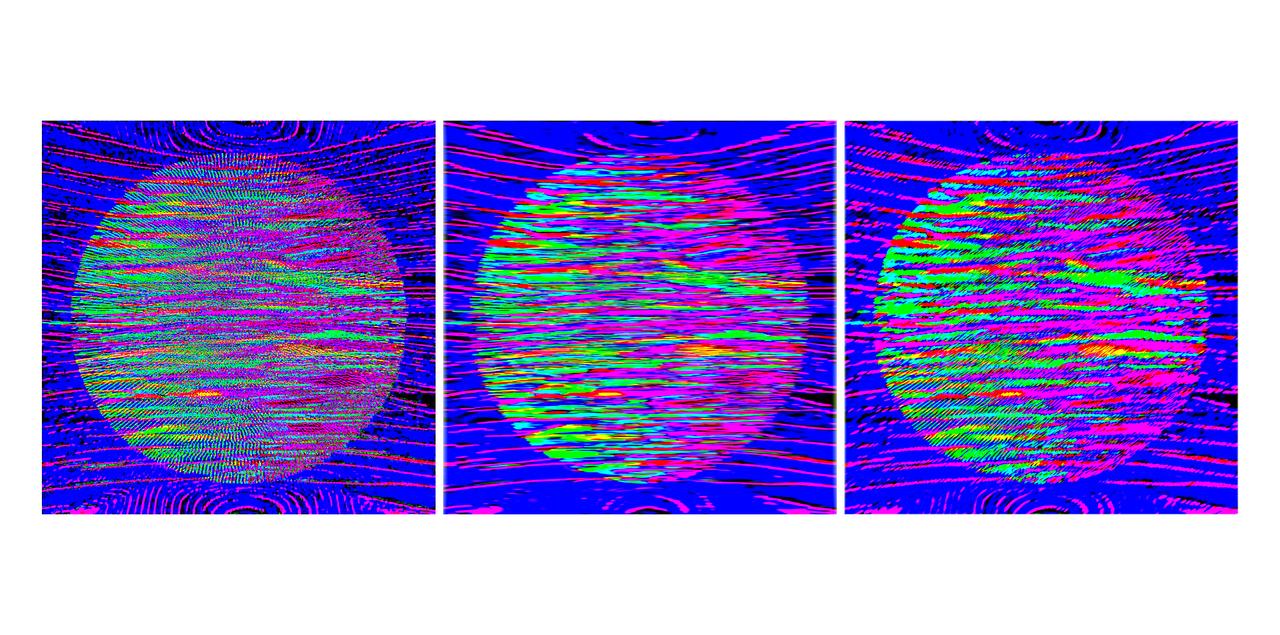
Resembling neurons of neural networks: “Static” — © Elise Racine
This article is part of Reset! Yearly Focus 2026: Digital Independence
Authors: Billie Dibb & Peter Bokor
Artificial intelligence is transforming everything, and the cultural landscape is no exception. It seems to offer unprecedented creative possibilities, but also raises fundamental questions about ownership, authorship, and bias. For Europe’s independent cultural scene, these tensions are particularly acute: how can a sector built on diversity, critical thinking, and artistic freedom embrace a technology largely shaped by powerful corporations and extractive business models? Rather than simply adopting or rejecting AI, the challenge could be to try and reclaim it, exploring more ethical, transparent, and community-driven alternatives that put culture and its creators first.
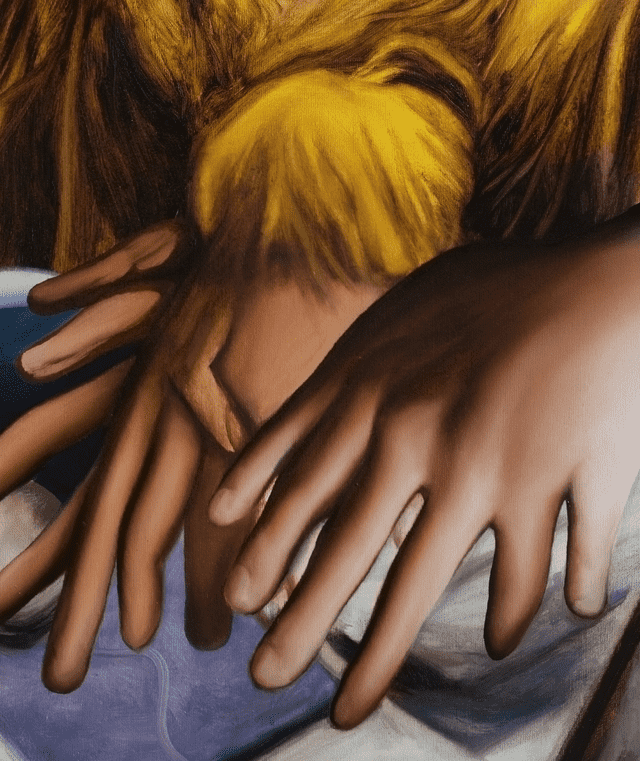
“There’s a Big Monkey Doing My Job in the Office” (cropped version of reproduction of oil on canvas original) — © Kristóf Lázár
In August 2025, the city of San Francisco paused $19 million of funding for Arts & Community Service Organisations supporting historically marginalised groups after MegaBlack SF found that the grants rejected black-centred and grassroot organisations.
Designed in 2021 to address systemic racism and disparities in San Francisco’s Black communities, the “Human Rights Commission grant” reportedly used AI to score its applicants, leading to the exclusion of the same communities it was meant to benefit.
The commission redid the process, confirming some use of AI and that its own workers had not scored the applications, but kept opaque the exact usage or model of AI, the structure of its evaluation process, or where the failure had exactly taken place.
The story exposes many fundamental problems with algorithmic decision-making: trained on our internet and pre-existing social structures the tool cannot be neutral and, as oppose to normal processes when human error occurs, allows for a lack of accountability. So how then, can modern AI be used—and even shaped—creatively and ethically by the ever precarious and critical independent cultural sector.
ChatGPT Changed the World
The AI boom started at the end of 2022 with OpenAI's launch of ChatGPT. The so-called Large Language Models’ (LLMs) ability to engage in human-like conversations captivated millions, triggering a surge in AI investment, research, and deployment.
These models are trained on vast amounts of written material from the internet to learn patterns and relationships in language. Think of them as advanced prediction machines: instead of following rigid programming rules, they determine the most likely words and sentences to naturally follow in response to a given question, or prompt.
The power to develop frontier LLM models remains highly concentrated among a handful of companies, with OpenAI and Anthropic standing as the clear front runners. OpenAI's GPT series has defined the state of the art, while Anthropic's Claude assistants consistently rank at the top of independent benchmarks. Legacy big tech companies are employing varied strategies to catch up, while European contenders like France's Mistral AI and Germany's Aleph Alpha have emerged as credible alternatives but operate at smaller scale with less funding. Chinese tech giants such as DeepSeek have developed competitive offerings, yet US export controls on advanced GPUs constrain their training capacity and peak performance.

The Ownership Problem
Hidden in Google Chrome’s original 2008 T&Cs was the “perpetual, irrevocable, worldwide, royalty-free, and non-exclusive license” to all your data, a form of extraction that has been compared to the Spanish Requerimiento of 1513.[1] OpenAI applies a similar methodology, anything shared during interactions may be repurposed by the model itself, as exemplified in 2026 when NYU mathematician Tristan Buckmaster's work on a Millennium Prize problem potentially informed OpenAI's own competing solution.
The generative music sector provides another stark example. Once startups, now major players, Suno and Udio, which enable users to create complete songs from text prompts, have faced multiple lawsuits from major labels and publishers alleging (and proving) unauthorised use of copyrighted music in their training datasets. Although these companies have attempted to clear copyrights for their training data, their latest models remain controversial, with a new filing specifically targeting Suno's latest models that should be clear of unauthorised use.
And can AI-generated content be reliably identified? 2025 experiments by Microsoft and Runway showed that 62% of AI-generated images could be distinguished, and only 9.5% of AI-generated video. Stats are more favourable on the music side, where streaming providers, such as Deezer from France, claims an over 99% precision of AI music detection, although critics raise that even 1% wrongly claimed AI music is a lot considering that it results in denying a vast amount of due royalty payments. In some contexts, legislation, such as the EU AI Act, requires a clear (or close to clear) disclosure of AI-generated content. For example, following this, Anthropic's Claude models have implemented statistical watermarking, a technique that subtly alters the probabilistic distribution of token selections during text generation to embed imperceptible but detectable patterns. Unlike legacy watermarking techniques such as hiding invisible text patterns, this statistical approach is robust against editing and paraphrasing, even translation. However, statistical watermarking also raises concerns that a piece of text's origin or authorship can be traced back to a specific vendor and technology, potentially exposing users and creating new privacy implications.
Tension is inherent across the core of the AI technology and the spirit of independent culture. On the one hand, AI is fed and based upon the established norms, the institutionalised, the canonised, which creates a distance even without copyright issues regarding the data involved. On the other hand, independent culture likes to think of itself as an agile early adopter of innovation, and, certainly, AI is not only brute force technology, it’s a high-end scientific innovation under the hood. Additionally, in a sector that feels doomed by its inherent lack of resources, could AI be the helper or assistant that has not been present (affordable) so far? This is the basic AI contradiction as its use conflicts with the core values of the field and its actors. Is there a way out, can it possibly be a love affair, or at least a fair relationship between AI and independent culture?
AI for Creativity
Let’s start with looking at creativity, an aspect that is ideally a virtue of independent culture. The whole point about AI is that its capabilities don’t stop at carrying out tedious, repetitive tasks. If AI-generated music by Suno or Udio is not a convincing proof, the infamous Hugging Face AI-bot attack incident and the solving of the hardest math problems clearly showcase that AI can indeed be creative. One may argue that nobody ever wanted to crack Hugging Face’s infrastructure, but you can be sure that the world’s best mathematicians have been trying hard to solve all Millennium Prize problems and they didn’t succeed (even if this came at an estimated price tag of $10-40 million to solve a problem with a bounty of $1 million).
Metaphorically, neural networks (the underlying mathematical structure of LLMs) work similar to the human brain: not in the sense of how neurons work but that a neural network “infers” based on previously seen information. A composer creates new music based on all inputs they were exposed to through their musical education, a neural network for generative music predicts the next musical note based on music used for its training. Neural networks can even be tuned for their “temperature”, which is to adjust how surprising (unpredictable) the output is supposed to be.
So yes, AI can mimic human creativity remarkably well, but with high cost. Its huge computational power has economic and ecological impacts, requires the prompter to be an expert for real creative tasks, and may replicate discriminatory societal views.
So how should the cultural sector use it? One Further’s Cultural Content Report of 2025 found that 77% of respondents used AI for part of their cultural content work. Still, we do not believe long-term that art reviews will be written by LLM from scratch—also because human (as the readers of these reviews) also care about what other human thinks about the art. Creative Europe proposals or cultural projects will not be developed without human intervention—even if it is imaginable in theory, there is no economic interest in creating a capable digital infrastructure for such a task. As cultural workers, we must make sure to make ethical choices in our usage of AI & new technologies. Remembering that art gives us a privileged space to speak on social issues, and each time you use ChatGPT for event ideas, article texts, or grant assessments, be aware that societal biases and those of the coders in Silicon Valley are curating your voice.

Visualisation of Riemann zeta function. One of mathematics’ most famous and long-standing open problem, the Riemann hypothesis, was allegedly proven with AI assistance as reported on November 20, 2026 — © Thomas Steiner, Wikimedia Commons
Indie AI (for Indie Culture)
Although the current production of large LLM models requires vast resources that, arguably, only the big tech or governments have at their disposal, there are ways to imagine how independent culture & AI could work together.
Smaller Initiatives such as those by the A+ Alliance or Weaving Liberation bring together artists, researchers, and technologists through participatory processes to explore feminist, decolonial, open-source, and community-oriented approaches of actually creating AI. Culture can also build their own & locally-run meaningful downstream applications using LLMs as a building block, like the Antwerp Royal Museum of Fine Arts’ in-house AI visitor assistant.
We can, today, make conscious vendor-choices of larger LLM models, choosing EU-based models, open-source, or those promising more transparency (about data, ecological footprint, labour conditions, etc). Luckily, AI is more than LLM. LLMs are a very mighty form of neural networks, a generic mathematical structure with a plethora of applications beyond language generation. Custom neural networks can be implemented by competent (smaller) players such as (European) academic research groups for, say, audio processing (e.g. the Essentia library), which can be picked up by the independent scene for further customisation (e.g., music similarity search by small agencies). And there are other fundamental customisation techniques that don’t require training big models from scratch. Few shot and transfer learning can tailor existing models using domain-specific data. For example, deciding valid subgenre tags for experimental music is a non-trivial expert task for which it is likely that no automation exists given the niche of the task. Still, it is possible to take an existing auto-tagger model that recognises basic music genres and teach it with just a few specific training examples that represent specific subgenres of music.
Perhaps the most interesting opportunity the independent cultural scene has today is to shape the AI of the future. Whether that’s through running educative programmes that help your community overcome digital literacy gaps, pushing for community AI governance (e.g. Democratic Digital Commons), joining campaigns for EU-run & shared data infrastructures or commons (see Open Future & EUmans), or creating your own networks of servers & AI co-operatives (see Servus & co/core).
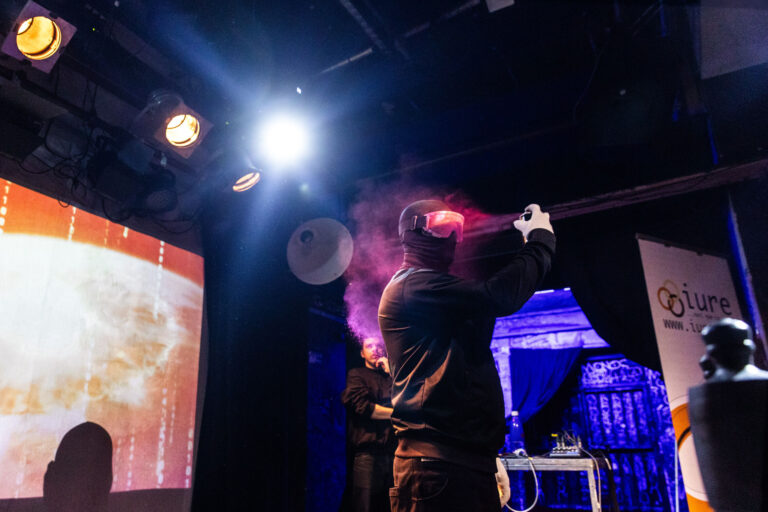
European Aternatives's Democratic Digital Commons in Prague, May 2026 — © Václav Vašků
For an active representation of independent culture towards AI, we in the Digital Ethics working group within Reset! monitor and develop sustainable use of AI in the cultural sector, and what EU-based, environmentally-conscious, and non-data-exploitative alternatives may look like practically now, and in the future.
Notes
[1] A legal-religious contract read aloud by Spanish fleets (in a non-native language & often in the middle of the night) that sought to justify their following colonisation of lands in Latin America.
Published on November 24th, 2026
About the authors:
Billie Dibb is an advocate for digital democracy, a cyber witch & music artist in Paris. They are currently the imagination coordinator at European Alternatives and running the democratic digital commons.
Peter Bokor is an engineer, the founder of MMN music magazine, Lahmacun community radio, and UnderSync music & tech agency.
