
Author: Manon Moulin
Armenia’s June 2026 parliamentary elections appeared to confirm political continuity, with Prime Minister Nikol Pashinyan and his Civil Contract party remaining in power. Yet the outcome is less straightforward than the results suggest. Taking place against the backdrop of the unfinished legacy of the 2018 Velvet Revolution, the consequences of war and displacement, and growing geopolitical tensions, the vote reflects a country still searching for direction. Rather than signalling either stability or rupture, the election highlights the mixed and often contradictory dynamics shaping Armenia’s political and cultural landscape today.
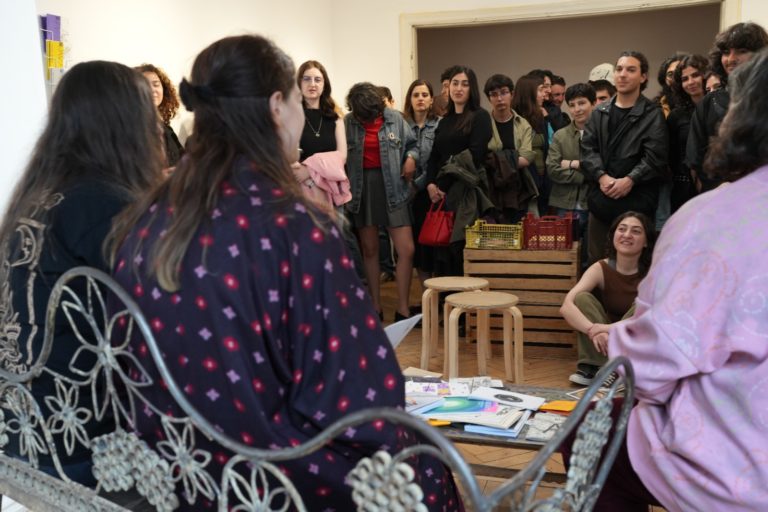
Q&A with Gazan Collective during FemLibrary's zine festival — © Greta Harutyunyan and Meri Harutyunyan
On June 7th, 2026, Armenia went through its first regular parliamentary elections since 2017—following two snap elections in 2018 and 2021. Armenian voters choose from a myriad of parties or alliances (19 in total), competing for 101 seats. On Sunday evening, it is Nikol Pashinyan, incumbent Prime Minister, who comes out on top of the ballot with 49.8% of the votes. Despite this stated continuity, the election campaign as well as the current international context raise questions on the future of Armenia and the stability of its independent cultural scene.
Looking Back, Looking Forward?
In the last 10 years, Armenia has made the headlines many times. From overthrowing the old right-wing Sargsyan regime during the 2018 Velvet Revolution, to the 2020 Nagorno-Karabakh war and the loss of the territory in 2023 followed by the displacement of hundreds of thousands of Armenians from the region, this small Caucasus country has been through intense political episodes that created social divisions and opportunities for external powers.
Indeed, most international coverage reads Armenia as a fighting ground between Western and Russian influences. On the one hand, Europe, and to a lesser extent Trump’s USA, are looking to stir Armenia towards their circle of allies through economic and military contracts, holding out the prospect of easier visa policy and business opportunities. On the other hand, Russia has historic roots in Armenia, since the 19th century with the Russian Empire and still under Soviet times. The Russian military presence is significant; however, it has suffered critics since the 2020 war and the lack of Russian intervention in assuring Armenia’s security against Azerbaijan.
This opposition translated in the election race with the main opposition to incumbent Pashinyan, close to neoliberal Western powers, being pro-Russian, notably through the figure of Russian-Armenian billionaire Samvel Karapetyan (currently in house arrest for usurpation of power). Nevertheless, to understand Armenia’s situation, this binary opposition is simply not enough.
As both Gohar Khachatryan, member of independent feminist safe space FemLibrary, and Tereza Davtyan, independent curator and founder of Yerevan-based multipurposed venue :DDD Kunst House, explain, all the opposition, be it Karapetyan’s or others, do not “offer a credible, realistic, or forward-looking vision for Armenia’s future.” Indeed, it is necessary to keep in mind that the country is going through a revolutionary process since 2018. Pashinyan—then a journalist, he was one of the leading figures of the revolution—is still seen as the continuous element of this political process, the one offering a horizon, hence his re-election; be it positive or not.
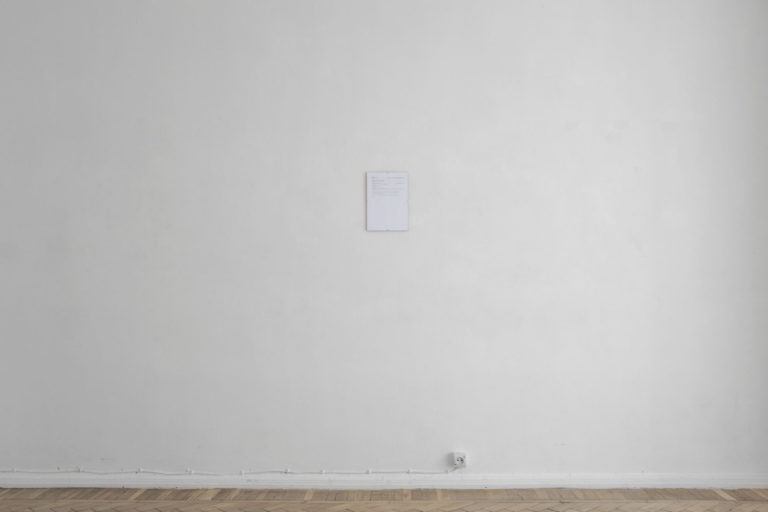
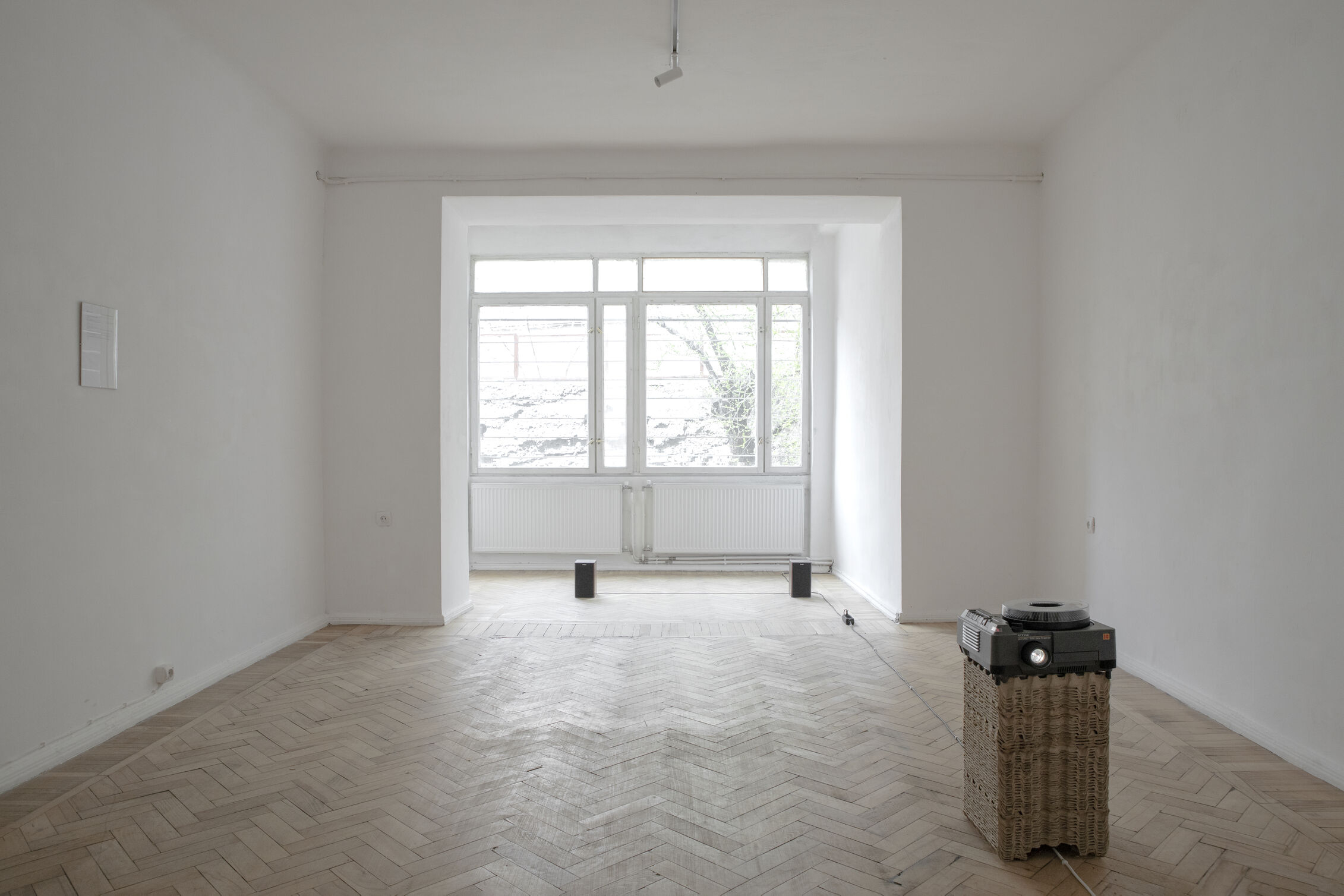
Exhibition 'Far Away Enough To Be In Touch' by artist Junya Li, in :DDD Kunst House (Yerevan, Armenia) — © Mariam Energetic
Change Is a Process
“In a way, ‘revolution’ cannot be understood as something that simply happens once and is then completed. It has to continue as a practice—at the level of thinking, institutions, and social relations. Otherwise, it risks becoming a closed historical moment that remains in the past but no longer actively shapes the present.” — Tereza Davtyan
The 2018 Armenian revolution has indeed changed many things. It opened a new political sequence, one of hope for civic and cultural openness; “The removal of the former political regime enabled independent cultural initiatives, and grassroots groups to operate more openly,” explains Gohar Khachatryan. Despite this opening, signs of stagnation and democratic backsliding with growing social divisions appear more and more evident. “Democratic reforms have expanded civic freedoms, yes, but economic justice, social protection, and labour rights have received far less attention,” Gohar says. She continues explaining that the current situation, with Nikol Pashinyan being re-elected, points out in a blurry direction.
“The direction is likely to remain mixed rather than straightforward.” — Gohar Khachatryan
This mixed situation is not helping to fix the structural challenges facing the independent cultural sector. Since 2018, no significant framework for cultural policy has been put in place, leaving independent players on the side. The latter, thus, are left with the necessary feeling and practice of resistance; finding ways to (keep) exist(ing).
A revolution is a process of change, and Armenia is in the middle of it—in this mixed, back and forward area mostly characterised by uncertainty.
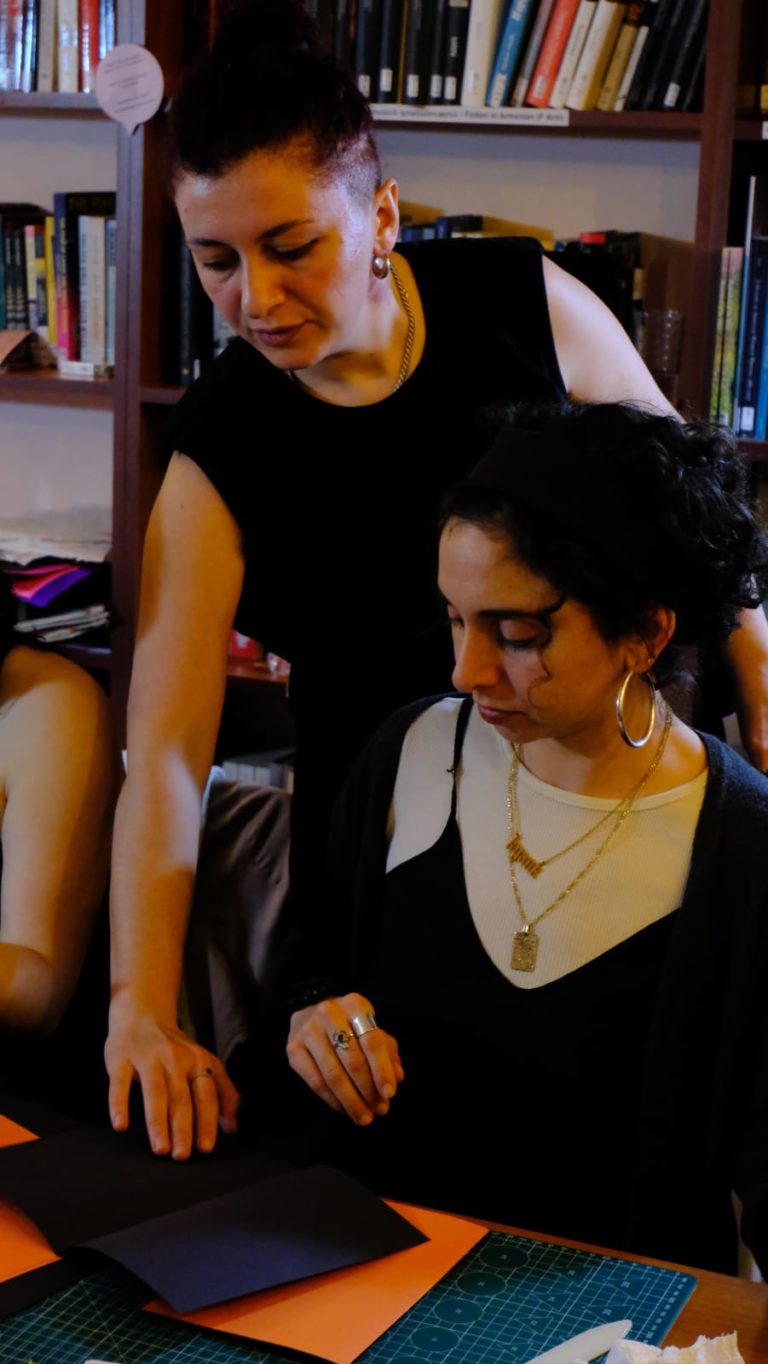
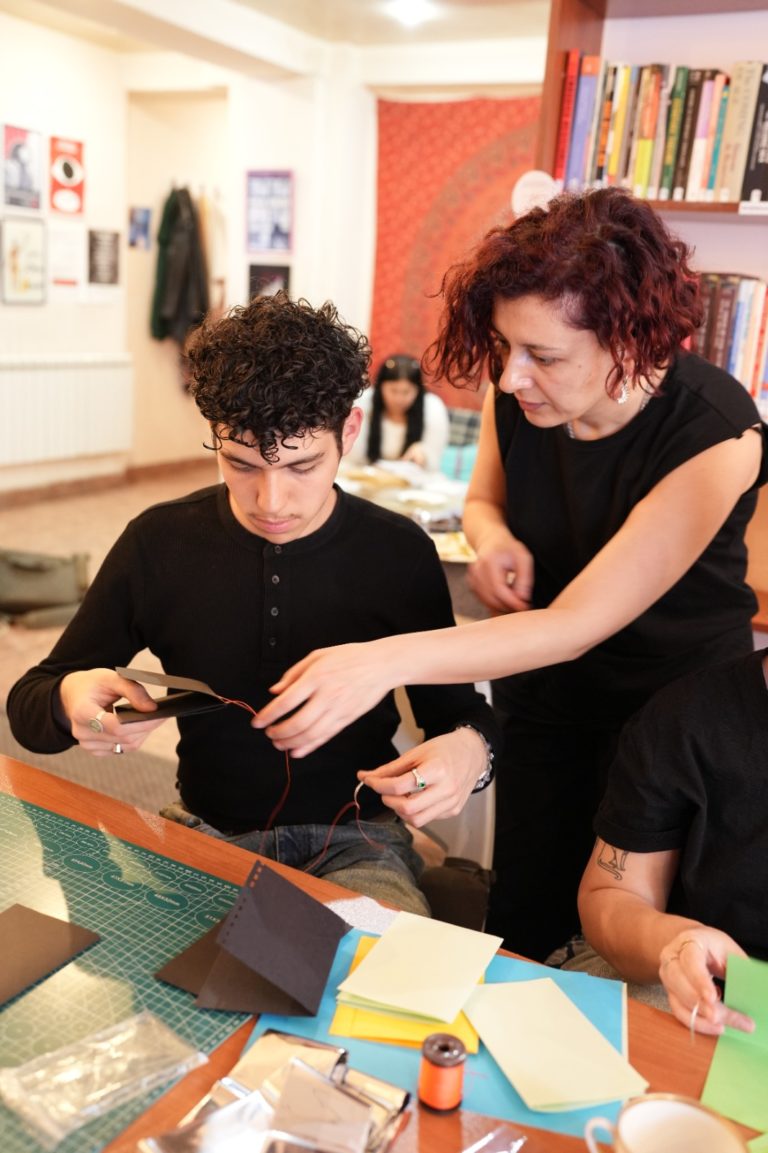
Zine-making workshop during FemLibrary's zine festival — © Greta Harutyunyan and Meri Harutyunyan
Resisting as the Option
When asking Tereza Davtyan about the difficulties independent cultural organisations are facing, she lists: “unstable long-term funding, limited institutional support, international mobility restrictions, the precarious working conditions of cultural workers, and the broader impact of regional political instability.” Gohar Khachatryan insists on the dependence on external funding—sometimes from the large diaspora, seen as a real resource—as a consequence of the lack of local allocated funds. This dependence can create problems of having to align with international donors’ priorities, then limiting the organisations’ independence, forcing them into a project-based model that makes any long-term sustainability very complicated to reach.
Adding to these long-term problems, the election has also brought misinformation over some cultural organisations. Gohar Khachatryan, from the FemLibrary perspective, explains that queer and feminist collectives have being targeted during this political moment.
Despite these hurdles, independent organisations remain indispensable when it comes to providing spaces of collective experimentation, creative sharing, and inclusivity. So, to try and escape these systemic limits, organisations like FemLibrary or :DDD Kunst House develop models “based on collaboration, resource-sharing, and collective responsibility,” points out Tereza. This allows them to create a community to sustain their projects and spaces. To add on this support, Tereza insists on the importance of international exchange, from the diaspora as a “source of opportunity and meaningful collaboration”, and beyond to foster critical dialogue.
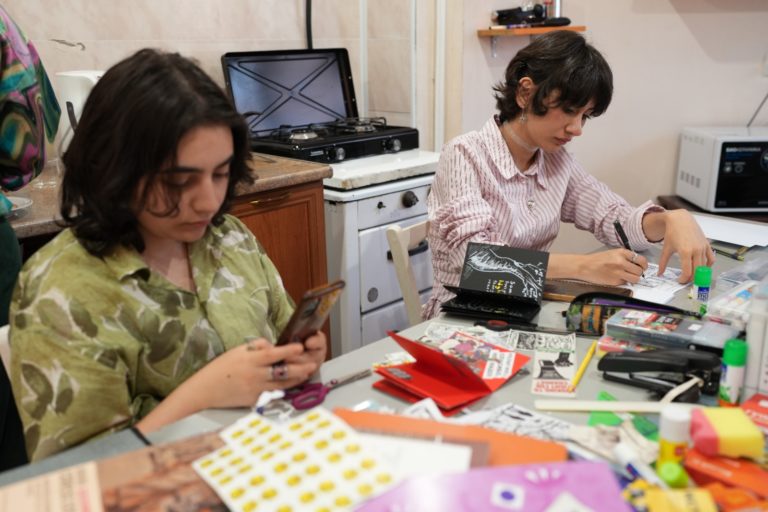
Zine-making workshop during FemLibrary's zine festival — © Greta Harutyunyan and Meri Harutyunyan
Armenia is a country undergoing change, even in continuous political events such as a re-election. The Armenian independent cultural scene is nothing but a representation of this given framework; it adapts to these conditions and reinterprets itself. It is connected, and strong on his self-organisation and community practices. As Tereza puts it; “change is not a final destination, but an ongoing practice and condition.”
References
"Elections in Armenia: National Assembly Elections Snapshot," International Foundation for Electoral Systems, 2026
Xandie Kuenning and Nate Ostiller, "Leaked documents show Russian plans to unseat Pashinyan, ties between Karapetyan and Putin," OC Media, May 26th, 2026
Hripsime Hovhannisyan, "Commentary: Breaking down key dynamics of Armenia’s 2026 parliamentary elections," eurasianet, May 27th, 2026
Yousef Bardouka, "‘Make Armenia Great Again’ — Trump endorses Pashinyan ahead of June elections," OC Media, May 28th, 2026
Arshaluys Barseghyan, "Who’s who in Armenia’s 2026 parliamentary elections?," OC Media, May 29th, 2026
Vardan Baghdasaryan, "'Extraordinary' Ordinary Elections in Armenia," Free Network Policy Briefs, June 1st, 2026
Arshaluys Barseghyan, "EU ‘looks into’ increasing support for Yerevan as Moscow tightens restrictions on Armenian imports," OC Media, June 3rd, 2026
Arshaluys Barseghyan, "Is the Armenian election really about the West vs Russia?," OC Media, June 3rd, 2026
Published on June 18th, 2026
About the author:
Manon Moulin is the editorial coordinator of all European projects for the non-profit organisation Arty Farty. She specifically works on the European network of independent cultural and media organisations Reset!.
