

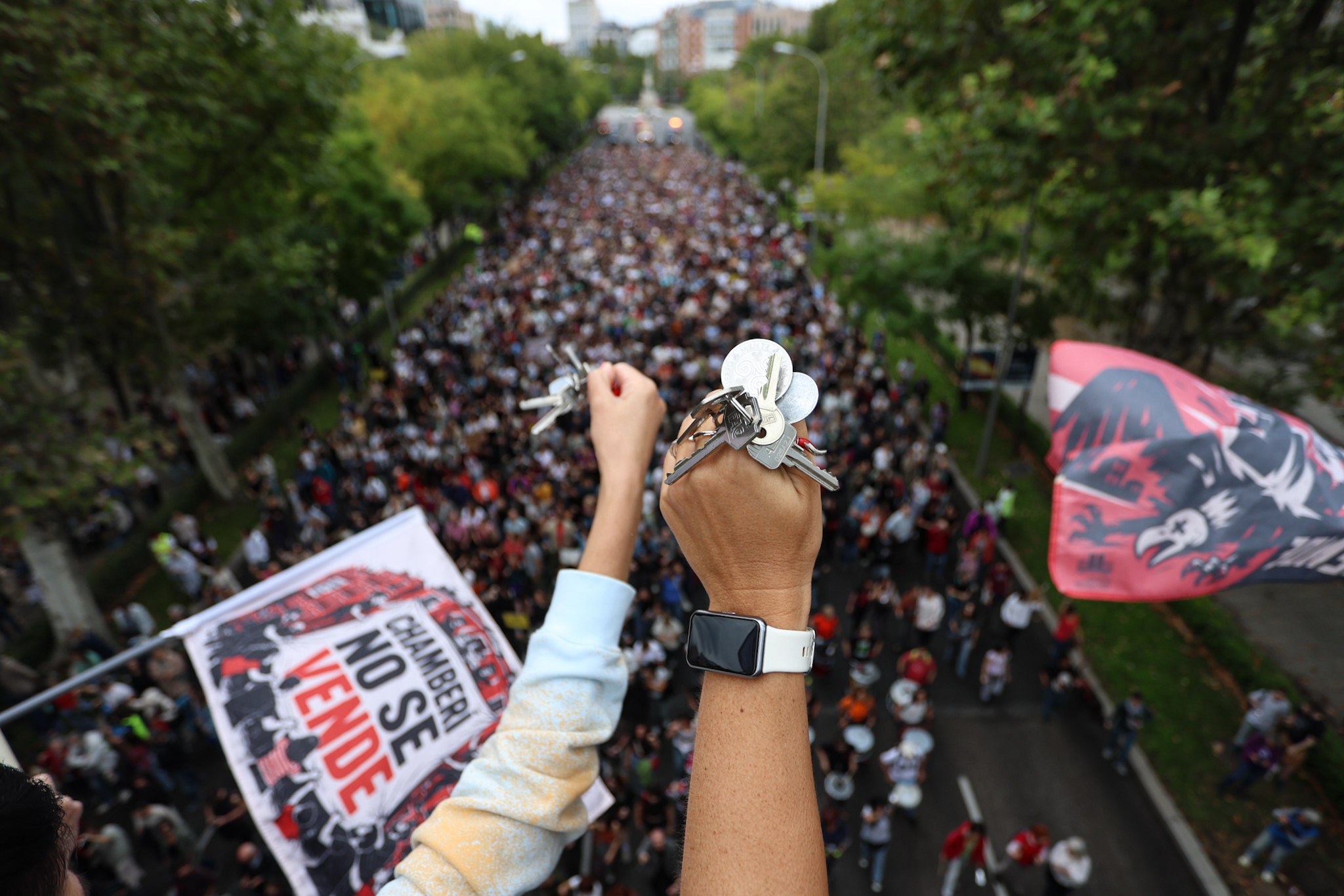
© Alberto Astudillo García (courtesy of El Salto)
Author: Manon Moulin
Across Spain, growing housing struggles are bringing new forms of collective resistance to the streets, raising broader questions about who has the right to live, work, and create in cities. As the country approaches a crucial political election, what does this mean for independent cultural spaces, grassroots initiatives, and media?
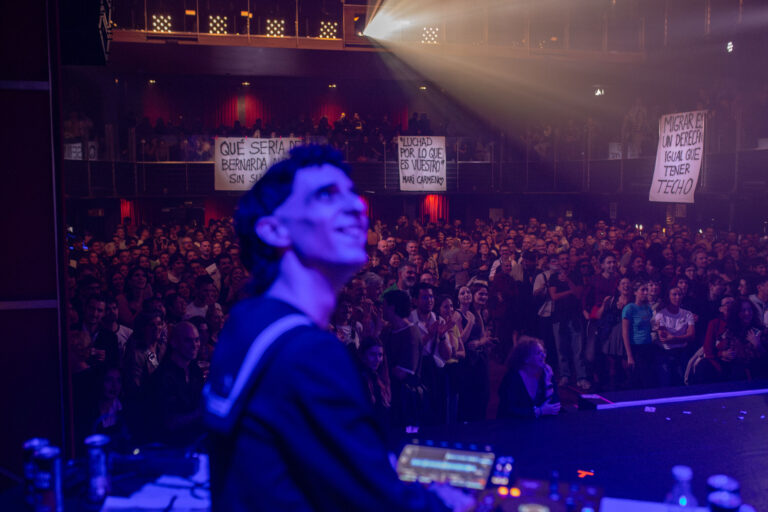
Futuroa Sarao Travesti in Paral·lel 62 on October 24th, 2026 — © Marcos G. Barker
Spain is approaching a decisive political moment. On November 29th, the country will head to the polls for anticipated general elections, in an overall context of growing political tension, institutional distrust, and mounting social discontent. While corruption scandals and a recent train collision have further weakened the government, one issue has increasingly come to dominate the national debate over the last years: housing.
In recent months, demonstrations have spread across the country, bringing together tenants, workers, young people, and precarious communities around a common demand: the right to live, and not simply to survive. Yet beyond the immediate political confrontation, these mobilisations raise fundamental questions about who gets to occupy public space, who can afford to remain in cities, and what happens to the cultural and community networks that make these places worth living in.
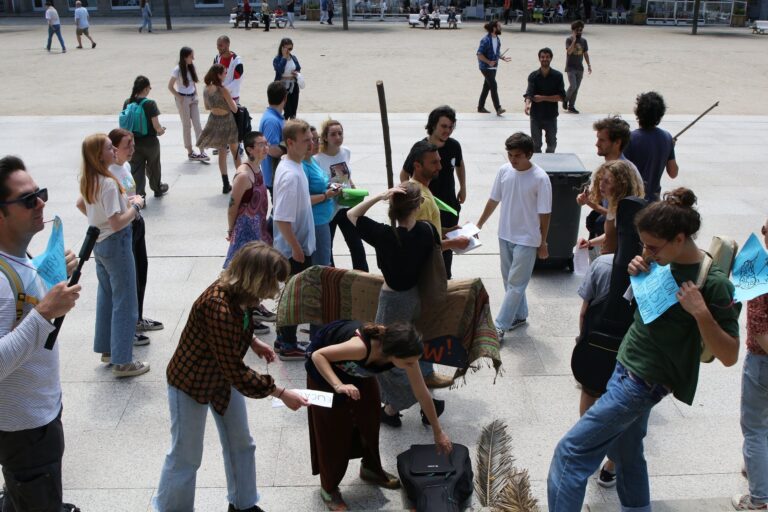
© Courtesy of Células Durmientes
A Housing Movement Refusing to Become an Electoral Instrument
On September 23rd, 2026, the eviction of Maricarmen, an 87-year-old woman living in the same apartment in Madrid since the 1950s, became the catalyst for a new wave of mobilisation and demonstrations firstly called by the Sindicato de Inquilinas (Tenants Union). What could appear to be another individual case of housing injustice quickly developed into a much broader movement. Patricia Reguero Ríos, writer and journalist at El Salto, places the eviction in a much longer history of housing activism. She traces this work back at least to 2009, when the Platform of People Affected by Mortgages (PAH) was founded, and notes how the Sindicato de Inquilinas later adapted the struggle to the issue of rent. In her words, the protests are “a response to accumulated frustration that suddenly reached its breaking point with Maricarmen’s eviction (and later death) a reason to say ‘enough’.”
On September 26th, demonstrators started the occupation of Madrid’s Puerta del Sol, transforming the square into a camp for housing rights. Similar initiatives and demonstrations emerged all over the country, from Barcelona to Malaga, Seville, or Santiago de Compostela.
In Madrid, the occupation developed into a temporary community space, with cultural activities (such as the F*ck Rent Fests), food distribution, information points, all structured around collective organisation. For weeks, Puerta del Sol became a physical expression of a political demand that had been building for years: housing must be treated as a fundamental right, rather than an asset for speculation.
Pressured, the government attempted to respond through two emergency housing decrees put up to vote on October 2nd, but these ultimately failed to secure parliamentary approval. This failure led the social-democrat Prime Minister, Pedro Sánchez, to announce snap elections for November 29th. For the movement, however, the electoral calendar was never supposed to determine the duration of its struggle.
In the night between November 2nd and 3rd, the protesters were violently removed from Puerta del Sol, bringing the five-week encampment to an end. But the mobilisation did not disappear with the tents. Its organisers had already begun shifting their activities towards neighbourhoods and the streets, marching on November 3rd and organising a general strike on November 11th around housing rights and the cost of living.
The strike became the first general stoppage in Spain in 14 years, with the housing crisis at its centre. The Sindicato de Inquilinas estimated that around four million people took part, while demonstrations and pickets took place across the country, drawing international media attention to the scale of the housing struggle.
Yet there is an important tension between the movement and the political institutions now attempting to respond to it. While Sánchez’s social-democrat government can present housing as a central part of its electoral programme, many activists are wary of seeing years of grassroots organising transformed into a campaign asset. The struggle predates the current electoral crisis, and it will outlast it.
For Reguero Ríos, the mobilisation is not only about returning housing to the political agenda; it challenges a model in which people are left to endure successive crises individually. She describes its deeper aspiration as “a yearning for change, a hope that we can do more than just suffer the consequences of one crisis after another individually.”
As Andres Sánchez, coordinator of Células Durmientes a small independent cultural association, puts it, social rights are “something won, not gifted.” The distinction matters. A movement that has spent years building solidarity from the ground up cannot simply be absorbed into the political strategies of parties seeking to retain power. The November 11th strike therefore represents more than another demonstration: it is an attempt to maintain pressure independently of the electoral process.
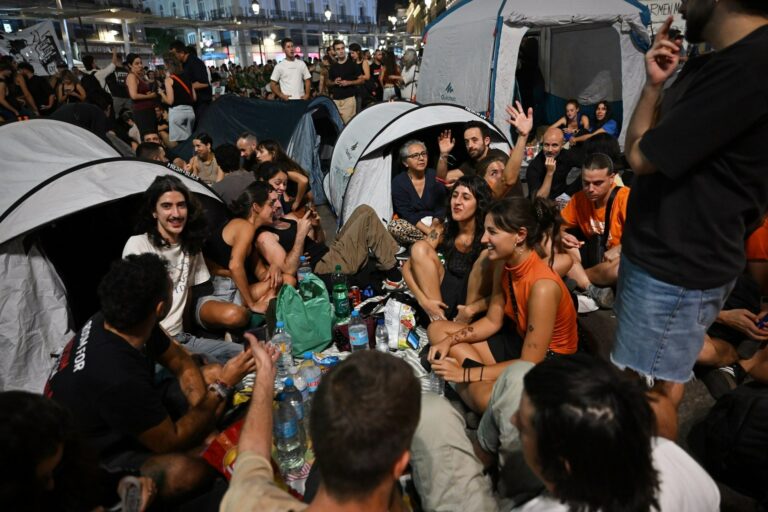
© Dani Gago (courtesy of El Salto)
Independent Culture Between Housing Crisis and Political Neglect
The housing crisis is also a cultural crisis. Rising rents, the commercialisation of urban space, and the growing cost of maintaining independent venues are progressively undermining the conditions necessary for grassroots cultural action. When artists cannot afford to live in the cities where they work, when small associations cannot maintain their premises, and when public spaces are increasingly organised around commercial interests, independent culture is among the first casualties.
Reguero Ríos points to the closure of independent bookshops as one concrete consequence of rising rents in Madrid. She recalls that “several bookstores in Madrid have closed due to rising rents.” She singles out a bookshop in the Malasaña district, where tourism and gentrification played a role in erasing the neighbourhood’s former character. Same goes for the Carabanchel district where El Salto is based. At the same time, housing has also become a topic of cultural reflection; One example is Poemas habitables (Habitable Poems), published by Traficantes de Sueños, an independent bookstore and publishing house also based in Malasaña, which brings the question of housing into the cultural conversation.
Still, as Andres Sánchez explains, “The rise in housing rents has its parallel in the rise in the rents of commercial premises.” The consequences are particularly severe for small organisations or freelancers operating outside established institutional circuits. Unlike major cultural companies and festival structures, they rarely have the financial reserves or institutional connections to absorb increasing costs.
The problem is compounded by an administrative and economic system that makes independence increasingly difficult to sustain. For many, the options are to work outside the formal system, abandon their artistic practice for another source of income, or accept a level of precarity that makes long-term cultural activity almost impossible.
This is not simply a matter of insufficient cultural funding. It is also about how resources are distributed, and whose cultural production is considered valuable. Established companies and large organisations continue to benefit from public support, while smaller, community-based initiatives struggle to access spaces, funding, and professional recognition.
The relationship between housing and culture is therefore direct. Both are increasingly subordinated to the same logic of commodification, in which public space, property, and cultural production are valued according to their capacity to generate profit.
Sergi Egea cultural worker at L’Afluent, one of the cooperatives running Barcelona cultural venue Paral·lel 62 argues that the commercialisation of cities pushes out people and cultural spaces that cannot generate sufficient profit: “When a city is treated as a business, people and cultural spaces that don’t generate enough profit get pushed out.” The consequences extend beyond the disappearance of individual venues or shops, involving the loss of social connections, accumulated knowledge, and opportunities for new projects. As he puts it, “the right to live in and take part in the life of a city shouldn’t depend solely on how much money you have.”
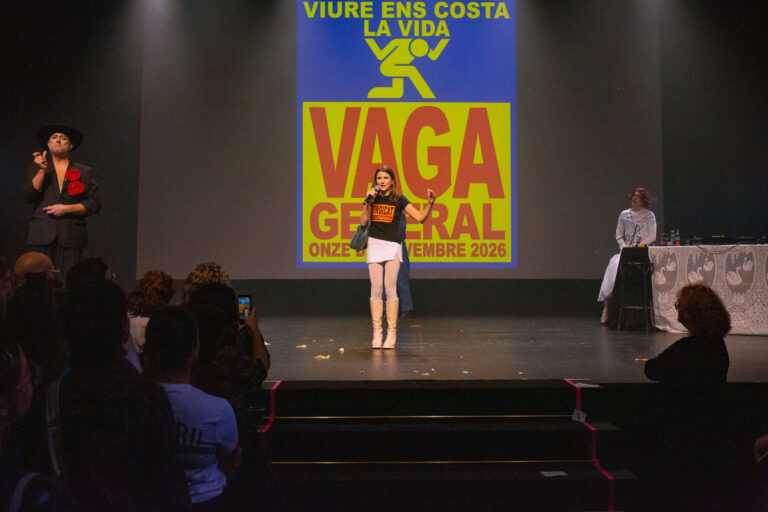
Carme Arcarazo, spokesperson for the Sindicat de Llogateres (Tenants Union), announcing the general strike for November 11th, during Futuroa Sarao Travesti in Paral·lel 62 on October 24th, 2026 — © Marcos G. Barker
Building Solidarity from the Margins
Despite these pressures, independent cultural organisations take part in the movement, either by organising or by supporting. Across Spain, grassroots players continue to develop alternative models of cultural production, community organisation and mutual support.
Paral·lel 62 offers one example of a cultural venue seeking to operate according to a public-service ethos. The municipally-owned Barcelona venue is run by three private organisations, two of them cooperatives. Egea explains that the project aims to demonstrate that a venue of this scale can work differently from a purely commercial business: “We see culture as a public service, but also as a space where people can come together, create, and build community.” He adds that profitability should not be the only factor determining programming, opportunities, or partnerships. Its role in social mobilisation is not to lead protests, but to make movements feel welcome and offer its space when possible.
Andres Sánchez highlights initiatives working outside major urban centres, including La Benéfica in Asturias, Concomientes, Cubo Verde and REACC, as well as Asociació Cubo in León.
These organisations demonstrate that independent culture is also about creating spaces where communities can exchange knowledge and develop collective responses to the conditions affecting their lives. Egea makes a direct connection between housing stability and participation in community life. He describes housing as “the material foundation that allows people to build a life and become part of a community.” Without the certainty of being able to remain in a neighbourhood, he argues, it becomes harder to build relationships with neighbours, join local associations, or take part in the cultural life around you.
In León, Andres Sánchez launched the Sindicato de Arte Leonés (Leon Arts Union) in early 2026, built around three principles: community, spaces and dignity. Its objective is to address the lack of solidarity between cultural workers, the disappearance of affordable spaces, and the normalisation of unpaid or underpaid labour.
His diagnosis is blunt: “There is too much elitism, even among those who only manage to climb up one level.” Building a genuinely independent cultural ecosystem therefore also requires confronting internal divisions and abandoning the competition for the crumbs distributed by established institutions.
Independent media also have a crucial role to play here. Outlets such as El Salto and CTXT continue to offer spaces for critical journalism and alternative perspectives, challenging the tendency of mainstream political debate to reduce complex social struggles to electoral competition.
Reguero Ríos describes El Salto’s approach as being close to the movements it covers. She calls it a “situated” media outlet, explaining that it is “situated alongside the movements, the neighbourhood struggles, the feminist movements, and we understand that our journalistic work involves listening to the movements.” She also underlines the precarious position of independent journalism, despite its public importance: “I think it’s paradoxical that a tense context like this makes us more necessary than ever, and at the same time, puts us in a more precarious situation than ever before.”
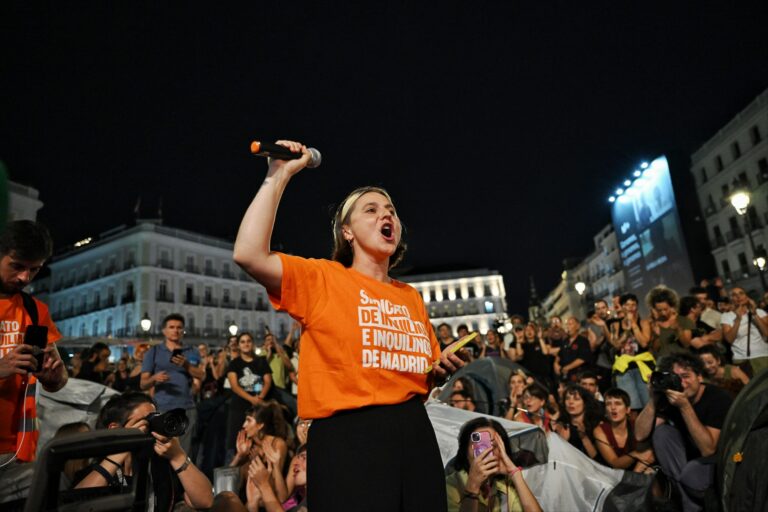
© Dani Gago (courtesy of El Salto)
November 29th: Spanish Turning Point, European Question
The upcoming elections are taking place at a particularly consequential moment. After years of Spain remaining one of the few major European countries governed by a social-democratic coalition, the possibility of a shift towards a conservative government supported by the far right is increasingly central to political debate. The conservative PP and far-right Vox have strengthened their position, while the left of the social-democrat PSOE—mainly represented by Frente Amplio and Podemos—remains fragmented and struggles to offer a strong alternative.
And the stakes extend beyond Spain. With several decisive elections expected across Europe in 2027, a change in the Spanish political landscape could contribute to an overall reconfiguration of power within the European Union. The result will also have implications for cultural and media freedoms, public funding, and the space available to independent organisations.
Indeed, for independent cultural actors, the prospect of a right-wing government raises understandable concerns about censorship, political pressure, and the withdrawal of support for cultural work. But Andres Sánchez warns against reducing the problem to what might happen after the elections; it is important to keep in mind that the existing system already makes it difficult for independent projects to survive.
“There is already an imposed censorship for underground projects, which have no room because the majors and the big cultural companies have it all locked up.”
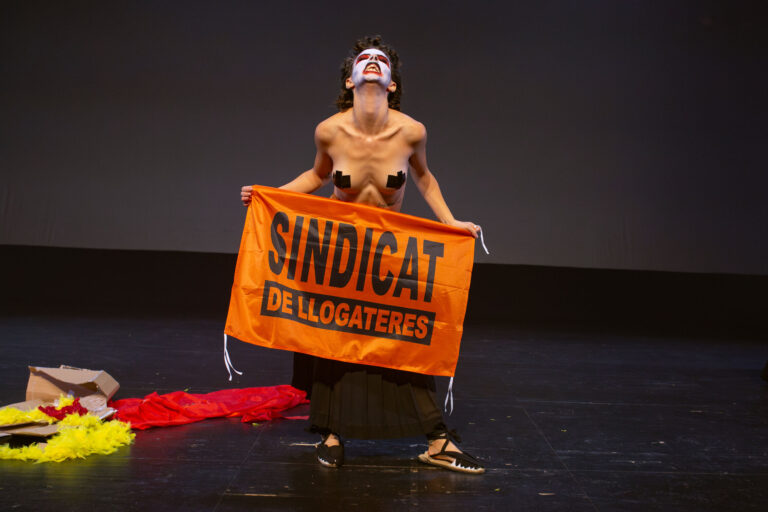
Futuroa Sarao Travesti in Paral·lel 62 on October 24th, 2026 — © Marcos G. Barker
The challenge, then, is not simply to defend independent culture against a possible political regression. It is to build the material and organisational conditions that allow it to exist independently of whoever occupies government offices and corporate giants.
Spain’s housing movement has demonstrated that collective action can force issues onto the political agenda. Its next challenge will be to ensure that this momentum does not disappear into electoral calculations. For independent cultural and media organisations, the task is closely related: to strengthen solidarity, defend autonomous spaces, and continue producing alternative narratives, regardless of the political outcome.
As Andres Sánchez concludes, “Community culture always comes from below. From the squares. Not from the offices.” Perhaps this is the most important lesson of the current moment. The future of independent culture in Spain will not be decided solely on November 29th. It will also be shaped by the communities that continue to organise, occupy, create, and resist long after the election posters have come down.
References
Edu Crespo and Martín Cúneo, “Una gran victoria en la lucha por la vivienda” (A major victory in the fight for housing), El Salto, November 16th, 2025
Guillermo Hormigo, “Ruta por la gentrificación cultural de Carabanchel y los barrios que no quieren estigmas ni ser el ‘Brookyln madrileño’” (A tour of the cultural gentrification of Carabanchel and the neighbourhoods that don’t want to be stigmatised or seen as the ‘Madrid Brooklyn’), El Diario, December 5th, 2025
“‘Nos hemos cansado de ser amables’: el abrazo del ‘Fuck Rent Fest’ a la protesta de Sol” (‘We’ve had enough of being nice’: the ‘Fuck Rent Fest’ embraces the Sol protest), HuffPost, September 28th, 2026
“Spain’s housing crisis: did the government address the protesters’ demands?,” Europod, September 30th, 2026
Madrid Takeover: A Day with Madrid No Frills, Reset! network, October 3rd, 2026
Javier Carbonell, “Spain’s snap election: Why Sánchez called it and what comes next,” European Policy Centre, October 5th, 2026
“Avec des élections anticipées en novembre, l'Espagne va ouvrir un cycle électoral en Europe qui pourrait changer le rapport de force au sein de l'UE” (With snap elections due in November, Spain is set to kick off an electoral cycle in Europe that could shift the balance of power within the EU), France Info, October 6th, 2026
“À l’approche des élections en Espagne, la gauche radicale se désunit : ‘Une farce grotesque’” (As the Spanish elections draw near, the radical left is falling apart: “A grotesque farce”), Courrier International, October 20th, 2026
John Tones, “Ticketmaster está a un nivel de monopolio entre las tiqueteras que ya vende hasta los actos del Sindicato de Inquilinas” (Ticketmaster has a near-monopoly amongst ticket agencies and now even sells tickets for events organised by the Tenants Union), Xataka, October 27th, 2026
“Battle lines redrawn in Spain’s snap election after latest train disaster,” The Guardian, October 30th, 2026
Isabelle Piquer, “En Espagne, Vox durcit le ton contre le gouvernement et poursuit son ascension dans les sondages” (In Spain, Vox is taking a tougher line against the government and continues to climb in the polls), Le Monde, November 1st, 2026
Robin Bjalon, “Espagne : le campement pour le logement à Madrid démantelé avant les élections” (Spain: the housing protest camp in Madrid cleared ahead of the elections), TV5 Monde, November 3rd, 2026
Adriana Rodríguez Bueno, “¿Qué pasaría si el 29N solo votaran policías y militares? Mayoría absoluta de derechas, con Vox a la cabeza” (What would happen if, on 29 November, only police officers and members of the armed forces were to vote? An absolute right-wing majority, led by Vox), El Salto, November 4th, 2026
Martín Cúneo, “Cómo desbordar la huelga general que le gustaría a Pedro Sánchez” (How to overcome the general strike that Pedro Sánchez would like to see), El Salto, November 4th, 2026
Francisco Gámiz, “Alcalá Norte: ‘Mucha gente votará por miedo a vivir en un mundo peor, en vez de por el deseo de vivir en uno mejor’” (Alcalá Norte: “Many people will vote out of fear of living in a worse world, rather than out of a desire to live in a better one”), El Diario, November 4th, 2026
Aitor Riveiro and Laura Olías, “PP y Vox abren otro frente con los sindicatos por la huelga de la vivienda” (The PP and Vox have opened another front with the trade unions over the housing strike), El Diario, November 4th, 2026
Demonstrations of November 3rd, 2026, acampada26s Instagram account
Cristina J. Orgaz, “3 claves de la primera huelga general en España en 14 años (y la paradoja de que el gobierno la defienda y la oposición la critique)” (3 key points about Spain’s first general strike in 14 years (and the paradox that the government supports it whilst the opposition criticises it)), BBC, November 11th, 2026
“‘La primera huelga general en 14 años’: la prensa internacional destaca el paro en España por el precio de la vivienda” (“The first general strike in 14 years”: the international press highlights the strike in Spain over house prices), El Diario, November 11th, 2026
“El Sindicato de Inquilinas cifra el seguimiento de la huelga en cuatro millones de personas” (The Tenants Union estimates that four million people took part in the strike), El Salto, November 11th, 2026
“La prensa internacional hace balance de una huelga ‘histórica’” (The international press takes stock of a “historic” strike), El Salto, November 12th, 2026
Published on November 19th, 2026
About the author:
Manon Moulin is the editorial coordinator of all European projects for the non-profit organisation Arty Farty. She specifically works on the European network of independent cultural and media organisations Reset!.
